
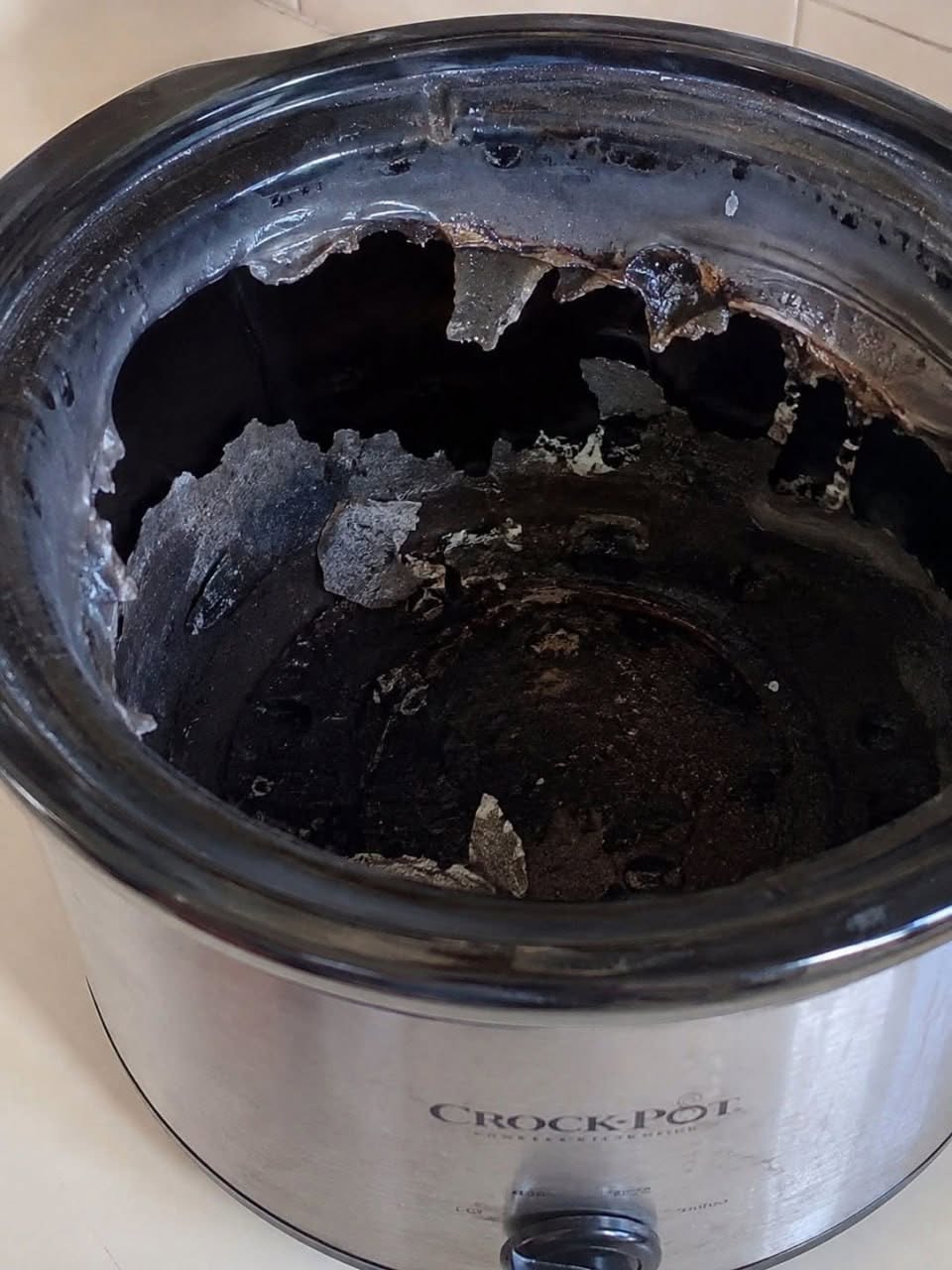
What Should You Do If the Crock Cracked During Cooking?
Follow this order:
- Switch off and unplug the appliance.
- Keep people and pets away.
- Do not lift the crock while it is hot.
- Allow it to cool naturally.
- Discard the food.
- Collect the fragments safely.
- Inspect the base for leakage or damage.
- Photograph the crock and model label.
- Contact the manufacturer.
- Replace the liner or appliance before cooking again.
If anyone swallowed a suspected ceramic fragment, do not induce vomiting. Contact a medical professional or local poison-control service for advice, especially if there is pain, bleeding, difficulty swallowing, or breathing trouble.
Common Mistakes to Avoid
Testing It With Water
Filling a cracked crock with water may show a leak, but it does not prove that the liner can survive heating. A crack can expand dramatically when the temperature changes.
Covering the Crack With Foil
Foil cannot restore the ceramic’s strength or guarantee that liquid will not reach the heating base.
Using a Slow-Cooker Bag as a Replacement
A cooking bag is only a liner for sound stoneware. It cannot replace a broken crock.
Ordering by Capacity Alone
A six-quart liner is not necessarily compatible with every six-quart slow cooker. Shape, dimensions, contact points, and heat distribution vary.
Keeping Food Because It Looks Fine
Small ceramic fragments can be difficult to see. Food exposed to a shattered liner should be discarded.
Important Safety Reminder
A cracked slow cooker insert should always be removed from service immediately. Even a small cracked slow cooker insert may leak when heated or break while carrying hot food. Never repair a cracked slow cooker insert with glue, silicone, or epoxy. Food that touched a cracked slow cooker insert should be discarded because tiny ceramic fragments may be present. Replace the cracked slow cooker insert only with a manufacturer-approved liner made for the exact appliance model. If an approved replacement is unavailable, dispose of the cracked slow cooker insert safely and replace the entire appliance.
Applying Glue
Household adhesives are not designed to restore structural cookware exposed to heat and food.
Frequently Asked Questions
Can I use a slow cooker with a hairline crack?
No. Stop using a crock with a structural crack. Heating can cause it to expand, leak, or break completely.
Why did my slow cooker insert crack overnight?
Possible causes include thermal shock, an earlier impact, a hidden manufacturing flaw, age-related weakness, or a combination of factors. Photographs and an inspection may help the manufacturer evaluate the failure.
Can I put a cold crock into a hot slow cooker?
Avoid sudden temperature changes unless the exact model’s manual clearly permits them. Gradual temperature adjustment reduces thermal stress.
Can I use the slow cooker with only a liner bag?
No. The bag must be placed inside an intact, compatible cooking insert.
Is food safe after the ceramic liner cracks?
The safest choice is to discard food that contacted a cracked or shattered crock because it may contain sharp ceramic particles.
Can I buy any insert with the same capacity?
No. Use the complete model number and purchase only a replacement confirmed as compatible by the manufacturer.
Can ceramic glue repair a cracked slow cooker insert?
No repair should be trusted for continued cooking. Heat, moisture, grease, and repeated temperature changes can cause the repair to fail.
Does the whole slow cooker need replacing?
Not always. If the base is undamaged and the manufacturer supplies an exact replacement insert, the appliance may remain usable. Replace the whole unit if compatibility or electrical safety is uncertain.
Final Conclusion
The damage in the photograph appears to be a severely cracked slow cooker insert, not ordinary staining or light surface wear.
Stop using it immediately. Unplug the appliance, allow it to cool, discard any exposed food, protect yourself from sharp fragments, and inspect the heating base without opening its electrical housing.
Do not glue the crock, cover it with foil, or depend on a disposable liner. Replace it only with a manufacturer-approved insert for the exact model. If no verified replacement is available—or if liquid reached the electrical components—replace the entire appliance.
Prevent future breakage by avoiding impact, empty preheating, direct stovetop heat, cold water on hot ceramic, and other sudden temperature changes.