
Ball-Headed War Club: What Is This Unusual Object?
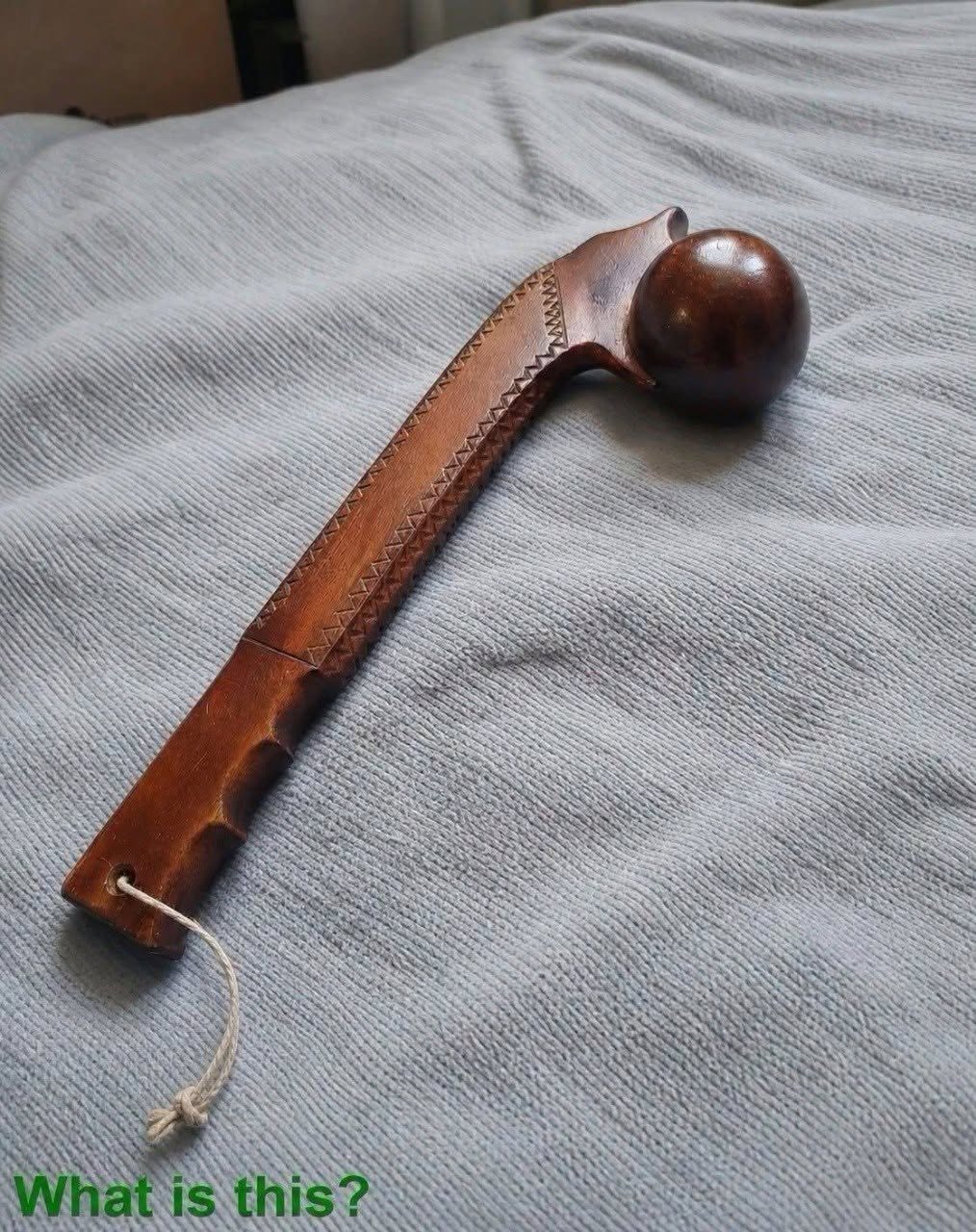
At first glance, the object in the photograph looks like an oversized tool, ceremonial walking stick, or handmade wooden mallet. Its large spherical head, curved neck, decorated leather covering, long handle, and carrying cord make it difficult to identify without context.
Based on these visible characteristics, it most closely resembles a ball-headed war club, or possibly a modern decorative interpretation inspired by one. Ball-headed clubs are historically associated with several Indigenous peoples of northeastern North America and the Great Lakes region.
However, a photograph alone cannot confirm the object’s exact date, maker, cultural origin, or authenticity. It could be an older artefact, a modern Indigenous-made ceremonial object, a historical reproduction, or a decorative piece produced in a traditional style.
The distinction matters. A genuine historical object can carry important cultural meaning and provenance, while a recent reproduction may have been created for display, reenactment, dance, education, or collecting.
Can You Guess What This Old Kitchen Tool Was Used For? Younger Generations Probably Can’t
This guide examines the features visible in the image, the history of the ball-headed club, its materials and construction, and the steps an owner should take before attempting to sell, clean, restore, or describe one.
Quick Identification
The object appears to have:
- A large polished wooden ball at one end
- A curved or angled neck below the ball
- A long, flat handle
- Brown leather or rawhide covering part of the handle
- Decorative zigzag stitching
- A cord or wrist loop at the bottom
- A handmade rather than machine-produced appearance
That combination is consistent with a ball-headed war club, although some features—especially the extensive stitched leather covering—could indicate a modern reproduction or individually designed interpretation.
It does not appear to be a conventional kitchen tool, agricultural implement, shoehorn, musical instrument, or ordinary household utensil.
What Is a Ball-Headed War Club?
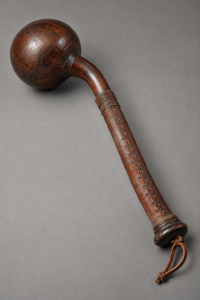
A ball-headed club is a traditional wooden object with a long handle and an enlarged rounded striking head. The ball and handle were often carved from a single piece of dense hardwood, although construction styles varied.
Historical examples are associated with Indigenous communities in parts of the northeastern United States, eastern Canada, and the Great Lakes region. They were functional objects, but some examples also carried ceremonial, diplomatic, artistic, or symbolic importance.
The Metropolitan Museum of Art’s ball-headed club is identified with the Western Great Lakes region. The museum notes that this general club form was associated with several American Indian peoples of the Northeast and Great Lakes for hundreds of years.
Museum examples demonstrate that these objects were not all identical. Their proportions, carving styles, surface decoration, head shapes, and symbolic features could differ substantially.
Some were relatively plain and practical, while others were carefully carved or decorated in ways that communicated identity, prestige, protective associations, or personal significance.
Why Does It Have a Large Wooden Ball?
The spherical or rounded head gave the club its recognizable name and silhouette. Concentrating more wood at one end also produced a heavier head than the handle.
On surviving historical pieces, the head can be almost perfectly round, slightly flattened, elongated, or integrated into an animal-inspired carving. Some examples include abstract forms that may represent animal jaws, faces, claws, or protective beings.
For instance, the Cleveland Museum of Art describes one historical example as having a ball held within an abstract jaw-like form. This suggests that the design of certain clubs carried more than a purely practical purpose.
The object in the supplied photograph has a prominent polished sphere held above a curved, flared section. That distinctive area may be decorative or may imitate a historical style in which the head emerged from a carved neck or symbolic form.
Seven Fascinating Facts About Ball-Headed Clubs
1. They Were Often Made From One Piece of Wood
Traditional makers could select hardwood trees or roots with naturally suitable shapes. A strong bend, knot, burl, or root formation could provide enough material for both the handle and enlarged head.
Carving the main structure from one piece avoided creating a weak mechanical joint between the ball and handle. Dense hardwood could then be shaped, scraped, polished, decorated, and sometimes stained.
Not every object described as a ball-headed club was made in exactly the same way. Materials and techniques varied by region, maker, period, and intended function.
2. Natural Tree Growth Influenced the Shape
A rounded root mass or burl could help a maker form the heavy head while retaining a narrower adjoining handle. This made the material itself an important part of the design process.
The curved section visible beneath the ball in the photograph may reflect that general tradition, although it could also have been deliberately shaped from a larger block of modern lumber.
A specialist would need to examine the wood grain closely to determine whether the head and handle form a continuous piece.