
3. Not Every Club Was Merely a Weapon
The word “war club” can create an incomplete impression. Depending on the community and historical context, clubs could also serve as objects of status, ceremony, dance, diplomacy, commemoration, storytelling, or artistic expression.
Later examples may have been created specifically for presentation, cultural performance, museum education, trade, historical interpretation, or sale to collectors.
Therefore, discovering a ball-headed war club does not automatically reveal how that particular object was used. Its individual history must be established through provenance and expert study.
4. Decoration Could Carry Meaning
Historical clubs sometimes featured carvings, incised lines, paint, metal fittings, beads, feathers, leather, rawhide, or other decorative elements.
These details should not be treated as generic decoration without research. A motif may be connected to the maker’s individual artistic choices, a particular cultural tradition, a later collector’s alteration, or a modern attempt to imitate an older appearance.
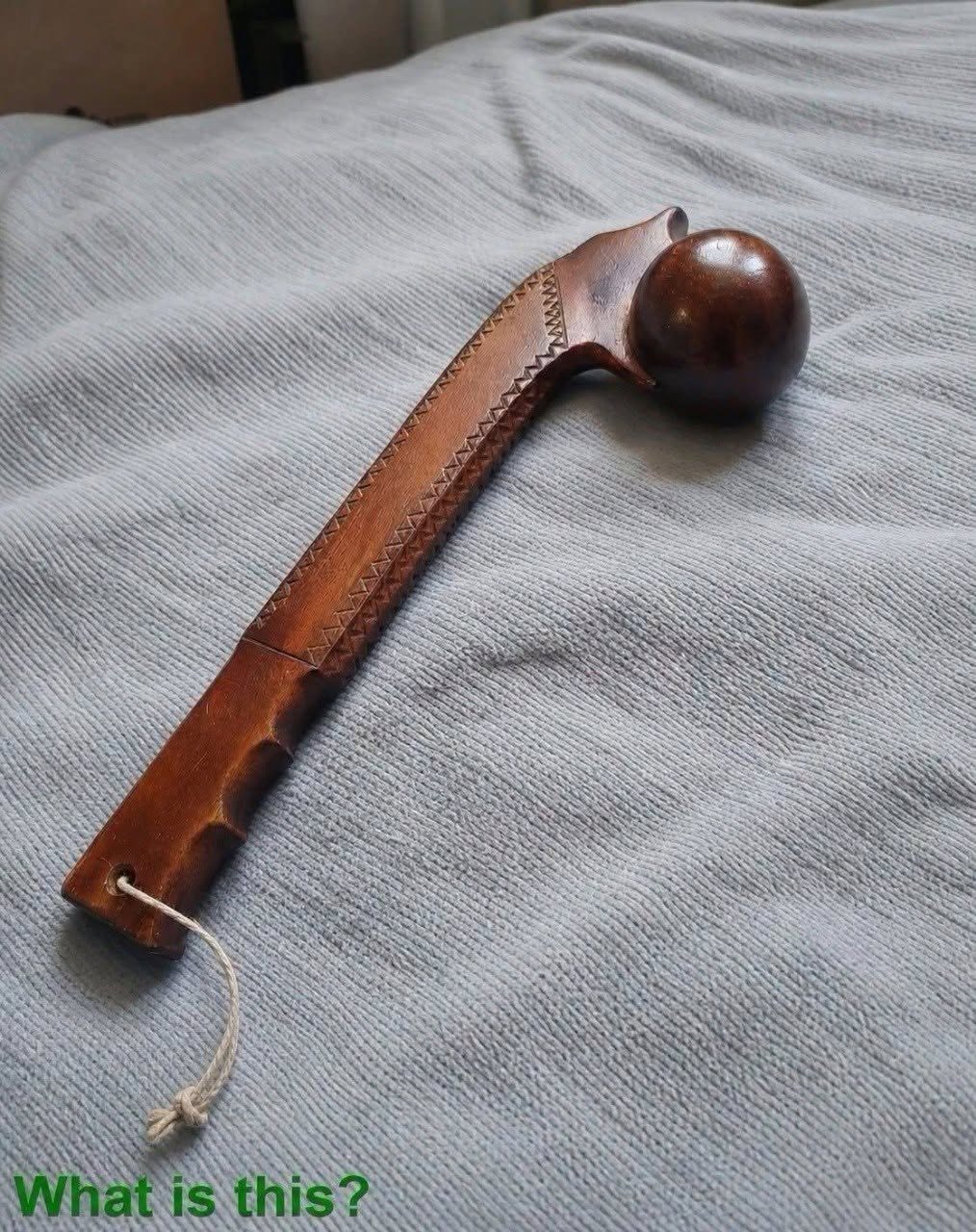
The photographed object has neat zigzag stitching and fitted brown leather. That craftsmanship is visually important, but the pattern alone cannot identify a specific nation, tribe, maker, or period.
5. Modern Reproductions Are Common
Today, many craftspeople create clubs inspired by historical examples. Some are respectfully made by Indigenous artists and clearly sold as contemporary works. Others are made for reenactments, theatrical productions, decorative displays, or the general souvenir market.
A modern object is not necessarily without artistic or financial value. Its correct identification simply prevents an inaccurate claim that it is an antique or museum-era artefact.
Visible modern stitching, recently tanned leather, synthetic thread, machine marks, commercial finishes, or limited wear may suggest recent production—but none of those signs is conclusive from a single photograph.
6. Provenance Is More Reliable Than Appearance
Provenance is the documented history of an object’s ownership and origin. Strong provenance might include:
- A maker’s name or signature
- A dated sales receipt
- Previous collection records
- Auction documentation
- Old photographs showing the object
- A museum or specialist assessment
- A written family history supported by evidence
- Information about where and when it was obtained
Statements such as “it belonged to my grandfather” can be helpful starting points, but they do not independently prove age or cultural origin.
7. Careless Cleaning Can Destroy Evidence
Old wood, leather, rawhide, pigment, stitching, and surface residues can provide useful information. Cleaning them aggressively may remove evidence of age or manufacture.
Do not apply furniture polish, leather dye, oil, varnish, wax, household cleaner, or water before an expert examines the object.
A shiny new coating can conceal tool marks, change the colour, weaken old materials, and reduce both research and collector value.
Is the Object in the Photograph Definitely Authentic?
No responsible identification can confirm authenticity from this photograph alone.
The shape strongly suggests a club inspired by a ball-headed form, but several questions remain:
- Is the spherical head carved as part of the handle?
- What species of wood was used?
- Is the covering leather, rawhide, or synthetic material?
- Is the stitching done by hand or machine?
- Does the object have hidden marks or a signature?
- How old is the cord attached to the handle?
- Was the leather added when the object was made or later?
- Are the wear patterns natural?
- Is there documented ownership history?
- Was it made for ceremony, display, reenactment, or another purpose?
The clean stitching, uniform brown covering, polished ball, and generally preserved condition could be consistent with a relatively recent handmade reproduction. That is only a visual possibility, not a final conclusion.
An expert must inspect the materials, workmanship, tool marks, oxidation, wear, construction, and provenance in person.
Could It Be a Knobkerrie?
A knobkerrie is another type of wooden club with an enlarged knob, most strongly associated with southern and eastern Africa.
Although a knobkerrie and a North American ball-headed club share a broad visual concept—a handle with a heavy rounded end—their traditional forms and cultural histories are different.
Many knobkerries have a straighter, more cane-like shaft with a rounded knob directly at the top. The object in the photograph instead has a pronounced bent neck, a large exposed sphere, a wide leather-covered section, decorative stitching, and a wrist cord.
Those features make a North American-inspired ball-headed war club or a modern fantasy interpretation appear more likely than a conventional knobkerrie. Nevertheless, material inspection and provenance would be needed to exclude other regional club traditions.
Is It a Blackjack or Sap?
A blackjack or sap is normally a smaller, concealable impact instrument containing a weighted material such as lead, usually enclosed in leather. Many saps are flat or slightly rounded rather than being built around a large exposed wooden sphere.
The photographed object is longer and more rigid, with a clearly visible wooden ball. It therefore does not closely match the usual form of a commercial police blackjack or flat leather sap.
Names are sometimes used loosely by collectors and online sellers, which can create confusion. Identification should be based on construction and history, not merely on an auction title.
Is It a Shillelagh?
A shillelagh is an Irish walking stick or club traditionally associated with blackthorn wood. It often has a natural knob or enlarged root end, but its overall appearance is generally more like a walking stick.
The object shown here has a flat, carefully covered handle and a distinctly engineered-looking ball-and-neck form. It does not resemble the most familiar traditional shillelagh shapes.
Calling every wooden object with a knob a shillelagh would ignore important cultural and design differences.
What Does the Leather Covering Tell Us?
The brown covering is one of the most interesting elements in the photograph.
It seems to be shaped closely around the handle and curved upper section. Repeated zigzag stitches create decorative borders, while the lower handle appears smoother and less heavily patterned.
The covering may have been intended to:
- Improve grip
- Reinforce the handle
- Protect the wooden surface
- Add visual decoration
- Reproduce the appearance of a historical rawhide covering
- Support use as a dance, ceremonial, or display object
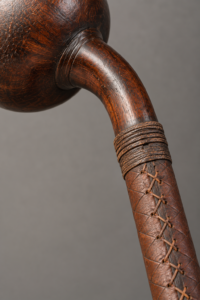
Its relatively uniform colour and stitching may point toward recent leather craftsmanship. An examiner should determine whether the material is vegetable-tanned leather, rawhide, imitation leather, or another covering.
The type of thread is also important. Natural sinew, linen, cotton, and modern synthetic thread can look similar in a photograph but may suggest different periods or production methods.
How to Examine It Safely
Treat the object as both a potential cultural item and a potentially dangerous heavy object.
Photograph Every Side
Take clear images of:
- The complete front and back
- Both sides
- The top of the ball
- The curved neck
- Every seam
- The end of the handle
- The cord and attachment hole
- Any cracks or repairs
- Any letters, numbers, symbols, or signatures
Place a ruler beside it for scale, but do not attach labels or tape directly to the object.
If you enjoy identifying mysterious vintage objects, explore our guide to unusual antique tools and their original uses.
Record Its Measurements
Record the overall length, the diameter of the spherical head, the widest part of the covered handle, and its weight.
These details can help experts compare it with catalogued pieces.