
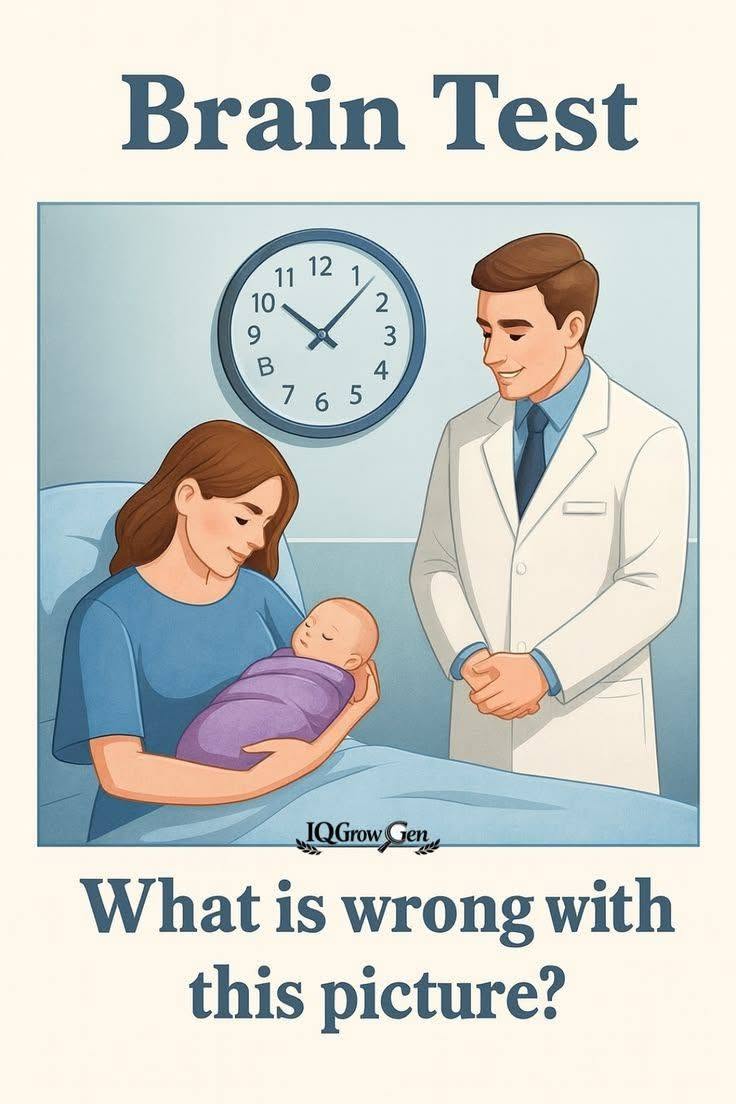
Brain Test: Can You Find the Mistake in 10 Seconds?
Some visual puzzles look incredibly simple at first glance.
You see a doctor, a mother holding a baby, a wall clock, and a question asking what is wrong with the picture. Nothing seems particularly unusual. But there is a small detail hidden in the scene that can be surprisingly easy to overlook.
That is exactly what makes a good brain test so entertaining.
The challenge is not necessarily about complicated mathematics, advanced knowledge, or difficult vocabulary. Instead, it tests how carefully you observe an ordinary-looking image.
In this puzzle, you have just 10 seconds to look at the picture and find the mistake.
Can you spot it before reading the explanation?
Take a close look at the entire image first. Don’t immediately zoom in on the clock or the people. Your brain may naturally focus on the larger objects while overlooking a tiny visual inconsistency.
Ready?
Start the timer.
10… 9… 8… 7… 6… 5… 4… 3… 2… 1…
Did you find it?
If you did, congratulations. If you didn’t, don’t worry. The hidden detail is easy to overlook because the rest of the picture looks completely normal at first glance.
Let’s examine the puzzle carefully.
Why This Brain Test Is So Easy to Miss
The biggest reason visual puzzles work is that our brains don’t process every detail of an image with equal attention.
When we look at a scene, we tend to identify the main subjects first.
In this picture, your attention is naturally drawn toward:
- The doctor
- The mother
- The newborn baby
- The large wall clock
- The question at the bottom
The clock is particularly noticeable because it is positioned near the center of the scene.
However, even when something is directly in front of us, our brains can overlook a small error if we are expecting everything to be normal.
This is one reason visual observation puzzles can feel surprisingly difficult.
You aren’t necessarily looking at the wrong place.
You may simply be looking without checking every detail.

Take Another Look at the Picture
Before revealing the answer, look at the image again.
There is a mother sitting on a hospital or examination bed while holding a baby.
A doctor is standing nearby.
Behind them is a large clock.
At first glance, the clock looks perfectly ordinary.
It has numbers arranged around the face.
There are hands pointing toward a particular time.
Everything seems normal.
But look more carefully at the numbers.
Don’t just count them.
Read them.
This is where the hidden mistake becomes easier to notice.