
Why You Probably Noticed It After the Reveal
This is another interesting part of visual puzzles.
Before the answer is revealed, the mistake can seem almost invisible.
After someone points it out, you may wonder:
“How did I not see that immediately?”
That’s because your brain has now been given the correct reference point.
You are no longer scanning the entire picture.
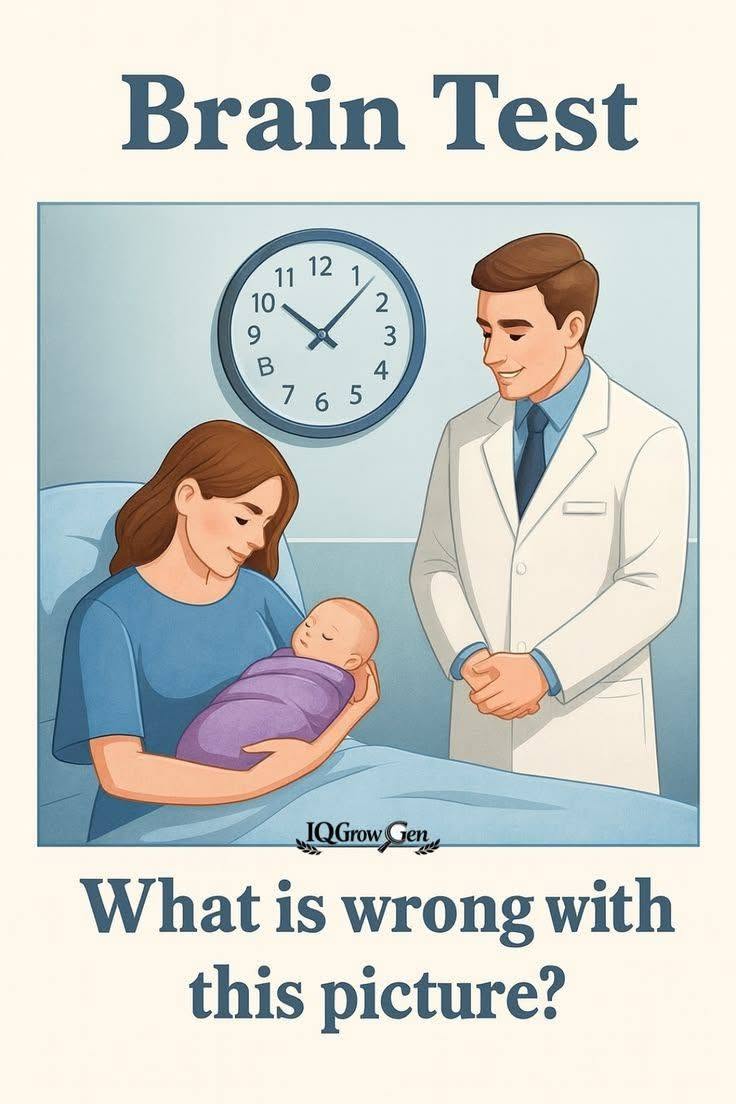
You are specifically looking for the character at the 8 o’clock position.
The search becomes much narrower.
This is why puzzle answers can seem obvious after the fact.
The Difference Between Looking and Observing
There’s an important difference between these two actions.
Looking
You take in the overall picture.
You recognize the people, the room, the clock, and the general situation.
Observing
You deliberately inspect individual details.
You compare symbols.
You notice inconsistencies.
You question whether every element belongs.
A visual brain test is designed to force you from simply looking into actively observing.
Don’t Let the People Distract You
The doctor and mother occupy a large part of the image.
Because humans naturally pay attention to faces and people, they can become a major distraction.
You may spend your 10 seconds examining:
- The doctor’s clothing
- The baby’s position
- The mother’s posture
- The hospital bed
- The interaction between the people
But none of those is where the main error is.
The puzzle is directing your attention toward the scene while hiding the answer in a smaller detail.
This is a classic visual-puzzle technique.
The Baby Is Not the Mistake
Some viewers may start looking at the baby because the picture is presented as a hospital or medical scene.
But the baby itself isn’t the key to the puzzle.
The scene is designed primarily as a distraction.
The mother holding the baby creates a realistic context.
The doctor adds another element that makes the image look like a medical illustration rather than a simple number puzzle.
That extra context makes the clock error less obvious.
The Doctor Is Not the Mistake Either
The doctor appears normally dressed in a white coat.
Nothing obvious about the doctor’s appearance is responsible for the puzzle’s answer.
This is another reason not to spend too much time analyzing the people.
When solving a timed visual puzzle, always consider whether the scene contains a particularly structured object.
Here, the clock provides a much stronger clue.
Why the Clock Is the Perfect Place to Hide an Error
A clock has an established visual structure.
Everyone expects twelve numbered positions.
That means changing one number creates an inconsistency while keeping the object recognizable.
If the puzzle designer replaced the entire clock with something completely different, the answer would be obvious.
Replacing 8 with B is much more subtle.
The clock still looks like a clock.
The sequence still appears almost correct.
Only one character breaks the pattern.

Can You Find Other Details in the Image?
Once you’ve discovered the main mistake, try another challenge.
Look at the picture again without focusing on the clock.
Can you identify any other unusual details?
Visual puzzles often encourage viewers to search for multiple inconsistencies, although the primary intended answer here is the incorrect character on the clock.
This can be a fun way to test your observation skills.
Why People Love “Find the Mistake” Puzzles
These puzzles are popular because they’re easy to understand.
You don’t need specialized knowledge.
You don’t need to calculate anything.
You simply need to observe.
They can also be shared easily with friends and family.
Someone can show you the picture and say:
“You have 10 seconds. Find what’s wrong.”
Immediately, the challenge begins.
They’re Also Great Conversation Starters
A simple visual puzzle can create a surprisingly competitive moment.
One person may find the mistake immediately.
Another may spend several minutes searching.
Someone else may confidently point to the wrong detail.
That’s part of the fun.
You can challenge:
- Friends
- Family
- Coworkers
- Children
- Students
Just remember that the puzzle is intended as entertainment, not as a scientific measurement of intelligence.
Does Finding It Quickly Mean You’re Smarter?
Not necessarily.
This is important.
A person finding the answer in five seconds does not prove that they are more intelligent than someone who takes thirty seconds.
Visual puzzles depend on many factors, including:
- Attention
- Familiarity
- Visual scanning habits
- Experience with puzzles
- Expectations
- Concentration
- How the image is displayed
Someone may simply notice the relevant detail quickly.
Another person may spend time examining the wrong part of the picture.
Neither result provides a reliable measure of overall intelligence.
Is This Really a Test of Brain Health?
No.
A social-media brain test like this should not be treated as a medical assessment of memory, cognition, or neurological health.
It is a visual observation puzzle.
Finding or missing the mistake does not diagnose anything.
Likewise, taking longer to solve it does not automatically indicate a problem with memory or cognitive function.
For genuine concerns about memory, attention, or other changes in thinking, a qualified healthcare professional should perform an appropriate assessment.
A Better Way to Approach Visual Puzzles
Instead of staring at the whole image repeatedly, use a systematic process.
Step 1: Identify the Main Objects
What are the largest elements?
Here, they include the mother, baby, doctor, and clock.
Step 2: Look for Structured Elements
The clock immediately stands out.
Step 3: Check Repeated Patterns
Look at the numbers around the clock.
Step 4: Compare Each Element
Does every character belong?
Step 5: Look for Substitutions
Is one symbol similar to another but technically incorrect?
That’s exactly what happens here.
Try This Strategy on Other Puzzles
The same approach works for many visual challenges.
For example, if you see a row of fruit, don’t simply look at the whole row.
Compare each fruit.
If you see a word repeated many times, compare each word.
If you see several clocks, compare the hands.
If you see a number sequence, check whether one number is missing or duplicated.
The key is to move from general observation to specific comparison.
Common Mistakes People Make When Solving These Puzzles
They Focus on the Largest Object
Large objects naturally attract attention.
But the answer is often hidden in a smaller element.
They Search for Something Dramatic
People often expect the mistake to be obvious.
In reality, the best puzzles use subtle errors.
They Don’t Compare Repeated Elements
A clock contains twelve positions, making comparison possible.
They Spend Too Much Time on One Area
If you have not found anything after several seconds, change your focus.
They Overthink the Scene
Sometimes the answer is much simpler than the story surrounding the image.
What Makes This Puzzle Tricky?
The substitution of B for 8 is particularly effective because both characters have rounded shapes.
At normal viewing size, the difference can be overlooked.
The viewer sees something that visually resembles the expected symbol.
The brain then continues scanning.
This is exactly the kind of small inconsistency that makes an observation puzzle challenging.
The Answer Explained
Let’s make it completely clear.
Look at the clock.
The sequence should contain:
7 → 8 → 9
But instead, the image shows:
7 → B → 9
The B is the mistake.
The character looks somewhat similar to an 8, which is why it can be overlooked when you’re trying to solve the puzzle quickly.
That’s the entire trick.
Why the Answer Is So Satisfying
A good puzzle should make sense once the answer is revealed.
This one does.
You can immediately look back at the clock and see the problem.
There isn’t a complicated interpretation.
There isn’t a hidden medical fact.
There isn’t a trick involving the baby’s age or the doctor’s clothing.
The mistake is simply a letter where a number should be.
That simplicity is what makes the puzzle work.
Challenge Your Friends
Now that you know the answer, don’t reveal it immediately if you’re sharing the puzzle.
Instead, show the image to a friend and give them 10 seconds.
Say:
“There’s one mistake in this picture. Can you find it?”
Then let them inspect the scene.
If they don’t find it, give them a second attempt.
You can also ask them to explain what they were looking at during the first 10 seconds.
You may be surprised by how many different details people focus on.
Make the Challenge More Difficult
If you want to make the puzzle harder, don’t give any hints.
Don’t mention the clock.
Don’t tell the person that the mistake is a character.
Simply say:
“Find the mistake.”
This forces them to scan the entire image.
If you want an easier version, tell them to examine the clock carefully.
Why Time Limits Make Puzzles More Fun
A time limit creates a sense of urgency.
Without a time limit, someone can inspect every pixel.
With 10 seconds, the person has to make quick decisions about where to look.
That is what turns a simple image into a challenge.
The time limit also makes the moment of discovery more satisfying.
Is This Puzzle Suitable for Kids?
Yes, as a simple observation game.
Children can practice:
- Attention
- Pattern recognition
- Visual comparison
- Patience
- Careful observation
However, it should be treated as a fun activity rather than a formal test of intelligence or development.
The goal is to encourage careful looking and problem-solving.
Is This Puzzle Suitable for Seniors?
Absolutely.
Visual puzzles can be enjoyable at any age.
But again, solving one quickly or slowly should not be interpreted as a measure of cognitive health.
A person may miss the answer because of eyesight, image quality, distraction, unfamiliarity with the puzzle format, or simply because they looked somewhere else first.
Entertainment puzzles should remain entertainment.
How to Make the Most of Brain Puzzles
If you enjoy these challenges, try different types.
Find the Difference
Compare two nearly identical pictures.
Odd One Out
Find the object that doesn’t belong.
Missing Number
Identify a missing element in a sequence.
Word Search
Find a hidden word among similar characters.
Pattern Puzzles
Determine what comes next.
Visual Illusions
Look at an image that can be interpreted in multiple ways.
Each type encourages a slightly different form of observation.
Don’t Rush When You Don’t Need To
The 10-second challenge is fun, but outside a puzzle environment, careful observation is often more useful than speed.
If something matters, slow down.
Read labels carefully.
Check numbers twice.
Compare information.
Look for small inconsistencies.
The same habit that helps with visual puzzles can be useful in everyday situations.
A Simple Observation Exercise
Want another challenge?
Look around the room you’re currently in.
Choose one familiar object.
Then deliberately inspect five details you normally wouldn’t notice.
For example, if you choose a clock:
- Check every number.
- Look at the hands.
- Inspect the markings.
- Look at the frame.
- Check whether anything is missing.
This exercise demonstrates how different the world can look when you shift from casual looking to deliberate observation.
Why Familiar Objects Can Hide Errors
The more familiar something is, the less consciously we may inspect it.
You probably don’t think about every letter when reading a familiar sign.
You don’t inspect every number on a clock every time you look at it.
You don’t consciously analyze every feature of a standard door.
Your brain has learned these patterns.
That saves mental effort.
But a puzzle designer can exploit that automatic processing by changing one tiny feature.
The Psychology of “I Should Have Seen That”
Almost everyone has experienced the moment when someone points out an obvious detail they completely missed.
This happens because attention is selective.
You can be looking directly at something without consciously processing the specific feature that matters.
Once the feature is pointed out, it becomes difficult to ignore.
That’s exactly what happens with the B on the clock.
Before the reveal, the symbol blends into the sequence.
After the reveal, it becomes obvious.
Can You Train Your Observation Skills?
You can practice deliberate observation, although this should not be confused with improving intelligence through social-media puzzles.
Try activities that require careful comparison.
For example:
- Spot-the-difference puzzles
- Jigsaw puzzles
- Memory games
- Pattern challenges
- Visual matching games
- Drawing from observation
The important part is paying attention to details rather than simply trying to solve as quickly as possible.
One More Look Before You Go
Now look at the clock again.
Find the sequence around the lower-left portion of the clock.
You should see:
7 → B → 9
There should be:
7 → 8 → 9
That’s the hidden error.
If you found it within the first 10 seconds, you successfully solved the challenge.
If you needed more time, that’s completely fine.
The puzzle was designed to make you overlook exactly this kind of tiny inconsistency.
Frequently Asked Questions
What is the mistake in the brain test?
The letter B appears where the number 8 should be on the clock.
Where is the mistake?
Look at the clock on the wall. The position between 7 and 9 contains B instead of 8.
Why is the mistake difficult to see?
The letter B has a shape that can resemble the number 8 at a quick glance, and the brain tends to recognize the overall clock pattern rather than inspect every character individually.
Can you find the mistake in 10 seconds?
The challenge is designed to see whether you can notice the incorrect character quickly, but the time limit is purely for entertainment.
Does solving the puzzle quickly mean you have a higher IQ?
No. A visual puzzle like this is not a standardized intelligence test.
Does missing the mistake mean you have poor memory?
No. Failing to notice one visual detail does not indicate a memory problem.
Is this a medical brain test?
No. It is an entertainment puzzle, not a clinical assessment.
What should the clock normally show?
A standard clock should have the number 8 between 7 and 9.
Why does B look like 8?
Both characters contain two rounded sections, making the substitution easier to overlook when viewed quickly.
Is there anything wrong with the doctor?
The intended mistake in this puzzle is not the doctor. The key error is on the clock.
Is something wrong with the baby?
The baby is not the intended answer. The scene is designed partly to distract you from the clock.
How can I become better at these puzzles?
Practice comparing repeated elements, checking structured objects carefully, and deliberately looking for small inconsistencies.
Why do I notice the mistake immediately after someone tells me?
Once you know where to look, your attention becomes focused on the relevant detail. The search is much easier than when you were scanning the entire image.
Are brain puzzles good for seniors?
They can be enjoyable recreational activities, but they should not be used to diagnose cognitive health or neurological conditions.
Can children play this puzzle?
Yes. It can be used as a simple observation and pattern-recognition activity.
Can I share this brain test with friends?
Yes. It works particularly well as a quick challenge because the answer can be hidden until after someone has had a chance to search.

Final Thoughts
This brain test looks simple, but the tiny error demonstrates how easily our attention can skip over familiar details.
The scene contains several elements designed to attract your attention, including the mother, the baby, the doctor, and the large clock. But the actual mistake is much smaller.
Look at the clock.
Between 7 and 9, you should see the number 8.
Instead, there is a B.
That’s the trick.
The interesting part isn’t simply finding the wrong character. It’s understanding why the mistake can remain hidden even when you’re looking directly at the clock.
Our brains are extremely good at recognizing familiar patterns quickly. That ability is useful, but it also means we don’t always examine every individual detail.
So the next time you take a brain test, don’t just look at the overall picture.
Slow down.
Compare repeated elements.
Check the small details.
And most importantly, don’t assume that something is correct simply because it looks familiar.
Did you find the B before the 10 seconds were up?