
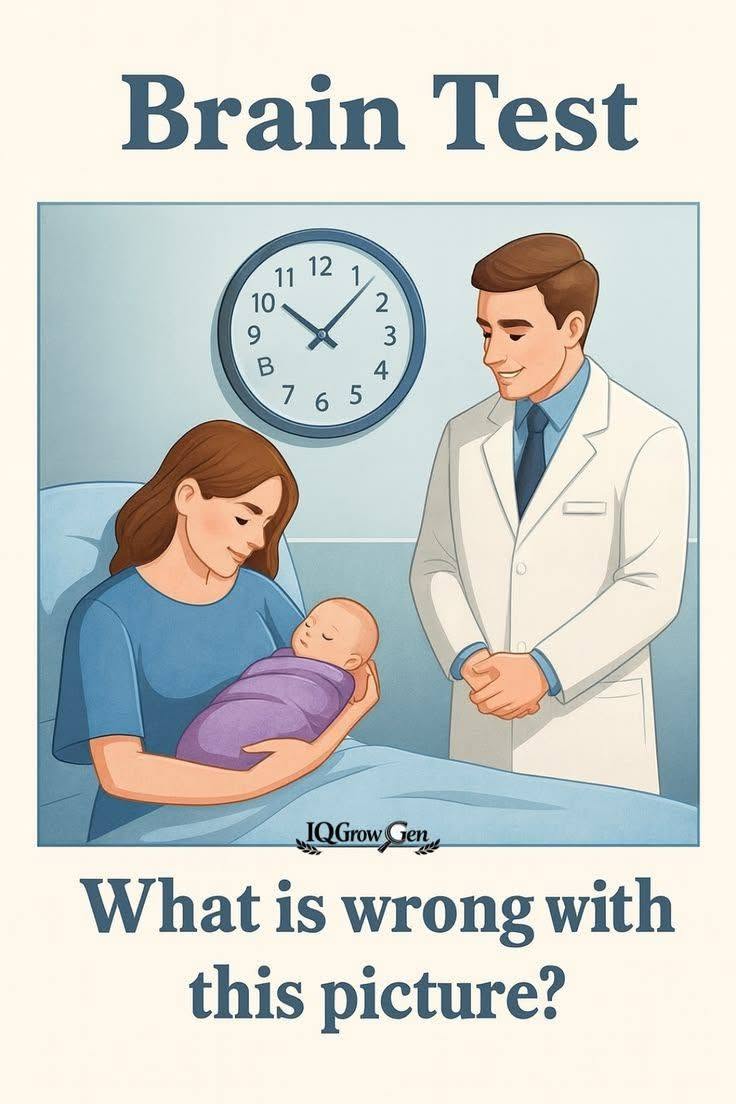
Did You Notice the Strange Character on the Clock?
If you focused on the clock, you may have noticed something unusual.
The numbers around the clock face are:
11, 12, 1, 2, 3, 4, 5, 6, 7, 9, 10…
But one position contains a character that doesn’t belong.
Instead of the number 8, the clock contains the letter B.
That is the hidden mistake.
The Answer: B Instead of 8
The clock should contain the number 8.
Instead, the image shows a B in that position.
It is a tiny visual substitution, but because the character has a shape that can resemble a number at a quick glance, your brain may initially accept it without questioning it.
That’s what makes this particular brain test effective.
The error is not enormous.
There is no missing person.
There is no dramatically unusual object.
There is no obvious mistake in the doctor’s clothing.
Instead, the puzzle relies on a tiny difference that you have to actively inspect.
Why Your Brain Can Miss a Simple Mistake
You might wonder how someone can look directly at the clock and still fail to notice that a letter has replaced a number.
The answer has to do with how we process visual information.
When we look at familiar objects, our brains often rely partly on expectations.
We know what a clock normally looks like.
We know that a traditional clock face contains numbers.
So when we see a series of symbols arranged around a clock, we automatically interpret them as numbers.
We don’t necessarily stop to verify every character individually.
This can make a familiar object surprisingly difficult to inspect carefully.
The Power of Familiar Patterns
A clock is an excellent example of a familiar pattern.
Most people have seen hundreds or thousands of clocks throughout their lives.
We recognize the circular shape.
We understand where the numbers should appear.
We know how the hands move.
Because the pattern is so familiar, we don’t need to consciously analyze every part of it.
That efficiency is useful in everyday life.
But it can work against you in a visual puzzle.
The puzzle takes advantage of your expectation that the clock is normal.
Your brain sees something resembling the expected sequence and moves on.
Why the Letter B Looks Easy to Ignore
The letter B isn’t completely unrelated to the number 8 visually.
Both characters contain two rounded sections.
When viewed quickly, especially in a stylized illustration, the letter can blend into the surrounding numbers.
The brain may register the general shape without carefully identifying the exact character.
This is why slowing down can make the difference between missing and finding the answer.
Instead of asking:
“What does this picture show?”
you need to ask:
“Is every individual detail exactly what it should be?”
That’s a completely different way of looking.
How Visual Brain Tests Work
A good brain test usually uses one of several techniques.
1. Pattern Recognition
The puzzle creates a familiar pattern and inserts something that doesn’t belong.
2. Visual Distraction
Large or interesting objects draw your attention away from the actual clue.
3. Similar Characters
The incorrect object resembles the correct one closely enough to avoid immediate detection.
4. Time Pressure
Giving yourself only a few seconds makes you rely more heavily on quick visual processing.
5. Expectation
Your brain assumes that a familiar object is correct unless something obviously signals otherwise.
This puzzle combines several of these techniques.
If you enjoy quick visual challenges, you can also try our spot-the-difference puzzles and see how quickly you can identify subtle changes between two similar images.
The 10-Second Challenge
Why does the puzzle specifically ask you to find the mistake within 10 seconds?
Time pressure changes the way you approach an image.
If someone tells you that you have unlimited time, you can inspect every part of the picture carefully.
You can zoom in.
You can count every number.
You can compare shapes.
You can systematically examine the entire scene.
But with only 10 seconds, most people immediately scan for something unusual.
That makes the challenge more difficult.
It also makes finding the answer more satisfying.
How to Solve This Brain Test Faster
If you enjoy visual puzzles, there are a few strategies that can help.
Start With the Most Structured Object
Look for objects containing repeated patterns.
Examples include:
- Clocks
- Calendars
- Bookshelves
- Number sequences
- Signs
- License plates
- Grids
- Rows of objects
Errors are often hidden inside structured elements because our brains tend to process the overall pattern rather than checking every individual item.
In this puzzle, the clock is the obvious structured object.
Compare Similar Elements
If you see a series of numbers, compare them.
Don’t simply look at the sequence.
Ask:
- Are they all numbers?
- Is one character different?
- Is one reversed?
- Is one missing?
- Is one repeated?
- Is the spacing unusual?
This method is much more reliable than simply scanning randomly.
Count the Clock Numbers
Another useful strategy is to count.
A traditional analog clock has twelve positions.
Starting at the top:
- 12
- 1
- 2
- 3
- 4
- 5
- 6
- 7
- 8
- 9
- 10
- 11
In this image, one of those positions does not contain the expected number.
The position where 8 should appear instead contains B.
Once you know what you’re looking for, the error becomes obvious.