
Which Banana Ripeness Is Best for You and Your Health? The Surprising Truth
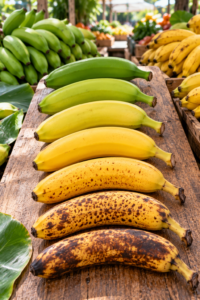
Have you ever stood in the kitchen looking at a bunch of bananas and wondered which one is actually best to eat?
One banana may be bright green, another yellow, and another covered with brown spots. They may all be the same fruit, but their texture, sweetness, and carbohydrate composition can change as they ripen.
So, which banana ripeness is best for your health?
The answer depends on what you are looking for.
Green bananas contain more resistant starch, while ripe bananas become softer and sweeter as some of that starch is converted into simpler sugars. Research has confirmed that ripening changes the starch composition and digestibility of bananas. PubMed
That means there isn’t one banana that is automatically “the healthiest” for everyone.
7 Impressive Benefits of Eating Raw Carrots
If you want a banana that is less sweet and contains more resistant starch, a firmer banana may be appealing. If you want maximum sweetness and a soft texture for smoothies, baking, or eating by itself, a yellow or spotted banana may be preferable.
Let’s look at the different stages so you can decide which one fits your needs.
Understanding Banana Ripeness
Bananas generally become softer, sweeter, and more aromatic as they ripen.
At the beginning, most of their carbohydrate is in the form of starch. As ripening progresses, some of that starch is converted into sugars.
This explains why a green banana tastes starchy and firm while an overripe banana tastes much sweeter and softer.
Research examining bananas at different ripening stages has found substantial changes in resistant starch and other nutritional characteristics during ripening. PubMed
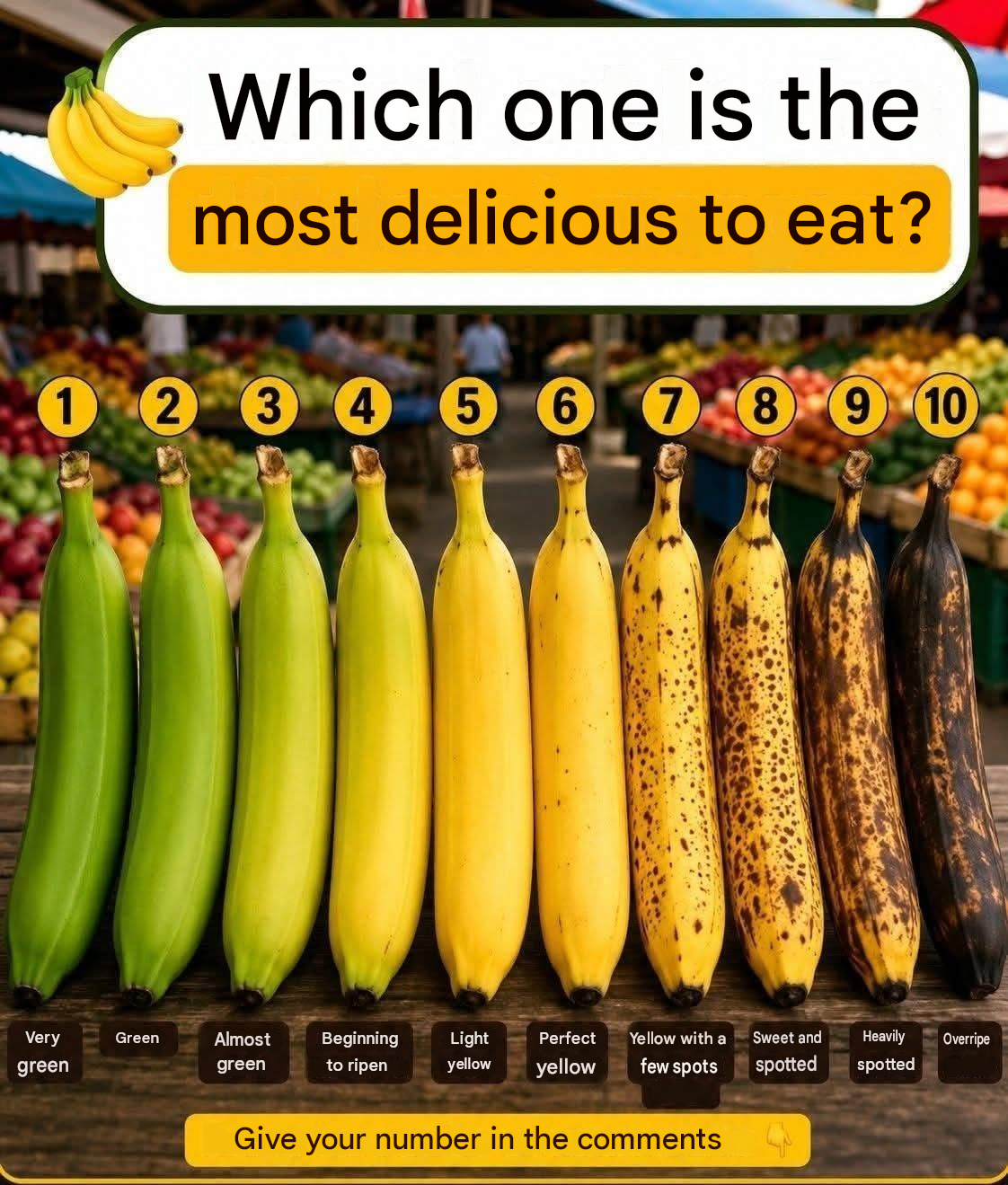
The stages can be roughly divided into:
- Very green
- Green
- Green with some yellow
- Mostly yellow
- Fully yellow
- Yellow with spots
- Heavily spotted
- Very brown or overripe
The banana in the picture shows this progression clearly.
But which stage should you choose?
Green Bananas: More Resistant Starch
Very green bananas are firm and relatively low in sweetness.
One of their most interesting characteristics is their higher amount of resistant starch. Resistant starch is a type of carbohydrate that is not completely digested in the small intestine.
Because of this, it behaves in some ways more like dietary fiber.
As bananas ripen, their resistant starch generally decreases as starch is converted into more readily available sugars. PubMed
This makes green bananas particularly interesting for people who prefer foods with less sweetness and more resistant starch.
However, green bananas aren’t necessarily the best choice for everyone.
They can be harder to digest for some people, and their firm, starchy texture isn’t appealing to everyone.
Green bananas are often better suited to cooking than simply eating raw.
Slightly Yellow Bananas: A Good Middle Ground
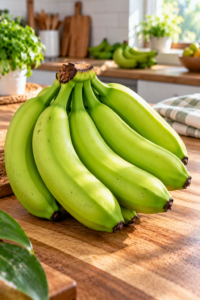
A banana that has started turning yellow but still has some green around the peel can offer a useful compromise.
It is softer than a completely green banana but isn’t as sweet as a fully ripe banana.
At this stage, the banana still contains some resistant starch while developing a more pleasant texture and flavor.
For people who don’t like the strong sweetness of very ripe bananas, this can be a comfortable stage for everyday eating.
It can also work well in breakfast bowls, sliced over oatmeal, or combined with yogurt.
Yellow Bananas: Sweet, Soft, and Easy to Eat
The classic yellow banana is probably the stage most people recognize.
It has a softer texture, a naturally sweet flavor, and is easy to eat without preparation.
As bananas ripen, starch is converted into sugars, which explains the increase in sweetness. Studies comparing bananas at different stages have demonstrated differences in glucose responses associated with ripeness, although individual responses vary. PubMed
A ripe yellow banana can therefore be a convenient source of carbohydrate, especially before or after physical activity.
Bananas also provide nutrients such as potassium, vitamin B6, and magnesium. Cleveland Clinic notes that potassium and magnesium contribute to normal muscle, nerve, heart, and brain function. Cleveland Clinic
For many people, a normal ripe banana is simply a convenient and nutritious fruit.
Yellow Bananas With Brown Spots
This is where the banana becomes noticeably sweeter.
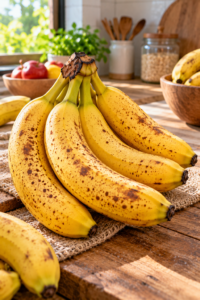
Small brown spots usually indicate that the banana is becoming more mature. The flesh becomes softer, and its flavor becomes richer.
Some people avoid spotted bananas because they assume they are no longer healthy.
That’s not necessarily true.
A banana with brown spots can still be perfectly good to eat as long as it doesn’t show signs of spoilage such as mold, leaking liquid, an unusual fermented smell, or a damaged interior.
Spotted bananas are particularly useful for recipes.
Their natural sweetness can make them excellent for:
- Banana bread
- Muffins
- Pancakes
- Smoothies
- Oatmeal
- Homemade desserts
In other words, a spotted banana isn’t automatically a bad banana.
Very Ripe Bananas: Are They Still Healthy?
Yes.
A very ripe banana can still provide nutrients and can be part of a balanced diet.
The major difference is that it is generally sweeter and contains less resistant starch than a less ripe banana.
That doesn’t make it unhealthy.
The important question is how much you eat and what the rest of your diet looks like.
Someone who enjoys a ripe banana as part of breakfast doesn’t need to avoid it simply because the peel has developed brown spots.
However, people who need to carefully manage their carbohydrate intake may prefer to consider portion size and how ripe their bananas are.
If you have diabetes or are monitoring blood glucose, your individual response matters more than a social-media rule saying that one particular banana stage is universally “best.”
Does Banana Ripeness Affect Blood Sugar?
It can.
As bananas ripen, starch is converted into sugars, which changes how the carbohydrate is digested.
A small older study involving people with type 2 diabetes found differences in post-meal glucose responses between under-ripe and over-ripe bananas. PubMed
Other research has also examined how banana maturity influences starch digestion and glycemic response. PubMed
However, this doesn’t mean that eating a ripe banana automatically causes an unhealthy blood sugar spike.
The overall meal matters.
Eating a banana alone is different from eating it with Greek yogurt, nuts, seeds, or another source of protein and fat.
Your individual metabolism, portion size, activity level, and overall diet also influence the response.
So it’s better to think about banana ripeness as one factor, rather than a simple healthy-versus-unhealthy rule.