
Baking Soda on the Face: Benefits, Risks, and How to Use It Safely
A quick search online will give you plenty of homemade skincare recipes featuring baking soda. Some promise smoother skin, fewer dark spots, smaller pores, fewer wrinkles, and even lighter dark circles under the eyes.
The idea is appealing because baking soda is inexpensive, easy to find, and already sitting in many kitchen cupboards.
But there is an important problem with many of these viral beauty claims: baking soda is not a proven facial treatment for dark spots, wrinkles, or dark circles, and putting it directly on your face can irritate your skin.
Age Spots on Hands: 7 Safe Ways to Fade Them
That doesn’t mean baking soda is useless in every situation. It simply means that a product being common in the kitchen doesn’t automatically make it appropriate for facial skincare.
Your facial skin has a protective barrier and a naturally acidic environment. Cleveland Clinic explains that healthy adult skin typically has a pH around 5.5, and disrupting that environment can contribute to dryness, irritation, and problems with the skin barrier. Cleveland Clinic
So if you’ve seen the viral claim that you can mix baking soda with water and use it as a miracle facial treatment, it’s worth taking a closer look before trying it.
In this article, we’ll explain what baking soda actually does, why people use it on their skin, what the evidence says about dark spots and wrinkles, the potential risks, and what dermatologists recommend instead.
What Is Baking Soda?
Baking soda is sodium bicarbonate, a white alkaline powder commonly used in baking and household applications.
In cooking, it can help baked goods rise when it reacts with an acid.
Around the home, people also use it for cleaning, deodorizing, and other household purposes.
But facial skin is a different environment.
Because baking soda is alkaline, applying it directly to the skin can alter the skin’s normal surface environment. Healthy skin has a slightly acidic pH, sometimes referred to as the skin’s acid mantle.
That slightly acidic environment contributes to normal barrier function and helps support the skin’s natural microbial environment. Cleveland Clinic
This is one of the main reasons why a kitchen ingredient shouldn’t automatically be treated as a skincare ingredient.
Why Do People Put Baking Soda on Their Face?
The popularity of baking soda on the face comes largely from DIY beauty recipes shared through social media, blogs, and video platforms.
Common claims include:
- Removing dark spots
- Reducing wrinkles
- Lightening dark circles
- Exfoliating dead skin
- Cleaning pores
- Reducing oiliness
- Treating acne
- Making skin look brighter
- Smoothing rough skin
Some recipes suggest mixing baking soda with water.
Others combine it with ingredients such as:
- Lemon juice
- Honey
- Coconut oil
- Yogurt
- Aloe vera
- Toothpaste
The problem is that a long list of ingredients does not automatically make a skincare treatment effective or safe.
Some combinations can actually increase irritation.
Does Baking Soda Remove Dark Spots?
There is no good evidence that applying household baking soda directly to the face is a reliable treatment for hyperpigmentation or dark spots.
Dark spots can have many causes, including:
- Sun exposure
- Acne
- Inflammation
- Hormonal changes
- Melasma
- Skin injuries
- Certain medications
- Irritating skincare products
Because the cause matters, treating every dark spot with the same homemade mixture isn’t a good approach.
The American Academy of Dermatology explains that irritated skin can actually develop more dark spots, particularly in people who are prone to hyperpigmentation. Dermatologists recommend gentle skincare and sun protection when treating dark spots. Académie Américaine de Dermatologie
That creates an important problem with harsh DIY treatments.
If baking soda irritates your skin, the irritation itself could potentially make discoloration more noticeable rather than less noticeable.
Does Baking Soda Whiten the Skin?
Baking soda does not safely “whiten” your natural skin tone.
You may see temporary changes after using an abrasive or drying product because the surface of the skin has been altered. That is not the same as safely treating pigmentation.
Healthy skincare should focus on maintaining the skin barrier and addressing the actual cause of uneven pigmentation.
If you’re concerned about dark spots, dermatologists may recommend ingredients such as:
- Vitamin C
- Azelaic acid
- Retinoids
- Glycolic acid
- Kojic acid
The American Academy of Dermatology lists these among ingredients that may help fade dark spots, depending on the cause and the individual’s skin. Académie Américaine de Dermatologie
Can Baking Soda Remove Wrinkles?
This is another popular claim that needs correcting.
Baking soda does not erase wrinkles.
Wrinkles develop through a combination of factors, including natural aging, repeated facial movement, collagen changes, and cumulative sun exposure.
A temporary smoothing effect after washing or exfoliating doesn’t mean the underlying wrinkle has been removed.
For people interested in reducing visible signs of aging, dermatologists place much more emphasis on:
- Daily sun protection
- Moisturizing
- Appropriate retinoid or retinol products
- Gentle skincare
- Professional treatment when appropriate
The American Academy of Dermatology recommends broad-spectrum SPF 30 or higher for protecting skin from premature aging and notes that retinoids can help improve fine lines and wrinkles in appropriate users. Académie Américaine de Dermatologie
What About Dark Circles?
Dark circles are particularly complicated because they don’t have one single cause.
They can be associated with:
- Genetics
- Skin pigmentation
- Thin skin
- Visible blood vessels
- Allergies
- Lack of sleep
- Shadowing caused by facial anatomy
- Aging
- Tear-trough changes
Applying baking soda around the eyes is especially questionable because the skin in this area is delicate.
A harsh or irritating product can cause redness, dryness, burning, and discomfort.
There is no good reason to assume that baking soda will safely eliminate dark circles.
If dark circles are persistent or changing, identifying the underlying cause is much more useful than trying increasingly aggressive homemade remedies.
Is Baking Soda a Good Facial Exfoliator?
This is one of the more believable claims because baking soda has a powdery texture.
However, something being physically abrasive doesn’t automatically make it a good facial exfoliant.
Facial skin can be sensitive to excessive friction.
The American Academy of Dermatology advises people with acne to avoid scrubbing because irritation can worsen breakouts. Académie Américaine de Dermatologie
The same general principle applies to other facial concerns.
If your goal is exfoliation, choose a product specifically formulated for facial skin rather than assuming a kitchen powder is an appropriate substitute.
Why Baking Soda Can Irritate Facial Skin
One of the biggest concerns with baking soda on the face is its alkalinity.
Healthy adult skin normally has a slightly acidic pH. Cleveland Clinic explains that when skin becomes too acidic or too alkaline, its natural microenvironment can be disrupted, potentially contributing to dryness, flaking, irritation, and sensitivity. Cleveland Clinic
A homemade baking soda paste can therefore be problematic for some people.
Possible reactions include:
- Dryness
- Tightness
- Redness
- Burning
- Itching
- Flaking
- Increased sensitivity
Some people may tolerate it briefly without an obvious reaction.
That doesn’t mean it is beneficial for the skin.
Baking Soda Can Make Sensitive Skin Feel Worse
If you already have sensitive skin, eczema, rosacea, or a damaged skin barrier, experimenting with harsh DIY ingredients is particularly risky.
Skin that is already irritated generally benefits from a simpler routine rather than additional experimentation.
The American Academy of Dermatology recommends gentle skincare for people dealing with irritation and notes that irritating products can worsen certain skin concerns. Académie Américaine de Dermatologie
If your face regularly feels:
- Tight after washing
- Burning
- Itchy
- Red
- Flaky
- Easily irritated
then baking soda is not a good ingredient to experiment with.
What Happens If Baking Soda Dries Out Your Skin?
You might initially think that dryness means the product is “working.”
It doesn’t.
Dryness is not proof that a product is removing toxins, impurities, or dark spots.
Excessive dryness can weaken the skin barrier and make your face feel rough and uncomfortable.
It may also make fine lines look more noticeable because dehydrated skin can temporarily appear less smooth.
That’s one reason dermatologists emphasize moisturization rather than repeatedly stripping the skin.
The AAD notes that moisturizer can reduce the appearance of fine lines by helping the skin retain water. Académie Américaine de Dermatologie
What About Baking Soda and Lemon?
This is one DIY combination you should be especially cautious about.
You may find recipes suggesting:
baking soda + lemon juice
for dark spots or “brightening.”
There is no reason to assume that this combination is a safe or effective facial treatment.
Lemon juice is acidic, while baking soda is alkaline.
When they react, they neutralize each other to some extent, producing carbon dioxide and other reaction products. But that doesn’t transform the mixture into a dermatologist-approved skin treatment.
More importantly, lemon juice can irritate skin and increase sensitivity to sunlight.
For pigmentation concerns, dermatologists emphasize gentle products and consistent sun protection rather than harsh kitchen mixtures.
Never Scrub Baking Soda Into Your Face
If you decide to experiment with any DIY facial product, aggressive scrubbing is one of the worst approaches.
Rubbing a gritty substance against the skin can create mechanical irritation.
This is particularly concerning if you have:
- Active acne
- Open pimples
- Sunburn
- Eczema
- Rosacea
- Cuts
- Recent cosmetic procedures
- Very sensitive skin
The American Academy of Dermatology specifically recommends avoiding scrubbing acne-prone skin because irritation can make acne worse. Académie Américaine de Dermatologie
Does Baking Soda Treat Acne?
There isn’t strong clinical evidence supporting ordinary household baking soda as a reliable acne treatment.
Acne involves clogged pores, inflammation, oil production, and other biological processes.
Effective acne treatments are formulated around ingredients that have been studied for those mechanisms.
The AAD recommends gentle cleansing and evidence-based acne treatments rather than irritating DIY approaches. Académie Américaine de Dermatologie
If you have occasional pimples, a properly formulated over-the-counter acne product is generally a more sensible choice than experimenting with baking soda.
What Dermatologists Recommend for Acne Instead
For mild acne, dermatologists may recommend products containing ingredients such as:
- Adapalene
- Benzoyl peroxide
- Salicylic acid
- Azelaic acid
The right choice depends on the type of acne and your skin.
The AAD notes that mild acne can often be treated with over-the-counter products, while deep, painful, or scarring acne may require professional treatment. Académie Américaine de Dermatologie
One important point is consistency.
Acne treatments generally don’t work overnight.
Changing products every few days can irritate the skin and make it harder to determine what is actually helping.
What Should You Use for Dark Spots Instead?
If your primary concern is pigmentation, start with the basics.
1. Protect Your Skin From the Sun
Sun exposure can make dark spots darker and can contribute to premature skin aging.
The AAD recommends broad-spectrum sunscreen with SPF 30 or higher. For some types of hyperpigmentation, dermatologists may recommend tinted sunscreen containing iron oxide because visible light can also contribute to pigmentation, especially in darker skin tones. Académie Américaine de Dermatologie
2. Avoid Irritating Products
If a product burns or stings, don’t assume that means it’s working.
Irritation can make pigmentation worse.
The AAD specifically recommends gentle products for people dealing with dark spots. Académie Américaine de Dermatologie
3. Consider Evidence-Based Ingredients
Depending on the cause, dermatologists may recommend:
- Vitamin C
- Azelaic acid
- Retinoids
- Glycolic acid
- Kojic acid
These are much more appropriate choices than household baking soda. Académie Américaine de Dermatologie
What Should You Use for Wrinkles Instead?
For early signs of aging, a simple routine can go a long way.
Morning
- Gentle cleanser
- Moisturizer
- Broad-spectrum SPF 30 or higher
-
If you’re interested in simple, evidence-based ways to improve the appearance of your skin, you can also read our guide to natural skincare tips for healthier-looking skin.
Evening
- Gentle cleanser
- Appropriate treatment product
- Moisturizer
Depending on your skin and goals, retinol or another retinoid may be useful.
The AAD explains that retinoids can help with fine lines, wrinkles, uneven tone, and some forms of pigmentation. Académie Américaine de Dermatologie
Retinoids can also cause irritation, however, so they should be introduced carefully and according to product directions or professional advice.
Why Sunscreen Matters More Than a DIY Baking Soda Mask
If your concern is dark spots or premature aging, sun protection is one of the most useful things you can do.
UV exposure contributes to:
- Wrinkles
- Age spots
- Uneven pigmentation
- Loss of skin elasticity
- Other signs of photoaging
The American Academy of Dermatology recommends daily sun protection and broad-spectrum SPF 30 or higher. Académie Américaine de Dermatologie
A simple sunscreen routine is therefore much more evidence-based than applying baking soda to your face.
Can Baking Soda Make Skin Look Brighter Temporarily?
Possibly, some people may perceive a temporary difference after washing away a powder or exfoliating product.
But temporary surface changes should not be confused with actual treatment of pigmentation.
If your face looks brighter because the surface has been stripped or dried, that doesn’t mean the underlying pigmentation has been corrected.
Long-term skin improvement usually requires addressing the actual cause.
What If You Already Used Baking Soda on Your Face?
Don’t panic.
If you applied a small amount and your skin feels completely normal, simply rinse it thoroughly with lukewarm water and return to a gentle skincare routine.
Avoid adding more active products immediately.
If your skin feels irritated, burning, or unusually dry:
- Rinse gently.
- Don’t scrub.
- Avoid acids and exfoliants temporarily.
- Use a bland moisturizer if you normally tolerate one.
- Avoid additional DIY treatments.
- Protect your skin from the sun.
The AAD recommends washing off a product if a reaction develops and using measures such as a cool compress or petroleum jelly when appropriate. Académie Américaine de Dermatologie
If the reaction is severe, persistent, swollen, blistering, or painful, seek medical attention.
What If Your Skin Turns Red?
Redness can be a sign of irritation.
Don’t assume that redness means the product is “pulling impurities out.”
If a skincare ingredient causes burning or redness, stop using it.
The AAD recommends avoiding products that irritate the skin when dealing with hyperpigmentation because irritation can contribute to additional dark spots. Académie Américaine de Dermatologie
What If Baking Soda Gets Near Your Eyes?
Be especially careful.
The skin around the eyes is delicate, and getting a powder or paste into the eye can cause significant irritation.
If baking soda gets into your eye, rinse thoroughly with clean water.
If pain, redness, blurred vision, or persistent irritation develops, seek appropriate medical care.
Don’t intentionally apply baking soda close to the eyes in an attempt to treat dark circles.
Can You Use Baking Soda as a Face Wash?
It’s better not to.
A facial cleanser is formulated specifically to clean skin while minimizing disruption to the skin barrier.
Baking soda is not a facial cleanser.
Cleveland Clinic explains that using products that are too alkaline can disrupt the skin’s natural environment and contribute to dryness and irritation. Cleveland Clinic
If you want a simple routine, choose a gentle facial cleanser rather than a kitchen ingredient.
Can Baking Soda Shrink Pores?
No permanent pore-shrinking effect has been established.
Pores don’t simply disappear because an alkaline powder is applied to them.
Some skincare products can make pores appear less noticeable by reducing oil, preventing clogging, or improving skin texture.
But baking soda isn’t a proven pore-treatment ingredient.
Can Baking Soda Remove Blackheads?
There isn’t strong evidence supporting baking soda as a safe blackhead treatment.
Blackheads form when pores become clogged with oil and dead skin cells.
The AAD notes that acne treatments such as adapalene can help unclog pores and prevent new blackheads. Académie Américaine de Dermatologie
That is a much more targeted approach than scrubbing your face with baking soda.
Can Baking Soda Remove Acne Scars?
No.
Acne scars involve changes in the structure or pigmentation of the skin.
A household baking soda paste cannot reliably rebuild lost collagen or safely correct scar tissue.
Depending on the type of scar, dermatologists may use treatments such as retinoids, chemical peels, laser procedures, microneedling, fillers, or other approaches.
The appropriate treatment depends heavily on whether the marks are actually scars, pigmentation, or another condition.
Dark Marks After Acne Are Different From Scars
This distinction is useful.
A flat brown or dark mark left behind after a pimple may be post-inflammatory hyperpigmentation.
A depression or raised area may be an actual acne scar.
These conditions require different approaches.
The AAD explains that irritation can contribute to dark spots and that gentle skincare and sun protection are important when treating hyperpigmentation. Académie Américaine de Dermatologie
If you aren’t sure what you’re seeing, a dermatologist can help identify it.
Baking Soda and Sensitive Skin
If your skin is naturally sensitive, it’s especially important to keep your routine simple.
Choose products labeled for sensitive skin and, when appropriate, fragrance-free.
The AAD notes that even skincare ingredients can cause irritation or allergic contact dermatitis and recommends testing products before fully incorporating them into a routine. Académie Américaine de Dermatologie
A simple routine is often better than constantly trying viral hacks.
What About “Natural” Skincare?
The word “natural” doesn’t automatically mean safe.
Lemon juice is natural.
Essential oils are natural.
Baking soda is naturally occurring.
That doesn’t mean all three are appropriate for facial skin.
Skin reacts to chemistry, concentration, pH, exposure time, and individual sensitivity.
A professionally formulated skincare product can therefore be safer and more predictable than a homemade mixture, even if the homemade mixture contains familiar ingredients.
Why DIY Skincare Videos Can Be Misleading
A social-media video usually shows only the result.
You don’t know:
- The person’s full skincare routine
- Their skin type
- Their medical history
- Their lighting
- Their camera settings
- Whether they used other treatments
- How long the effect lasted
- Whether irritation developed later
A before-and-after image isn’t proof that baking soda caused the improvement.
This is particularly important for pigmentation, because lighting and camera exposure can dramatically change how skin looks.
Don’t Judge a Product by One Viral Testimonial
One person saying:
“It worked for me”
doesn’t establish that a treatment is safe or effective for everyone.
Dermatology recommendations are based on accumulated evidence, clinical experience, and knowledge of how skin behaves.
The AAD recommends evidence-based skincare and warns against irritating DIY approaches for acne and other skin concerns. Académie Américaine de Dermatologie
A Better Simple Routine for Uneven Skin
If your goal is a smoother, more even complexion, you don’t need a complicated 12-step routine.
Try keeping things simple.
Morning
Step 1: Gentle cleanser
Use a mild facial cleanser appropriate for your skin type.
Step 2: Moisturizer
Choose a product that doesn’t leave your skin uncomfortably dry or greasy.
Step 3: Sunscreen
Use broad-spectrum SPF 30 or higher.
If hyperpigmentation is a major concern, ask a dermatologist whether a tinted sunscreen containing iron oxide would be useful for your skin. Académie Américaine de Dermatologie
Evening
Step 1: Cleanse
Remove makeup, sunscreen, and daily buildup gently.
Step 2: Choose One Targeted Treatment
Depending on your concern, this could be:
- Retinol
- Azelaic acid
- Vitamin C
- Another dermatologist-recommended treatment
Step 3: Moisturize
Support your skin barrier with a suitable moisturizer.
The key is consistency.
You don’t need to keep changing products every few days.
How Long Does It Take to See Results?
One of the biggest problems with viral beauty hacks is the promise of instant results.
Real skincare usually takes longer.
The AAD notes that many anti-aging products require at least several weeks to show meaningful results, while acne treatments can take weeks to months. Académie Américaine de Dermatologie
Dark spots can take even longer.
The AAD notes that some hyperpigmentation may take six to twelve months to fade once the underlying cause is addressed, although appropriate treatment can speed the process. Académie Américaine de Dermatologie
So if a post promises that baking soda will erase years of pigmentation in three minutes, be skeptical.
What About Baking Soda for Body Skin?
The face is particularly sensitive, but that doesn’t mean baking soda is automatically appropriate for every part of the body.
Some dermatologists may recommend baking soda in specific bathing situations, such as certain itchy rashes, but that is very different from rubbing a concentrated paste onto the face.
For example, the AAD lists baking soda added to running bath water as one option that may help relieve itching from poison ivy, oak, or sumac. Académie Américaine de Dermatologie
That does not mean the same ingredient should be scrubbed directly onto facial skin.
The route, concentration, exposure, and medical condition all matter.
When You Should See a Dermatologist
Consider seeing a dermatologist if you have:
- Persistent dark patches
- Rapidly changing pigmentation
- Deep acne
- Painful acne
- Acne that scars
- Persistent redness
- Burning or itching
- A rash that doesn’t improve
- New or unusual skin changes
- Pigmentation around the eyes that concerns you
- Skin irritation after using DIY products
The AAD notes that some conditions can look like acne but actually require a different diagnosis and treatment. Académie Américaine de Dermatologie
Getting the right diagnosis is often more valuable than trying another home remedy.
Common Mistakes to Avoid
Mistake 1: Using Baking Soda Every Day
Repeated exposure increases the chance of irritation and dryness.
Mistake 2: Scrubbing Hard
More friction doesn’t mean better exfoliation.
Mistake 3: Adding Lemon Juice
Combining several irritating ingredients doesn’t create a safer treatment.
Mistake 4: Applying It Around the Eyes
The eye area is delicate and shouldn’t be treated casually with household powders.
Mistake 5: Expecting Instant Results
Dark spots and wrinkles don’t disappear overnight.
Mistake 6: Ignoring Sunscreen
Sun protection is fundamental for preventing and managing pigmentation and premature aging. Académie Américaine de Dermatologie
Mistake 7: Using Too Many DIY Treatments
If your skin becomes irritated, you may not know which ingredient caused it.
Baking Soda vs. Proper Facial Exfoliants
There is a major difference between household baking soda and a facial exfoliating product.
A properly formulated exfoliant is designed around:
- A controlled concentration
- Appropriate pH
- Skin compatibility
- Stability
- Directions for use
- Safety testing
Baking soda doesn’t provide those same guarantees.
That’s why “it’s natural and cheap” isn’t enough to make it a good facial treatment.
What If You Really Want to Try It?
From an evidence-based skincare perspective, there is no established baking soda facial recipe that can be recommended as a proven treatment for dark spots, wrinkles, or dark circles.
If you are still considering a DIY product, at minimum:
- Don’t use it on broken or irritated skin.
- Don’t scrub aggressively.
- Don’t apply it near the eyes.
- Don’t mix it with multiple potentially irritating ingredients.
- Stop immediately if you experience burning or significant irritation.
- Don’t use irritation as a sign that the treatment is “working.”
The AAD recommends testing new skincare products on a small area first because irritation or allergic reactions can occur. Académie Américaine de Dermatologie
However, a patch test cannot turn an unproven DIY treatment into a proven one.
The Better Way to Think About Baking Soda
Instead of asking:
“How can I use baking soda to fix my face?”
ask:
“What is actually causing the skin problem I’m trying to fix?”
If the problem is:
Dark spots
Focus on sun protection and appropriate pigmentation treatments.
Fine lines
Focus on sunscreen, moisturizer, and evidence-based anti-aging ingredients.
Acne
Use proven acne treatments.
Dark circles
Determine the likely cause.
Dryness
Focus on barrier-friendly skincare.
Irritation
Remove potential irritants and simplify your routine.
This approach is much more likely to produce useful results than trying one ingredient for every problem.
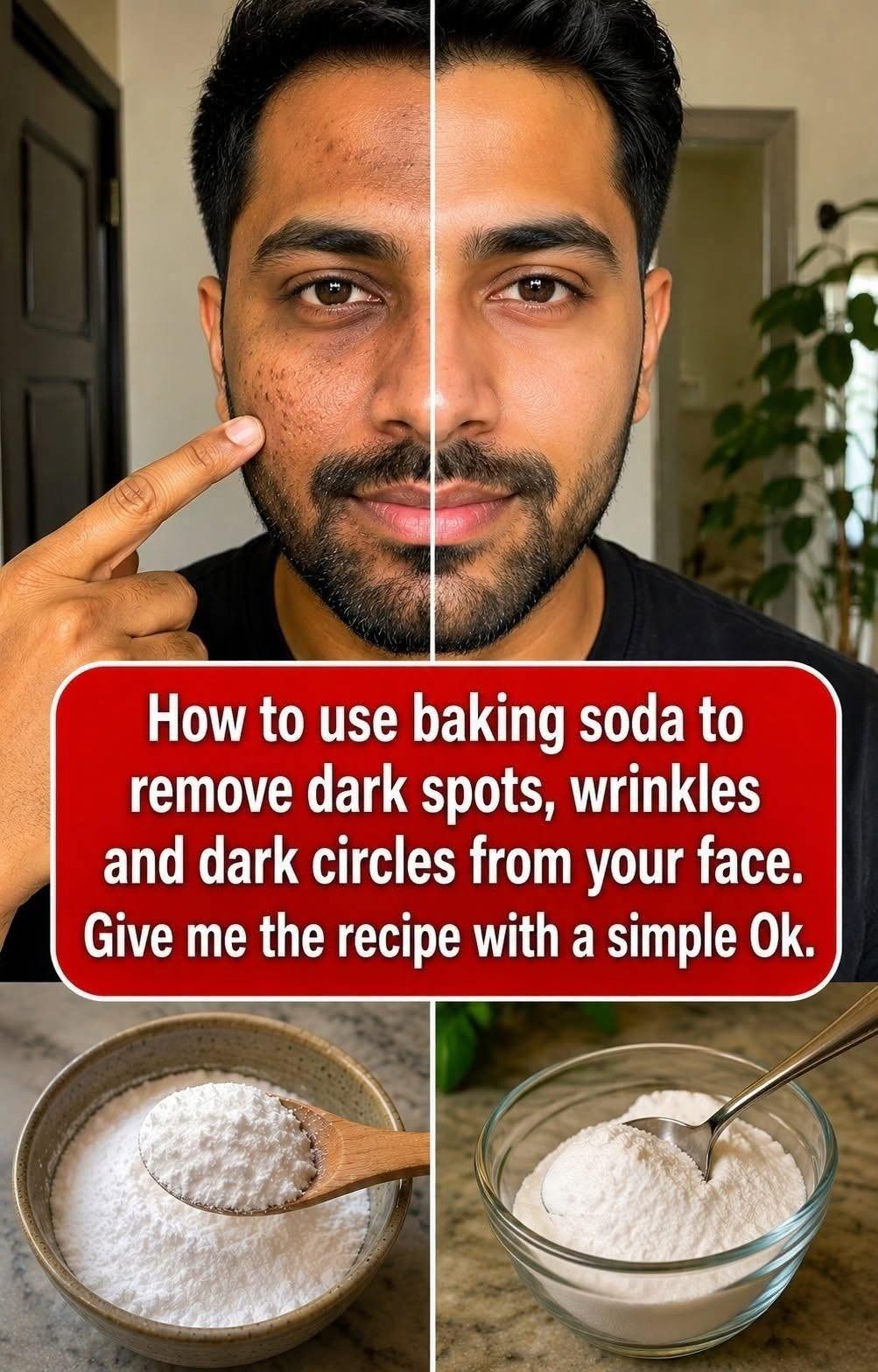
The Image Claim Needs Some Context
The viral image associated with this article suggests that baking soda can remove:
- Dark spots
- Wrinkles
- Dark circles
Those are three very different skin concerns.
There is no reason to expect one kitchen ingredient to solve all three.
Dark spots involve pigmentation.
Wrinkles involve structural changes and collagen.
Dark circles can involve pigmentation, blood vessels, anatomy, shadows, allergies, or other factors.
Treating them as one condition oversimplifies the biology of skin.
Why Irritation Can Actually Make Pigmentation Worse
This is particularly important for people with darker skin tones.
When skin becomes inflamed or irritated, it can respond by producing additional pigment.
The AAD specifically notes that irritating skincare products can contribute to dark spots and recommends gentler products when treating hyperpigmentation. Académie Américaine de Dermatologie
So aggressively scrubbing a dark spot with baking soda may create the opposite of the result you’re looking for.
You could end up with more irritation and potentially more noticeable discoloration.
A Note About Retinoids
Retinoids are among the better-studied ingredients for several facial concerns.
They can help with:
- Mild acne
- Fine lines
- Uneven skin tone
- Some pigmentation
- Skin texture
The AAD explains that retinoids can improve skin tone and reduce fine lines and wrinkles. Académie Américaine de Dermatologie
However, retinoids aren’t suitable for everyone.
They can irritate sensitive skin and should not be used during pregnancy. Académie Américaine de Dermatologie
This is another example of why the right skincare ingredient depends on the person and the problem.
A Note About Vitamin C
Vitamin C is another ingredient frequently used for uneven tone and dark spots.
The AAD notes that vitamin C can help reduce signs of skin aging and dark spots. Académie Américaine de Dermatologie
Unlike baking soda, vitamin C is available in skincare formulations specifically designed for topical use.
Again, formulation matters.
A kitchen ingredient and a professionally formulated skincare product aren’t equivalent simply because both can be described as “natural” or “chemical.”
A Note About Azelaic Acid
Azelaic acid is another ingredient dermatologists may recommend for certain pigmentation and acne concerns.
The AAD includes azelaic acid among ingredients that can help fade dark spots. Académie Américaine de Dermatologie
It can be particularly useful when acne and pigmentation occur together.
If you have persistent pigmentation, a dermatologist can help determine whether an ingredient such as azelaic acid is appropriate for you.
What Makes a Good Skincare Product?
A good facial product isn’t simply one that contains an impressive ingredient.
It should also be:
- Appropriate for the skin concern
- Formulated at a useful concentration
- Stable
- Tested for safety
- Appropriate for the skin type
- Used according to directions
This is why homemade recipes can be unpredictable.
The ingredient itself is only part of the equation.
Frequently Asked Questions
Is baking soda safe to put on your face?
Direct facial use isn’t generally recommended as a routine skincare treatment because baking soda is alkaline and can disrupt the skin’s normal environment, potentially causing dryness or irritation. Cleveland Clinic
Can baking soda remove dark spots?
There isn’t good evidence that baking soda safely removes facial dark spots. Irritation may actually make pigmentation worse in some people. Académie Américaine de Dermatologie
Can baking soda remove wrinkles?
No. Baking soda has not been established as an effective wrinkle treatment.
Can baking soda remove dark circles?
There is no good evidence that baking soda safely removes dark circles. Dark circles have many possible causes and may require a different approach.
Can baking soda treat acne?
Baking soda is not a recommended evidence-based acne treatment. Dermatologists generally recommend gentle skincare and proven acne ingredients instead. Académie Américaine de Dermatologie
Can I mix baking soda with lemon for my face?
It’s better to avoid this DIY combination. Lemon can irritate the skin, and combining it with baking soda doesn’t create a scientifically proven treatment for pigmentation.
Is baking soda a natural exfoliator?
It can have a physical abrasive effect, but that doesn’t mean it is a suitable facial exfoliant. Excessive friction can irritate skin.
Can baking soda lighten skin?
There is no established safe skin-lightening effect from applying household baking soda to the face.
Can baking soda shrink pores?
There is no reliable evidence that baking soda permanently shrinks facial pores.
Can baking soda remove blackheads?
It is not a proven blackhead treatment. Evidence-based acne ingredients are a better option.
What should I use for dark spots instead?
Depending on the cause, dermatologists may recommend sunscreen, vitamin C, azelaic acid, retinoids, glycolic acid, or kojic acid. Académie Américaine de Dermatologie
What is better for wrinkles?
Daily sunscreen, moisturizer, and appropriate retinoid or retinol products have much stronger support than baking soda. Académie Américaine de Dermatologie
What should I do if baking soda burns my face?
Rinse it off gently, stop using it, avoid additional irritating products, and use a bland moisturizer if tolerated. If the reaction is severe or persistent, seek medical advice. Académie Américaine de Dermatologie
Can I use baking soda around my eyes?
It is best not to apply baking soda around the eyes. The area is delicate and can be easily irritated.
Can baking soda help sensitive skin?
It may actually irritate sensitive skin. A gentle, fragrance-free skincare routine is generally a better choice.
Is baking soda good for oily skin?
Although it may temporarily remove oils from the skin’s surface, that doesn’t make it an appropriate daily facial cleanser. Excessive stripping can irritate the skin.
How long does it take for dark spots to fade?
It depends on the cause and depth of pigmentation. The AAD notes that some dark spots may take six to twelve months to fade once the underlying cause is addressed. Académie Américaine de Dermatologie
Does sunscreen help dark spots?
Yes. Sun protection is a key part of preventing and treating hyperpigmentation. Académie Américaine de Dermatologie
Is retinol better than baking soda for wrinkles?
Retinol has substantially more dermatological support for fine lines, wrinkles, uneven tone, and texture than baking soda. Académie Américaine de Dermatologie
Can I use baking soda on a pimple?
It’s better to use a properly formulated acne treatment rather than baking soda. Irritating a pimple can worsen inflammation. Académie Américaine de Dermatologie
Does a burning sensation mean baking soda is working?
No. Burning or stinging is a sign of irritation, not proof that a skincare treatment is effective. The AAD recommends stopping products that irritate the skin. Académie Américaine de Dermatologie
Final Thoughts
The idea of using baking soda on the face is understandable. It’s inexpensive, familiar, and easy to find.
But familiar doesn’t necessarily mean suitable for facial skin.
Baking soda is alkaline, while healthy skin normally has a mildly acidic pH. Disrupting that balance can contribute to dryness and irritation. Cleveland Clinic
More importantly, there isn’t good evidence that rubbing baking soda onto your face will safely remove dark spots, erase wrinkles, eliminate dark circles, or provide the dramatic results promised in viral posts.
If your goal is clearer, smoother, more even-looking skin, a simple evidence-based routine is a much better starting point:
gentle cleanser + moisturizer + daily broad-spectrum SPF 30 or higher, followed by a targeted ingredient chosen for your specific concern.
For dark spots, dermatologists may recommend ingredients such as vitamin C, azelaic acid, retinoids, glycolic acid, or kojic acid. Académie Américaine de Dermatologie
For fine lines, sunscreen, moisturizer, and appropriate retinoid products have considerably stronger support than household baking soda. Académie Américaine de Dermatologie
And if your skin is persistently irritated, deeply acne-prone, developing unusual pigmentation, or changing in a way that concerns you, seeing a dermatologist is more useful than trying another viral DIY recipe.
So, should you put baking soda on your face?
As a routine treatment for dark spots, wrinkles, or dark circles, there is little reason to do so. Your skin deserves a product designed for skin—not simply an ingredient that happens to be in your kitchen.