
Water Caltrop: 7 Fascinating Facts and Safety Tips
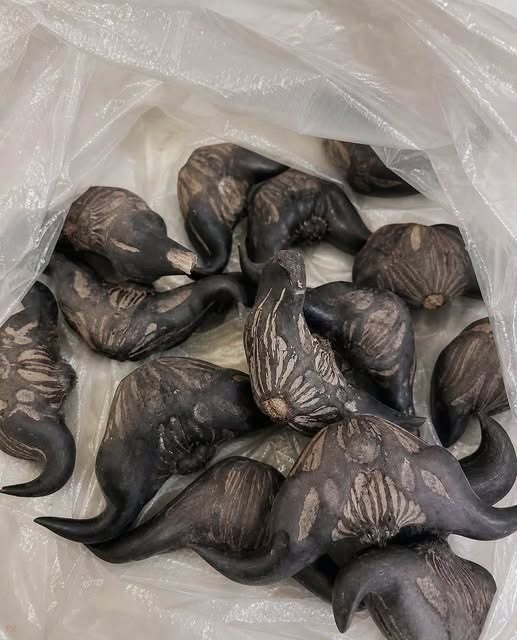
The unusual black objects in the photograph are most likely water caltrop fruits, often called horned water chestnuts, bat nuts, buffalo nuts, or devil pods. Their dark shells and dramatic curved horns can make them look more like carved ornaments than something produced by a plant.
Water caltrops belong to the genus Trapa, a group of aquatic plants that grow in slow-moving or still freshwater. Certain species and varieties have a long culinary history in parts of Asia, where their starchy kernels may be cooked and eaten. However, identifying the exact species from a photograph alone is difficult.
That distinction is important. A person should never eat an unidentified wild fruit simply because it resembles an edible water caltrop. The pods can also be extremely sharp, and some Trapa species are regulated as invasive plants in North America and elsewhere.
This guide explains what a water caltrop is, how to recognize it, whether it can be eaten, how it differs from the familiar water chestnut, and what precautions to take before handling or preparing it.
Identification note: The objects in the supplied image strongly resemble horned fruits from a Trapa plant, but a photograph cannot confirm their species, origin, condition, or suitability for eating.
What Is a Water Caltrop?
A water caltrop is the fruit of an annual aquatic plant belonging to the genus Trapa. The plant grows with its roots anchored in the sediment while a rosette of leaves floats on the water’s surface.
After flowering, the plant produces hard fruits containing a starchy seed. Depending on the species or cultivated variety, a fruit may have two or four prominent horns. Once mature and dry, the shell can become dark brown or nearly black.
Common names include:
- Water caltrop
- Horned water chestnut
- Water nut
- Buffalo nut
- Bat nut
- Devil pod
- Singhara
- Ling nut
Common names vary considerably between countries and communities. Therefore, a local name should not be treated as proof of the plant’s botanical identity.
The image shows numerous dark, woody fruits with two substantial curved projections. That appearance is consistent with the two-horned forms frequently associated with Trapa bicornis or closely related cultivated water caltrops.
Nevertheless, members of the genus can be difficult to distinguish using fruit shape alone. Their appearance also changes with maturity, cultivation, drying, and storage.
Seven Fascinating Facts About Water Caltrops
1. The Fruit Naturally Develops Horns
The horns are not decorative additions. They are part of the water caltrop’s woody fruit.
Their number, length, thickness, and curvature depend on the species or variety. Some fruits have two large horns, while others possess four sharp spines. The two-horned examples can resemble a bull’s head or a bat with outstretched wings.
The pods in the photograph have rounded central bodies and long, downward-curving horns. This is why they are likely water caltrops rather than ordinary nuts, roots, or manufactured objects.
2. It Grows as a Floating Aquatic Plant
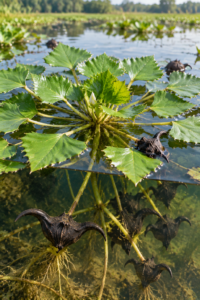
Although its fruit resembles a terrestrial nut, the water caltrop comes from a freshwater plant. It grows in lakes, ponds, canals, and slow-moving waterways.
Its submerged stem is rooted in the sediment, but the upper leaves form a floating rosette. This arrangement allows the leaves to receive sunlight while the plant remains anchored below the surface.
The plant can spread across the water and create dense floating mats. According to the US National Invasive Species Information Center, water chestnut or water caltrop can displace native vegetation and interfere with swimming, boating, fishing, and other recreational activities.