
7. A Photograph Cannot Confirm Food Safety
Visual identification is only the beginning. A photograph cannot reveal whether a fruit:
- Belongs to an edible cultivated variety
- Was collected from contaminated water
- Has been stored correctly
- Contains mould or internal decay
- Was treated with chemicals
- Is legally possessed in the area
- Requires a particular preparation method
Even if the object is confidently identified as a water caltrop, that does not automatically make it safe to eat.
If it came from an unlabelled bag, an unknown seller, or a wild waterway, the safest choice is not to taste it. Ask a local agricultural extension office, botanist, qualified plant specialist, or relevant environmental authority for an in-person identification.
What Does the Supplied Photograph Show?
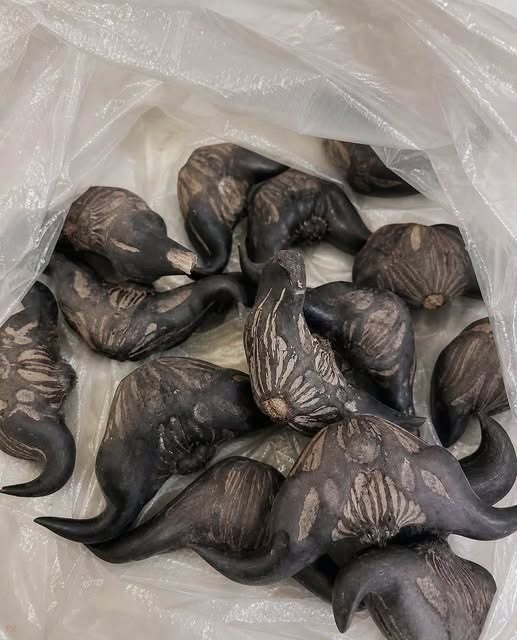
The photograph appears to show a plastic bag containing mature, dark water caltrop fruits. Most have two heavy curved horns and a central shell with pale natural markings.
Their consistent shape suggests they may have been deliberately harvested or sold together. However, the photograph does not show packaging, a label, their geographic origin, or how they were stored.
Based on visible characteristics, the objects are unlikely to be:
- Chinese water-chestnut corms
- Ordinary tree chestnuts
- Cashews
- Seed pods from a typical garden plant
- Animal horns or teeth
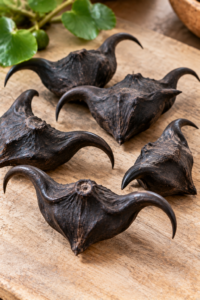
The most reasonable provisional identification is two-horned water caltrop, possibly a form associated with Trapa bicornis. It should remain a provisional identification unless an expert examines the physical specimens.
Is Water Caltrop Edible?
Certain cultivated water caltrops are edible after appropriate preparation. Their kernels have been consumed traditionally for generations.
That statement must be interpreted carefully. It does not mean every Trapa fruit should be eaten, nor does it establish that the particular objects in the photograph are food-grade.
Only consider preparing them when all of the following are true:
- They were sold for human consumption by a reputable food supplier.
- The package clearly identifies the product.
- The fruits are within their stated storage period.
- There are no signs of mould, fermentation, insect damage, or unusual odour.
- You have preparation directions appropriate to that particular product.
- The product is legal to possess where you live.
Do not use a social-media photograph or visual similarity as the sole basis for eating a wild plant.
Should Water Caltrops Be Eaten Raw?
Avoid eating an unidentified or unprocessed water caltrop raw. Preparation requirements can differ between products and traditions, and water collected from an uncontrolled environment may carry biological or chemical contamination.
Commercial products should be prepared according to their package directions. If no label or reliable instructions are available, do not improvise.
Cooking cannot correct every possible problem. It does not make an incorrectly identified plant safe, and it may not eliminate chemical pollutants absorbed from contaminated water.
For broader everyday advice about avoiding cross-contamination and handling unfamiliar ingredients, refer to this kitchen food-safety guide.
How Commercial Edible Water Caltrops Are Commonly Prepared
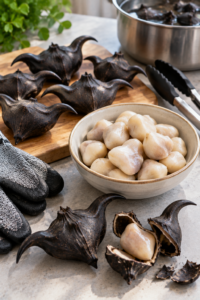
This section is general background rather than preparation instructions for unidentified wild pods.
Food-grade water caltrops are commonly cooked in water or steamed until the internal seed becomes tender. The hard shell is then opened carefully, and the kernel is removed.
Exact cooking time varies with the fruit’s size, maturity, freshness, and whether it is sold fresh or dried. Follow the supplier’s directions rather than relying on a universal cooking time.
A safe general workflow for a clearly labelled commercial product is:
- Read the full package and confirm the product is intended for eating.
- Discard any fruit showing mould, leakage, decay, or an abnormal smell.
- Rinse the exterior without allowing the sharp horns to puncture your skin.
- Cook it exactly as directed by the producer or retailer.
- Allow it to cool enough to handle safely.
- Stabilize the fruit on a cutting board before opening the shell.
- Remove the kernel without crushing the pod in your hand.
- Refrigerate cooked leftovers promptly in a covered container.
Because products differ, these steps do not replace the manufacturer’s directions.
How to Handle the Sharp Pods Safely
Water caltrops deserve the same attention given to sharp tools. Their horns may puncture skin even if they do not look especially pointed in a photograph.
Use the following precautions:
- Wear thick gloves when sorting large quantities.
- Use tongs to move particularly sharp fruits.
- Work on a stable cutting board.
- Keep the horns pointed away from your body.
- Do not let children open the shells.
- Inspect the floor after handling them.
- Place unwanted pods in a sturdy, puncture-resistant container.
- Follow local invasive-species disposal advice.
If a horn punctures the skin, wash the injury promptly and seek medical guidance when the wound is deep, dirty, painful, swollen, or showing signs of infection.