Another Version That Gives the Same Answer
You could rewrite the original puzzle as:
I had six eggs. I cracked two eggs, cooked those same two eggs, and ate them. How many eggs are left?
Nobody would probably calculate zero.
The trick disappears because the wording makes the sequence explicit.
The original puzzle simply leaves that connection for you to discover.
If you enjoy tricky logic puzzles like this one, you can also try our brain test puzzles and see how quickly you can spot hidden mistakes.
Can You Create Your Own Riddle?
Absolutely.
You can use the same structure.
Start with a number of objects.
Then describe several actions involving a smaller group.
For example:
I have 10 apples.
I washed 3.
I sliced 3.
I ate 3.
How many are left?
Answer:
7, assuming the same three apples were washed, sliced, and eaten.
The secret is making the wording just ambiguous enough to encourage a quick incorrect calculation.
Why These Puzzles Work So Well on Pinterest and Facebook
Short logic puzzles are naturally shareable.
They have:
- A simple question
- A visual hook
- A quick challenge
- A surprising answer
- An easy comment opportunity
Readers can answer in seconds.
They can also challenge friends by sharing the image.
That’s why “Can you solve this?” posts frequently attract attention.
A Good Way to Present the Answer
If you’re publishing this puzzle online, don’t reveal the answer immediately.
Let readers think first.
A good structure is:
Challenge → pause → explanation → answer
For example:
“How many eggs are left? Think carefully before scrolling.”
Then later:
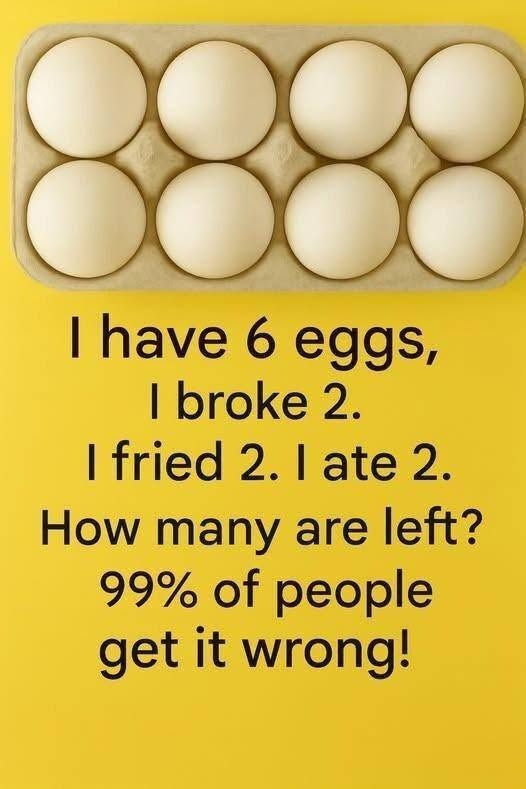
Answer: 4. The same two eggs were broken, fried, and eaten.
This keeps the puzzle engaging without making the reader search through a long explanation to understand the trick.
Frequently Asked Questions
What is the answer to the 6 egg riddle?
The answer is 4 eggs.
Why are 4 eggs left?
The same two eggs were broken, fried, and eaten. Only two of the original six eggs were actually used.
Why isn’t the answer 0?
Because the puzzle doesn’t say that three different groups of two eggs were used. The same two eggs can be broken, fried, and eaten.
Were the broken eggs the same eggs that were fried?
Yes. That is the intended interpretation.
Were the fried eggs the same eggs that were eaten?
Yes. The sequence is break, fry, and eat the same two eggs.
Is the answer always 4?
For the wording shown in this puzzle, 4 is the intended answer. If the wording specified three different groups of two eggs, the answer could be different.
Is this a math riddle?
It uses numbers, but the main challenge is interpreting the wording rather than performing difficult mathematics.
Why do people answer 0?
They often subtract each occurrence of “2” as though it refers to a separate pair of eggs.
What is the trick?
The trick is that the same two eggs can be involved in all three actions.
Does “broke” mean the eggs disappeared?
No. Breaking an egg changes its state; it doesn’t remove it from the total number of eggs until the egg is ultimately consumed.
Can the same eggs be broken and fried?
Yes. That’s the normal sequence when preparing eggs.
Can the same eggs be fried and eaten?
Yes. The cooked eggs are the ones that can then be eaten.
What would make the answer 0?
The riddle would need to specify that six different eggs were used across three separate pairs, such as two broken, two other eggs fried, and two additional eggs eaten.
Is this a good puzzle for children?
Yes. It is a simple way to encourage careful reading and logical reasoning.
Does solving it quickly prove intelligence?
No. It is an entertainment riddle, not a standardized intelligence assessment.
Why does the wording matter so much?
Because the numbers alone don’t tell you whether each “2” represents a different group. The verbs and sequence provide the context.
A Small Food-Safety Note
Although this is a riddle rather than a cooking tutorial, if you’re actually preparing the eggs shown in the puzzle, handle and cook eggs safely. For official guidance on egg handling and cooking, see the USDA Food Safety and Inspection Service guidance on eggs.
The riddle itself is simply about the wording and does not provide a cooking method or food-safety instructions.

Final Thoughts
The 6 egg riddle is a great example of how a simple sentence can completely change the way you approach a problem.
At first, the numbers seem to tell you:
6 − 2 − 2 − 2 = 0
But that’s based on an assumption.
The puzzle never says that three separate pairs of eggs were involved.
Instead, the most natural sequence is:
Break 2 eggs → fry those same 2 eggs → eat those same 2 eggs.
Only two eggs are removed from the original six.
So:
6 − 2 = 4
The final answer is 4 eggs.
The next time you see a riddle containing several numbers, don’t rush straight to the calculator.
Read the words.
Look at the sequence.
Ask whether the same objects are being described more than once.
Sometimes the hardest part of a simple puzzle isn’t the math at all.
It’s noticing the assumption you made before doing the math.