The Important Word Is “I”
Look closely at the wording:
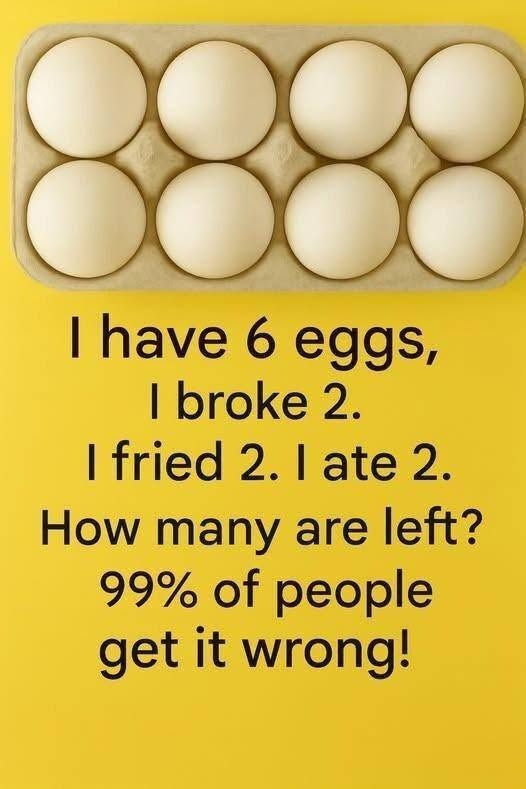
“I broke 2.
I fried 2.
I ate 2.”
The subject remains the same.
The most natural sequence is:
broke → fried → ate
That’s a process.
You break an egg before frying it.
Then you eat the cooked egg.
The three actions describe different stages of preparing the same two eggs.
That’s why the wording is clever.
It’s Not Really a Math Problem
The 6 egg riddle looks like arithmetic, but it is primarily a reading-comprehension puzzle.
You don’t need advanced mathematics.
You don’t even need to calculate much.
The real challenge is recognizing that three actions can apply to the same objects.
This is a common technique in riddles.
The numbers are there to encourage you to calculate quickly.
The wording is there to make you slow down.
The Difference Between Counting Actions and Counting Objects
This is the key lesson.
You should not automatically count every action as a new group of objects.
For example:
I bought 6 apples.
I washed 2.
I cut 2.
I ate 2.
Would you assume that six apples were used?
Not necessarily.
The same two apples could have been washed, cut, and eaten.
The same principle applies to the eggs.
The riddle describes three actions, but those actions can involve the same two eggs.
A Simple Visual Explanation
Imagine six eggs:
🥚 🥚 🥚 🥚 🥚 🥚
You take two:
🥚 🥚
You break them:
🍳 🍳
You fry them:
🍳 🍳
You eat them.
The remaining eggs are:
🥚 🥚 🥚 🥚
So the final answer is:
4 eggs
Why the Wording Matters
Riddles often depend on precise wording.
If the puzzle wanted the answer to be zero, it would need to make it clear that three different pairs were involved.
For example:
“I have 6 eggs. I broke 2 eggs, fried another 2 eggs, and ate the final 2 eggs. How many are left?”
That version would lead to:
0 eggs.
But the original wording doesn’t say “another 2” or “the final 2.”
That’s why the intended answer is 4.
What If the Fried Eggs Were the Same Two?
That’s exactly the intended interpretation.
Think about how cooking normally works.
You don’t usually break two eggs and then throw them away before frying two completely different eggs.
You crack the eggs.
Then you fry them.
Then you eat them.
The actions happen sequentially.
So the sentence naturally describes a single pair moving through three stages.
What If Someone Says the Answer Is 0?
This is where the puzzle becomes interesting.
Someone could argue that the wording is ambiguous.
If the three groups were different, the answer could indeed be zero.
But if the same eggs were broken, fried, and eaten, the answer is four.
Most versions of this riddle intend the second interpretation.
The point isn’t to prove that zero is mathematically impossible.
The point is to recognize the wordplay and sequencing that produces the intended answer.
Why These Riddles Go Viral
Short riddles like this work extremely well on social media because they require very little time to understand.
You can read the question in a few seconds.
You immediately see the numbers.
You start calculating.
Then you discover that your first answer may have been wrong.
That creates a satisfying “wait a minute” moment.
It’s exactly the kind of puzzle that encourages people to comment with their answers.
The First Answer You Think Of May Be Wrong
That’s another reason the 6 egg riddle works so well.
Your brain wants to simplify the problem.
It sees:
6, 2, 2, 2
and starts subtracting.
But riddles often punish automatic calculations.
Before solving a word problem, ask:
What exactly does each number represent?
Are they different objects?
Are they different stages?
Are they repeated references to the same objects?
That small pause can completely change your answer.
A Useful Riddle-Solving Strategy
When you encounter a puzzle like this, don’t calculate immediately.
Use these five steps.
1. Read the Entire Riddle
Don’t stop after the first sentence.
2. Identify the Objects
Here, the object is eggs.
3. Identify the Actions
The actions are:
- Breaking
- Frying
- Eating
4. Ask Whether the Actions Can Apply to the Same Objects
In this case, yes.
5. Calculate Only After Understanding the Sequence
Six eggs minus two used eggs equals four.
This strategy works for many similar puzzles.
The Cooking Sequence Gives You the Clue
There’s another reason the answer is easier once you think about real-world cooking.
Eggs are normally cracked before they are fried.
And fried eggs are eaten after they are cooked.
So the sequence itself makes sense:
Break → Fry → Eat
That sequence strongly suggests that the same eggs are being described throughout.
If the puzzle had said:
“I broke two eggs, then found two more eggs and fried them, then found two more and ate them,”
the answer would obviously be different.
But it doesn’t.
Could the Answer Be 2?
Some people may also argue that two eggs remain because they think the wording implies the fried eggs were separate from the broken eggs in some unusual way.
But that interpretation doesn’t fit the normal sequence of preparing eggs.
If you break two eggs, then fry those two eggs, then eat those two eggs, the number remaining from the original six is four.
There is no reason to remove another two.
Could the Answer Be 6?
No, not if the eggs were actually eaten.
Eating two eggs means two of the original eggs are no longer left.
The only question is whether the broken, fried, and eaten eggs are the same two.
Once that is understood, four is the natural answer.