The Riddle Tests Careful Reading
This is perhaps the most important lesson.
The puzzle isn’t testing whether you can subtract.
Almost anyone can calculate:
6 − 2 − 2 − 2 = 0
The challenge is deciding whether that equation accurately represents the situation.
That’s a much more interesting skill.
In everyday life, we constantly interpret information before acting on it.
A sentence can contain several numbers without each number representing a different quantity.
Similar Examples
The same trick can be used with many other objects.
Consider:
I have 10 cookies.
I opened 3.
I warmed 3.
I ate 3.
How many are left?
If the same three cookies were opened, warmed, and eaten, the answer would be:
7.
Another example:
I have 8 potatoes.
I peeled 2.
I boiled 2.
I served 2.
How many potatoes remain?
Again, if the same two potatoes went through all three steps, six remain.
The important thing is to recognize whether the verbs describe different objects or different stages involving the same objects.
Why Numbers Can Be Misleading
Numbers look precise.
That’s why our brains trust them.
If a riddle contains several numbers, we instinctively assume they represent separate quantities.
But numbers don’t explain themselves.
The surrounding words determine what they mean.
In the 6 egg riddle, each “2” refers to the same pair of eggs at different stages.
The number itself never changes.
The state of the eggs changes.
Broken Does Not Mean Gone
This is another subtle point.
When an egg is broken, it hasn’t disappeared.
It’s still there.
It’s simply no longer intact.
Then it can be fried.
Then it can be eaten.
Only after eating does it stop being part of the remaining six eggs.
So you cannot subtract the same two eggs every time their state changes.
That’s the fundamental logical mistake behind the zero answer.
Fried Does Not Mean New Eggs
The second common mistake is treating “fried 2” as if the word “fried” introduces another pair.
It doesn’t.
The sentence:
“I fried 2”
doesn’t tell us where those two eggs came from.
But because it follows:
“I broke 2”
the natural reading is that the same eggs were fried.
Eaten Is the Final Stage
The final action is what matters most for determining how many eggs remain.
Two eggs were ultimately eaten.
Therefore, two eggs are gone.
Six originally existed.
So:
6 − 2 = 4
That’s the simplest way to solve the riddle.
A Timeline Makes It Obvious
Here’s the entire sequence:
Starting Point
6 eggs
↓
Two Eggs Broken
6 eggs still exist, but 2 are no longer intact
↓
Same Two Eggs Fried
Still the same 2 eggs
↓
Same Two Eggs Eaten
2 eggs are now gone
↓
Final Result
4 eggs remain
Once you visualize the timeline, the trick becomes much harder to miss.
Why the Picture Helps
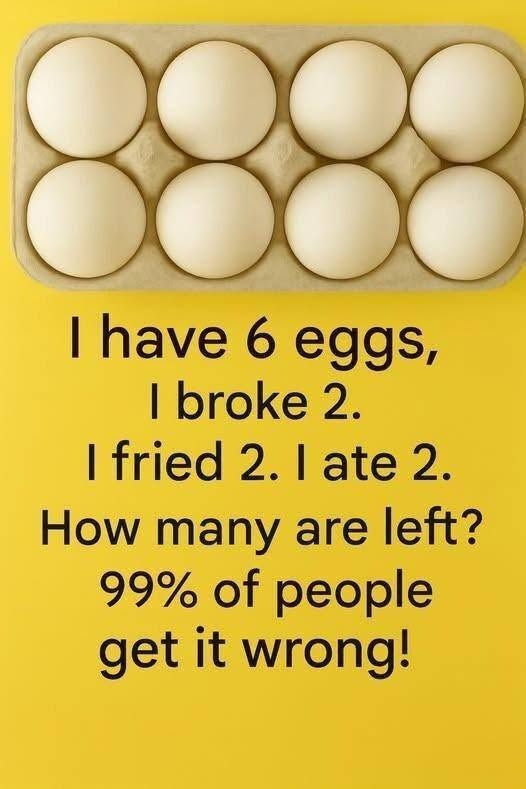
The image shows a tray containing six eggs.
That visual makes the puzzle look even more like a simple subtraction problem.
You see six eggs and then read three actions involving two eggs.
Your brain may immediately start removing eggs from the tray mentally.
But the image doesn’t show three different groups of eggs being used.
The picture is mainly there to make the riddle visually appealing and easy to understand.
Don’t Let the “99%” Claim Influence Your Answer
The image says that 99% of people get the riddle wrong.
Claims like this are often used in social-media puzzle posts to create curiosity and encourage engagement.
Unless there is a reliable study behind such a statistic, it should not be treated as an established fact.
The puzzle remains fun without needing a precise percentage.
What matters is whether you can explain your answer logically.
Is This an Intelligence Test?
No.
The 6 egg riddle is a recreational logic puzzle.
Getting the answer quickly doesn’t establish that someone has a higher IQ.
Likewise, getting it wrong doesn’t mean someone lacks intelligence.
People approach language puzzles differently.
Some people immediately look for wordplay.
Others instinctively calculate the numbers.
Both approaches are normal.
Why Adults Often Get Simple Riddles Wrong
Being good at mathematics doesn’t necessarily make someone good at riddles.
Riddles often require you to question the assumptions hidden inside the wording.
An experienced calculator may immediately perform the subtraction.
A person who enjoys word puzzles may first ask:
“Are these the same eggs?”
That second question is what unlocks the puzzle.
The Most Important Question to Ask
Whenever a riddle gives you multiple quantities, ask:
Are these quantities independent?
For this puzzle:
- 2 broken
- 2 fried
- 2 eaten
They don’t have to be independent.
They can all refer to the same two eggs.
Once you recognize that, the answer is straightforward.
How to Explain the Answer to Someone Else
If a friend gives the wrong answer, don’t simply tell them “4.”
Explain the sequence.
You can say:
“The two eggs you broke are the same two eggs you fried, and those are the same two eggs you ate. So only two eggs were actually used, leaving four.”
That’s enough.
There’s no complicated formula.
The Answer in One Line
If you want the shortest possible explanation:
You broke, fried, and ate the same 2 eggs, so 6 − 2 = 4 eggs remain.
That’s the entire trick.
Try the Riddle Without Looking at the Answer
Before moving on, cover the next section and answer it yourself:
I have 6 eggs.
I broke 2.
I fried 2.
I ate 2.
How many are left?
Think carefully.
Don’t subtract automatically.
Ask yourself what happened to the same two eggs.
If you answered 4, you’ve got it.
The Answer Revealed
4 eggs are left.
The two eggs that were broken are the same two eggs that were fried.
Those same two eggs were then eaten.
So the sequence is:
2 broken → 2 fried → 2 eaten
not:
2 eggs + 2 different eggs + 2 different eggs.
Therefore:
6 − 2 = 4
What This Riddle Teaches
Although it’s a simple puzzle, it demonstrates an important reasoning principle:
Don’t treat repeated numbers as separate quantities until the wording tells you they are separate.
This idea applies far beyond riddles.
It can help when reading:
- Instructions
- Recipes
- Word problems
- Reports
- Statistics
- Contracts
- Lists
- Everyday conversations
Context matters.
The Same Principle in Recipes
Interestingly, this exact type of confusion can happen in cooking instructions.
Suppose a recipe says:
“Add two eggs. Beat two eggs. Bake two eggs.”
You wouldn’t assume six eggs were used.
The same eggs are being described through different preparation steps.
The 6 egg riddle works because it uses a familiar cooking sequence and turns it into a logic puzzle.
Why the Riddle Feels Like a Trick
There’s no hidden mathematical formula.
There’s no complicated word.
There’s no unusual definition.
The trick is simply that the reader makes an assumption that the wording never actually states.
You assume:
different action = different eggs
But that’s not necessarily true.
Once that assumption disappears, the puzzle becomes easy.
A Quick Test for Similar Riddles
When you encounter another puzzle like this, ask yourself three questions:
Question 1
What objects are we counting?
Question 2
What happens to those objects?
Question 3
Could several actions describe the same objects?
If the answer to the third question is yes, don’t subtract each action separately.
That simple habit can help you solve many trick questions.
Why the Correct Answer Is More Logical
The answer of four isn’t just a clever technicality.
It’s also consistent with the natural order of cooking.
You:
- Break the eggs.
- Fry the eggs.
- Eat the eggs.
The same eggs move through each stage.
That’s exactly how cooking normally works.
What If the Riddle Were Written Differently?
Compare these two versions.
Original
I have 6 eggs. I broke 2. I fried 2. I ate 2.
Answer: 4
Different Version
I have 6 eggs. I broke 2 eggs, then fried 2 other eggs, and finally ate the remaining 2 eggs.
Answer: 0
The addition of the words “other” and “remaining” completely changes the logic.
That’s how important wording is.