
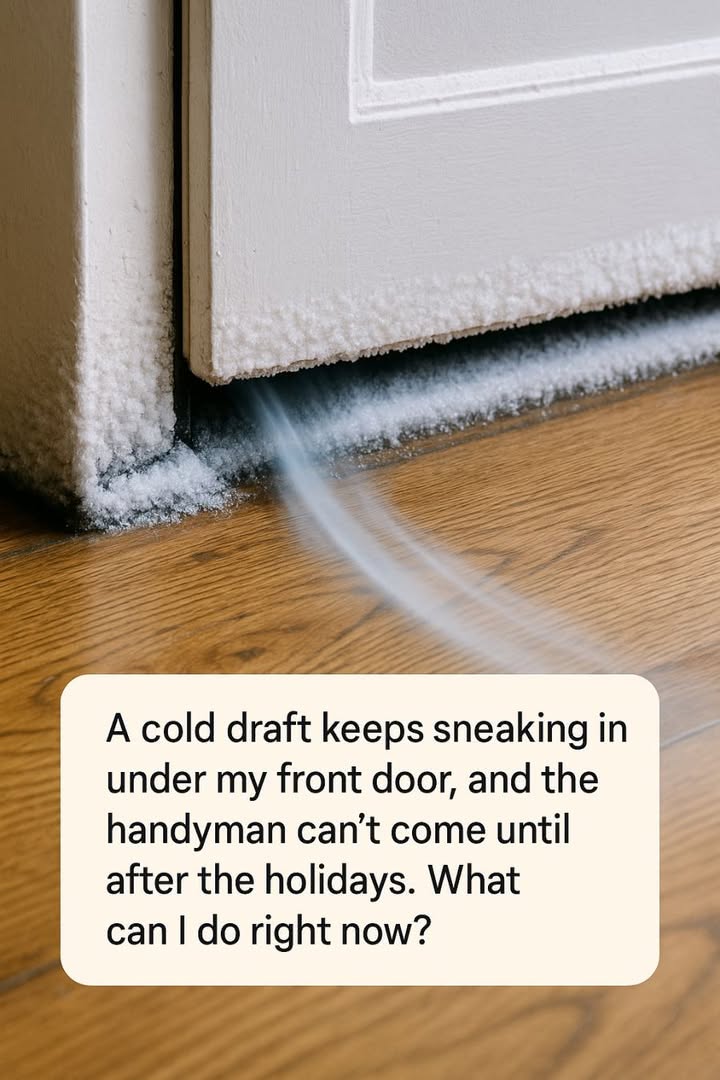
Make a Towel Draft Blocker Work Better
A loose towel can move every time someone opens the door.
If you want a more effective temporary solution, make the towel heavier.
You can roll a towel around:
- A long scarf
- Another towel
- A piece of clothing
- A soft blanket
- A foam tube
Then place the finished roll tightly against the bottom of the door.
If necessary, use removable tape to keep the fabric from sliding, but don’t tape over a surface if it could damage paint or finish.
The goal is simply to create a flexible barrier that follows the floor and blocks the opening.
Try a Door Snake
A “door snake” is essentially a long fabric tube filled with material that gives it enough weight to stay against the door.
It’s particularly useful when you have a cold draft under front door but don’t want to make a permanent modification.
You can purchase one from a home-improvement store, or make a simple version using a long fabric sleeve filled with something suitable.
The important part is that the door snake should be:
- Long enough to cover the entire doorway
- Heavy enough to stay in place
- Flexible enough to sit against an uneven floor
- Easy to move when you need to open the door
Install a Temporary Door Sweep
If you want something more effective than a towel, consider a temporary door sweep.
A door sweep attaches along the bottom of the door and helps close the space between the door and threshold.
For a cold draft under front door, this is often a more appropriate long-term solution than simply placing a towel on the floor.
Some door sweeps are adhesive-backed and can be installed without drilling.
Before installing one, clean and dry the surface so the adhesive has the best chance of sticking.
Measure the width of the door first so you choose the correct size.
The Department of Energy’s weatherization guidance specifically identifies weatherstripping and door sweeps as measures used to reduce air infiltration while allowing the door to operate properly. The Department of Energy’s Energy.gov
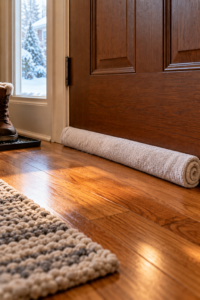
Check the Existing Door Sweep
You may already have a door sweep installed.
Look underneath the door from inside the house.
If you see a rubber, vinyl, brush, or flexible strip along the bottom, inspect it carefully.
Look for:
- Cracks
- Tears
- Missing sections
- Hardened rubber
- Bent material
- Gaps at the corners
- A sweep that no longer touches the threshold
A damaged sweep can create a surprisingly noticeable cold draft under front door.
If the sweep is worn, replacing it may solve the problem without replacing the entire door.
Check the Door Threshold
The threshold is the horizontal surface beneath the door.
If the threshold is too low, damaged, or poorly adjusted, a gap can develop between it and the bottom of the door.
Look at the area from inside.
When the door is closed, there shouldn’t be a large visible opening underneath.
If there is a significant gap, don’t immediately start adjusting screws or removing parts unless you’re comfortable doing so.
A handyman can inspect the threshold and determine whether it needs adjustment or replacement.
For now, a properly positioned draft stopper can provide a temporary barrier.
What If the Air Is Coming From the Sides?
Sometimes the problem appears to be underneath the door when the actual leak is around the frame.
Run your hand along both sides of the closed door.
If you feel cold air there, the bottom may not be the only issue.
You may need weatherstripping around the sides and top.
Weatherstripping is designed to close the small contact gap between the moving door and stationary frame.
If the existing strip is cracked, compressed, or missing, replacing it can significantly improve the seal.
ENERGY STAR identifies weatherstripping around doors as one of the accessible DIY approaches for reducing drafts. ENERGY STAR
Check the Top of the Door Too
Don’t automatically assume the bottom is the only problem.
Cold air can enter through:
- The top corners
- The hinge side
- The latch side
- The upper door frame
Close the door and inspect all four sides.
If you discover air movement at several points, replacing only the bottom sweep may not completely solve the problem.
A full weatherstripping replacement may be more appropriate.
Use Removable Foam Weatherstripping
Foam weatherstripping can be a convenient option for a door that has small gaps around its edges.
It is generally sold in rolls and can be cut to the required length.
For a temporary repair:
- Clean the door frame.
- Let the surface dry completely.
- Measure the section that needs sealing.
- Cut the weatherstripping.
- Apply it carefully.
- Close the door.
- Check whether the seal is too tight.
The door should close and latch normally.
Don’t add so much material that you have to force the door shut.
Properly installed weatherstripping should reduce unwanted airflow without preventing normal door operation. The Department of Energy’s Energy.gov
Don’t Ignore a Door That No Longer Closes Properly
A persistent cold draft under front door can sometimes be a symptom of a larger problem.
If the door is:
- Sagging
- Difficult to close
- Scraping the floor
- Not latching
- Visibly warped
- Leaving unusually large gaps
then simply adding weatherstripping may not be enough.
The door or frame may need adjustment.
In that situation, a handyman or qualified professional can determine whether the hinges, frame, threshold, or door itself is responsible.
A Simple Paper Test
Here’s another useful way to check whether the door seal is working.
Place a sheet of paper between the closed door and the frame.
Close and latch the door.
Then gently try to pull the paper out.
If it slides out extremely easily in a particular area, the seal may be weak there.
Repeat the test around different parts of the door.
This can help identify areas where weatherstripping isn’t making enough contact.
For more detailed air-leak testing and sealing information, see ENERGY STAR’s guide to locating air leaks.
Don’t Use Permanent Caulk on the Moving Door
Caulk can be excellent for sealing stationary gaps around a door frame.
But you shouldn’t simply apply caulk around the moving edge of the door.
The door needs to open and close.
Permanent sealant in the wrong location can interfere with operation and make future repairs more difficult.
Caulking is more appropriate for stationary cracks and gaps around trim or the fixed frame when the correct type of product and application are used.
The Department of Energy notes that caulking and weatherstripping are both useful air-sealing techniques, but they serve different purposes. The Department of Energy’s Energy.gov
What About Spray Foam?
Be careful with expanding spray foam around doors.
Spray foam can be useful for sealing certain gaps around a door’s rough opening, but it isn’t a good substitute for a door sweep or weatherstripping on the moving portion of the door.
If foam is used incorrectly, expansion can interfere with the frame or door operation.
For gaps around door and window rough openings, DOE building-science guidance recommends products such as caulk, low-expansion foam designed for doors and windows, or backer rod, depending on the situation. Building Science Education
If you’re not sure where the gap is located, wait for the handyman rather than filling a large hidden cavity with expanding foam.
A Rolled Blanket Can Help in an Emergency
If you have no supplies at all, use what you already have.
A thick blanket rolled tightly along the bottom of the door can provide an immediate barrier.
This is particularly useful overnight.
For better coverage, fold the blanket into a long strip and push it firmly against the bottom edge.
If the floor is uneven, a soft blanket may actually conform better than a rigid object.
Just remember to move it before opening the door.