
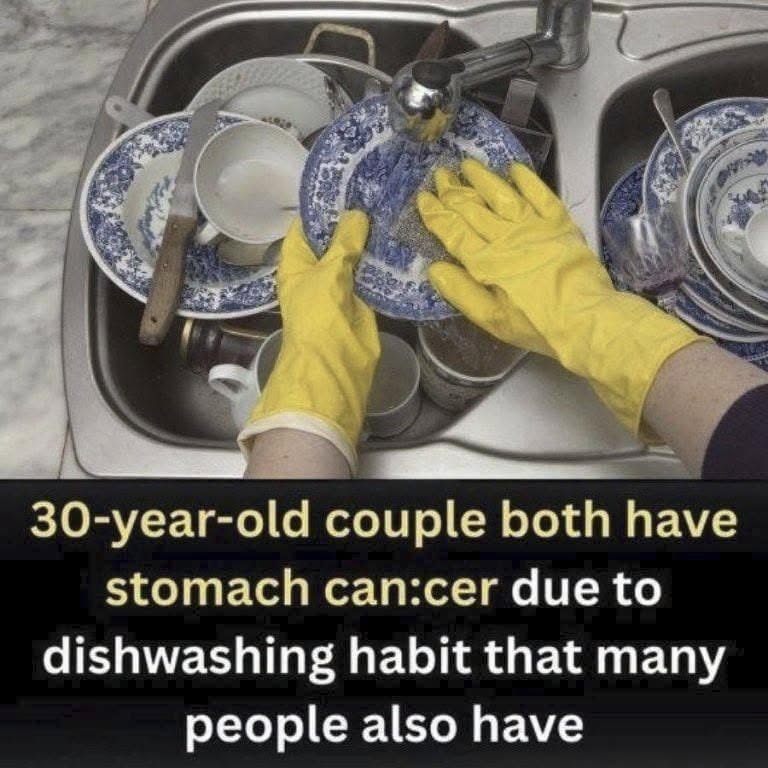
Dishwashing Habits and Stomach Cancer: The Truth Behind the Viral Claim

A viral image claiming that a young couple developed stomach cancer because of the way they wash dishes has understandably attracted attention. The picture shows someone washing plates while wearing rubber gloves, alongside the alarming statement that a common dishwashing habit can cause stomach cancer.
But there is an important problem with that message: there is no good evidence that an ordinary dishwashing habit causes stomach cancer.
Stomach cancer has several well-established risk factors, including chronic Helicobacter pylori infection, smoking, diets high in salted or poorly preserved foods, certain medical conditions, family history, and some genetic factors. Dishwashing itself is not listed as an established cause of stomach cancer by the National Cancer Institute. Institut National du Cancer
That does not mean household chemical exposure should be ignored. Cleaning products should always be used correctly, stored safely, and kept away from food. But it is very different from saying that washing dishes causes cancer.
So what should you actually know about dishwashing habits and stomach cancer?
Can Washing Dishes Cause Stomach Cancer?
There is currently no established evidence that routine dishwashing causes stomach cancer.
A person can wash dishes every day for decades without that habit meaning they will develop stomach cancer.
According to the National Cancer Institute, recognized stomach cancer risk factors include chronic H. pylori infection, smoking, certain dietary patterns, obesity, gastroesophageal reflux disease, chronic atrophic gastritis, pernicious anemia, some genetic conditions, family history, and certain occupational or environmental exposures. Institut National du Cancer
Dishwashing is not identified as a standard stomach cancer risk factor.
This distinction matters because viral health posts often take a real concern—chemical exposure, food contamination, or poor hygiene—and turn it into a much stronger medical claim that the available evidence doesn’t support.
Why Is This Claim Spreading Online?
Health-related posts often use a dramatic story to make people stop scrolling.
A headline might say:
“This common dishwashing habit causes stomach cancer.”
The problem is that a headline doesn’t tell you whether the claim came from a scientific study, a doctor’s observation, a personal story, or simply a social-media post.
A photograph also doesn’t prove a cause-and-effect relationship.
Even if two people in the same household developed the same cancer, that would not automatically demonstrate that a household habit caused it.
Researchers need carefully designed studies to determine whether an exposure is actually associated with increased cancer risk.
That’s particularly important with cancer because many cancers develop over years or decades and can involve several interacting factors.
What Actually Causes Stomach Cancer?
Stomach cancer develops when cells in the stomach lining acquire changes that allow them to grow and divide abnormally.
There isn’t one universal cause.
The National Cancer Institute explains that stomach cancer has multiple risk factors, and having one or more risk factors does not mean a person will definitely develop the disease. Institut National du Cancer
Some of the most important factors include the following.

1. Helicobacter pylori Infection
One of the most important established risk factors is infection with Helicobacter pylori, commonly called H. pylori.
This bacterium can live in the stomach and cause long-term inflammation.
In some people, chronic infection can contribute to changes in the stomach lining that eventually increase the risk of gastric cancer.
The National Cancer Institute identifies chronic H. pylori infection as a major risk factor for stomach cancer and notes that treating the infection can reduce the risk. Institut National du Cancer
Importantly, most people who have H. pylori do not develop stomach cancer.
Risk is influenced by additional factors, including the strain of bacteria, genetics, smoking, and diet.
2. Smoking
Smoking is another established risk factor.
The National Cancer Institute states that people who smoke have a higher risk of stomach cancer than people who do not smoke. Institut National du Cancer
The relationship is important because smoking affects many parts of the body, not only the lungs.
The good news is that stopping smoking can reduce stomach cancer risk over time.
The longer someone remains smoke-free, the more health benefits accumulate.
3. A Diet High in Salted or Poorly Preserved Foods
Diet can also influence stomach cancer risk.
The National Cancer Institute identifies diets high in salted, smoked, or poorly preserved foods as risk factors associated with stomach cancer. Institut National du Cancer
The World Health Organization also identifies excessive sodium intake as a risk factor for gastric cancer, in addition to its well-established effects on blood pressure and cardiovascular health. Organisation Mondiale de la Santé
This doesn’t mean that eating a salty meal will cause cancer.
The concern is more about long-term dietary patterns.
A diet based heavily on highly salted and preserved foods may be less favorable than one containing a variety of fresh foods.
4. Family History
Genetics can also matter.
Having a close family member who had stomach cancer can increase a person’s risk.
The National Cancer Institute identifies a first-degree relative with stomach cancer as a risk factor. Certain inherited cancer syndromes can also substantially increase risk. Institut National du Cancer
If several close relatives have had stomach cancer, discussing your family history with a healthcare professional may be worthwhile.
This is particularly important when cancers occurred at unusually young ages or when several family members were affected.