
Joggling Board: 7 Fascinating Facts About It
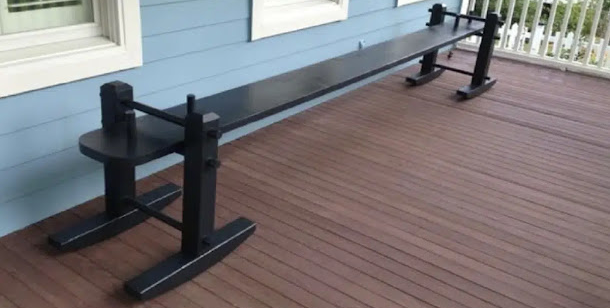
At first glance, the long wooden object in the photograph might look like an unfinished bench, an old exercise device, or even part of a quilting frame. It is actually a Joggling Board, a distinctive form of flexible porch furniture closely associated with South Carolina and the American Lowcountry.
A Joggling Board combines some of the characteristics of a bench, rocking chair, and springboard. When someone sits on its long wooden plank, it bends slightly and creates a gentle bouncing—or “joggling”—motion.
Ball-Headed War Club: 7 Fascinating Facts
Once common on Southern porches, these unusual seats are now appreciated as functional furniture, decorative conversation pieces, and reminders of Lowcountry history.
What Is a Joggling Board?
A traditional Joggling Board consists of one long, narrow, flexible plank supported by two wooden stands.
The stands often have curved bases similar to the rockers on a rocking chair. These curved feet allow the board to move in several ways:
- The long plank flexes up and down.
- The stands rock gently from side to side.
- People sitting on it may gradually slide toward the center.
- The entire structure provides a soft, rhythmic motion.
The plank is normally wide enough to sit on, but it is considerably longer and narrower than a conventional garden bench.
According to the South Carolina Encyclopedia, some examples can extend as long as 16 feet. Fir and cypress are among the woods traditionally used, although construction materials vary.
How Does a Joggling Board Work?
The central plank is long and intentionally flexible. It rests securely between the two supporting stands but is not rigidly reinforced like an ordinary bench.
When a person sits near the middle, their weight causes the plank to bend slightly. Small body movements make it bounce gently.
The curved feet on the stands may also allow the structure to rock sideways. This creates a movement that is different from a traditional rocking chair.
A properly constructed Joggling Board should flex in a controlled way. It should not feel cracked, unstable, or close to breaking.
Why Is It So Long?
The unusual length serves both a practical and mechanical purpose.
A longer wooden plank can flex more easily than a short, thick seat. That flexibility produces the characteristic bouncing motion.
Its length also allows several people to sit together. Large boards may accommodate family members, friends, children, or couples.
The furniture was particularly well suited to the large covered porches found on many historic Southern homes. These porches provided enough protected space for a board that could be 10 feet or longer.
Seven Fascinating Joggling Board Facts
1. It Is Strongly Associated With South Carolina
The Joggling Board became a recognizable part of porch culture in Charleston, Georgetown, Pawleys Island, and other parts of the South Carolina Lowcountry.
Although its exact origin is surrounded by folklore, historical sources indicate that the furniture was common along the South Carolina coast by the late nineteenth century.
The South Carolina Encyclopedia’s Joggling Board history provides additional information about the tradition, construction, and stories associated with this unusual furniture.
2. Its Origin Story Involves a Woman With Rheumatism
One widely repeated story traces the first South Carolina Joggling Board to Acton Plantation in the early nineteenth century.
According to the story, a woman named Mrs. Benjamin Kinloch Huger suffered from severe rheumatism and had difficulty exercising. Relatives in Scotland supposedly sent the family a model of a flexible board that could provide gentle movement.
A local carpenter then built a full-size version from available timber. The design reportedly became popular on porches and in yards throughout the region.
This is best treated as a traditional origin story rather than a completely verified invention record. Even the South Carolina Encyclopedia notes that the precise origin has become mixed with local legend.
3. It Is Sometimes Called a Jostling Board
The names Joggling Board and jostling board are both used.
The word “joggle” can describe a light shaking, rocking, or repeated movement. That term accurately describes the board’s flexible bouncing action.
It may also be called:
- Joggling bench
- Jostling board
- Bouncing bench
- Charleston Joggling Board
- Lowcountry porch bench
However, “Joggling Board” is the most recognizable traditional name.
4. Many Were Painted Charleston Green
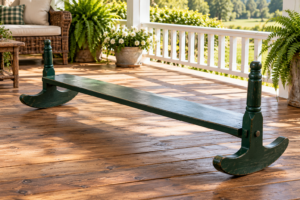
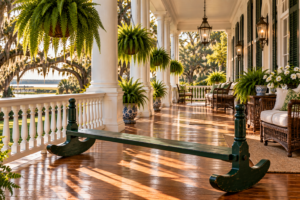
Traditional examples are often painted a very dark green commonly associated with Charleston architecture and outdoor furniture.
In photographs, Charleston green may appear almost black, especially in shadows. The board in the uploaded image may be finished in black or an extremely dark green.
Modern versions are available in many colors, but dark green remains closely connected with the classic Lowcountry appearance.
5. It Is Sometimes Called a Courting Bench
One of the most charming pieces of Joggling Board folklore is its connection with courtship.
A young couple could sit separately at opposite ends of the long plank. As the board flexed and moved, they might gradually slide closer to the center.
This led to the nickname “courting bench” or “lover’s bench.” A traditional saying claimed that a home with a Joggling Board would not have an unmarried daughter for long.
This should be understood as playful social folklore rather than a historical guarantee.
6. It Was Used by Both Adults and Children
The board’s gentle motion made it appealing to people of different ages.
Adults used it for relaxing, socializing, and enjoying the porch. Parents sometimes used its motion while comforting children, while older children enjoyed bouncing on it.
Today, children should only use one with adult supervision. The structure must be stable, properly maintained, and used according to the maker’s weight and safety guidance.
7. It Nearly Disappeared Before Being Revived
Joggling Boards became less common during the twentieth century. Suitable long timber became harder or more expensive to obtain, and hand construction required time and skill.
Interest returned as people began restoring historic homes and rediscovering Lowcountry furniture traditions.
Modern craftspeople now produce traditional and updated versions for porches, gardens, resorts, historic properties, and private homes.