
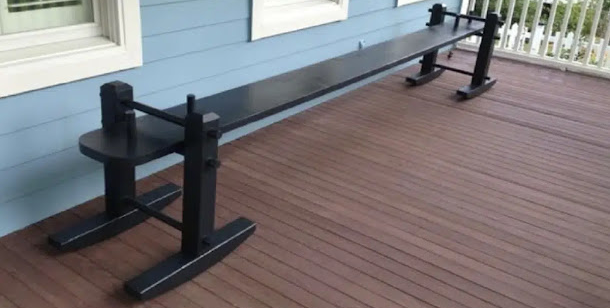
Is It a Bench or a Rocking Chair?
It is technically closer to a flexible bench, but it shares qualities with both.
A standard bench has a rigid seat and stationary legs. A rocking chair has curved runners that move the entire chair forward and backward.
The Joggling Board has:
- A long flexible seat
- Separate supporting stands
- Gentle vertical movement
- Possible side-to-side rocking
- Room for several people
Its distinctive movement comes primarily from the flexibility of the long plank.
Is It a Quilting Frame?
No. A quilting frame uses several rails or rollers to hold a large piece of fabric under tension while it is stitched.
The object in the photograph can be confused with one because both are long and supported at the ends. However, the broad central plank, curved feet, and seating height identify this object as a Joggling Board.
A quilting frame normally has an open rectangular working area. A Joggling Board has a single solid plank designed to support people.
Traditional Construction
A classic Joggling Board generally includes:
The Main Plank
The long seat must be strong enough to support weight but flexible enough to create the bouncing motion.
Two Supporting Stands
The stands hold the plank at approximately bench height. Their design may include upright posts that prevent the plank from sliding out of position.
Curved Rockers
Some stands have curved bottoms, allowing the furniture to sway gently.
Protective Finish
Exterior paint or another weather-resistant finish protects the wood from moisture, sunlight, and insects.
Traditional dimensions vary. Boards may be approximately 10–16 feet long, but shorter modern versions are also available.
Where Should a Joggling Board Be Placed?
A covered porch is the traditional location. It protects the wooden furniture from direct rain and excessive sunlight while leaving enough room for movement.
It may also be placed on:
- A covered patio
- A veranda
- A stable wooden deck
- A garden terrace
- A firm, level courtyard
- A sheltered outdoor seating area
Avoid placing it on unstable soil, steep slopes, loose gravel, or uneven paving.
Leave sufficient clearance around both ends. The furniture needs space to flex and rock without striking walls, railings, planters, or other objects.
How to Sit on It Safely
Before using a Joggling Board, inspect the entire structure.
Check for:
- Cracks in the main plank
- Splintered wood
- Loose hardware
- Unstable stands
- Rot or insect damage
- Excessive bending
- Peeling paint
- Movement between structural joints
Sit down carefully rather than jumping onto the plank. Keep both feet stable until you understand how the board moves.
Do not intentionally bounce with excessive force. Avoid standing, running, or climbing on the board.
Young children should always be supervised, and users should follow any weight limit supplied by the manufacturer.
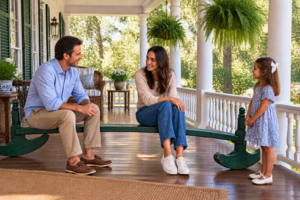
Can Several People Use It?
Yes, many Joggling Boards were designed to seat multiple people. However, the safe capacity depends on:
- Board length
- Wood species
- Plank thickness
- Age and condition
- Construction method
- Supporting stands
- Manufacturer’s weight limit
Do not assume that an antique board remains structurally safe. Hidden rot, cracks, or weakened joints can make old furniture dangerous even when its surface looks attractive.