
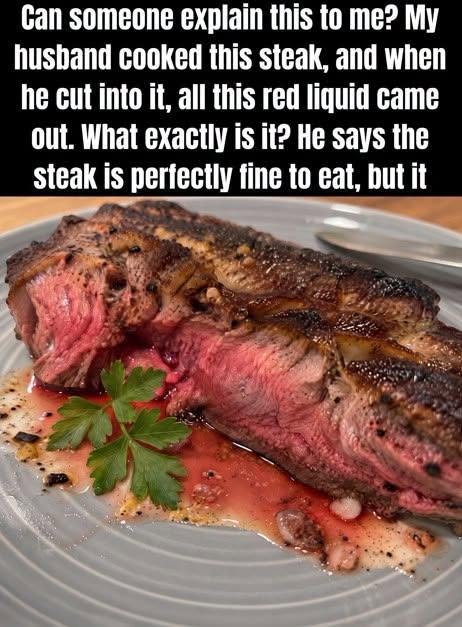
Why Does Raw Beef Look Red?
When beef is freshly cut, its appearance can vary depending on how much oxygen reaches the surface.
Meat that has not been exposed to much oxygen can have a darker purplish-red appearance.
Once oxygen reaches the surface, myoglobin interacts with oxygen and forms oxymyoglobin, which produces the familiar bright cherry-red color often associated with fresh beef at the store.
This is a normal chemical process.
It also explains why the same piece of beef can change color after being removed from packaging.
A darker color does not automatically mean the beef is spoiled.
Food safety depends on several factors, including storage conditions, odor, texture, temperature, and handling.
Why Does Steak Release Red Juice During Cooking?
When you cook steak, heat affects the water and proteins inside the muscle.
As the steak heats up, some moisture moves toward the surface.
If the steak is relatively thick and cooked to a lower internal temperature, you may see more reddish or pink moisture when you cut into it.
This liquid can mix with melted fat, seasoning, and other natural juices from the steak.
The result can look dramatically red on a white plate.
That appearance can be surprising, but it is not necessarily evidence that the steak contains a significant amount of blood.
Is the Red Liquid Actually Blood?
In normal circumstances, the red liquid you see from a steak is not simply blood flowing out of the meat.
Blood is part of the animal’s circulatory system, while myoglobin is a protein located inside muscle tissue.
The USDA specifically notes that blood is removed during slaughter and that the liquid associated with fresh beef comes largely from natural moisture and protein within the meat.
This is one of the most common misunderstandings about steak.
The appearance can be convincing because myoglobin has a strong red color.
But the chemistry is different.
Why Does Rare Steak Look So Red?
Rare steak has a lower internal temperature than a more thoroughly cooked steak.
Because the center has been exposed to less heat, the muscle structure remains closer to its original state.
That can result in:
- A deep red center
- Pink or red juices
- A softer texture
- A warmer outer surface
- More visible moisture after slicing
However, appearance should not be used as the only method for judging food safety.
The USDA specifically recommends using a food thermometer rather than relying on color or texture to determine whether meat has reached a safe temperature.
Does Red Liquid Mean the Steak Is Undercooked?
Not necessarily.
The presence of red or pink liquid does not, by itself, tell you the internal temperature of the steak.
Likewise, a steak that looks brown is not automatically guaranteed to be safe.
The USDA explains that visual indicators such as color are not reliable enough to determine whether meat has reached a safe temperature.
That is why a food thermometer is the most useful tool for checking doneness from a food-safety perspective.
The Safe Temperature for Steak
For whole cuts of beef such as steaks, chops, and roasts, the USDA recommends a minimum internal temperature of:
145°F (62.8°C)
After reaching that temperature, the meat should rest for at least:
3 minutes
before carving or eating.
This recommendation is about food safety.
Some people prefer their steak cooked beyond this minimum temperature because of personal taste and texture preferences.
The important point is that you should use a thermometer to verify the internal temperature rather than relying solely on the steak’s color.
For official guidance on safe cooking temperatures and food handling, readers can also consult the USDA Food Safety and Inspection Service resources.
USDA Food Safety and Inspection Service
Where Should You Put the Thermometer?
For a thick steak, insert the food thermometer into the thickest part of the meat.
The probe should be positioned so that it measures the internal temperature rather than simply touching the surface.
If the steak is particularly thin, inserting the thermometer from the side can make it easier to get an accurate reading.
A reliable thermometer gives you much more useful information than simply looking at the color of the center.