
Organization reduces mistakes.
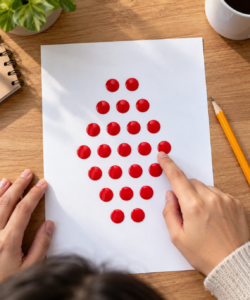
Why the Symmetry Can Fool Your Eyes
Symmetry is one of the main reasons this puzzle can feel confusing.
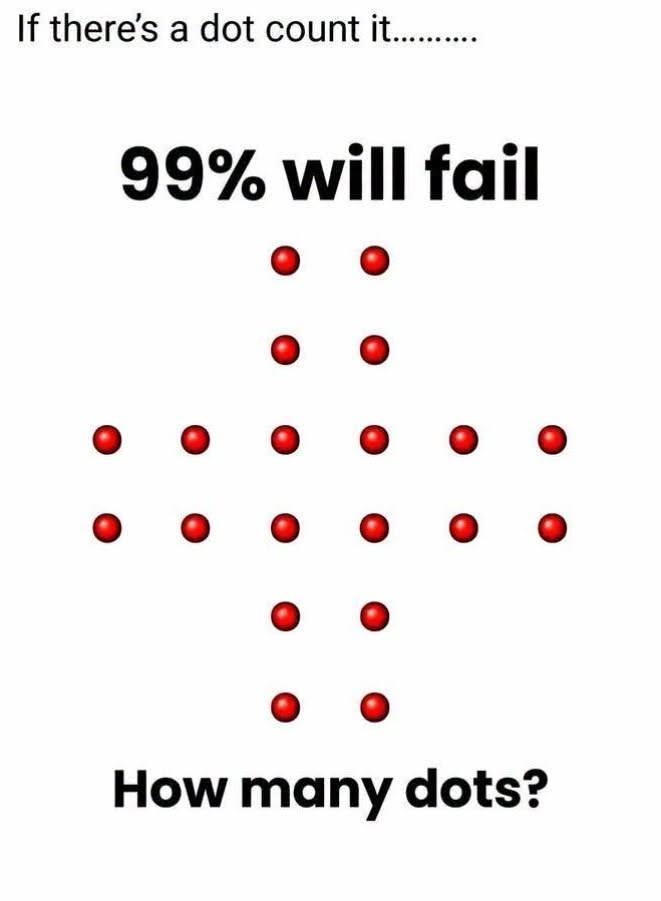
The upper section resembles the lower section. The middle section is wider, and the overall arrangement feels balanced from left to right.
Your brain recognizes that balance almost immediately.
However, the question doesn’t ask you to identify the pattern. It asks you to count individual dots.
That means you need to switch from recognizing the whole image to examining its individual components.
This is a common feature of visual brain teasers.
The designer doesn’t necessarily need to hide anything. Sometimes simply arranging obvious objects in a particular way is enough to make people hesitate.
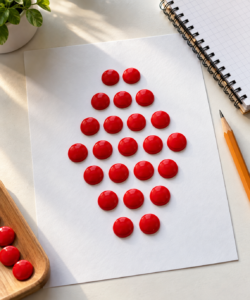
Don’t Count Too Quickly
One of the easiest ways to make a mistake is to assume the puzzle is too simple to require careful attention.
When something looks easy, people often answer before completing the task.
The phrase at the top of the image, “99% will fail,” also adds psychological pressure. It makes the viewer wonder whether there is a hidden trick.
However, you don’t need to worry about the claim.
There is no evidence in the image itself that exactly 99% of people would fail. It is better understood as attention-grabbing wording commonly used with online puzzle content.
The actual challenge is much simpler: carefully count the red dots.
Once you divide them into rows, the solution becomes clear.
A Second Way to Check the Answer
If you want to verify your answer, you can group the rows differently.
The first two rows contain:
2 + 2 = 4
The two middle rows contain:
6 + 6 = 12
The final two rows contain:
2 + 2 = 4
Now combine the three sections:
4 + 12 + 4 = 20
This produces the same result.
Using two different counting methods is a useful way to check visual puzzles. If both methods give the same total, you can be more confident that you haven’t accidentally skipped something.
Why Counting in Groups Works
Grouping is a basic problem-solving technique that can make complicated information easier to process.
Instead of remembering twenty separate objects, you remember several smaller groups.
For this puzzle, you only need to remember six numbers:
2, 2, 6, 6, 2, 2
That is much easier than trying to remember the position of every individual dot.
The same idea can be used outside puzzles.
You might group items when counting inventory, organize people into sections when estimating a crowd, or divide information into categories when studying.
The puzzle provides a simple example of why organization can improve accu