
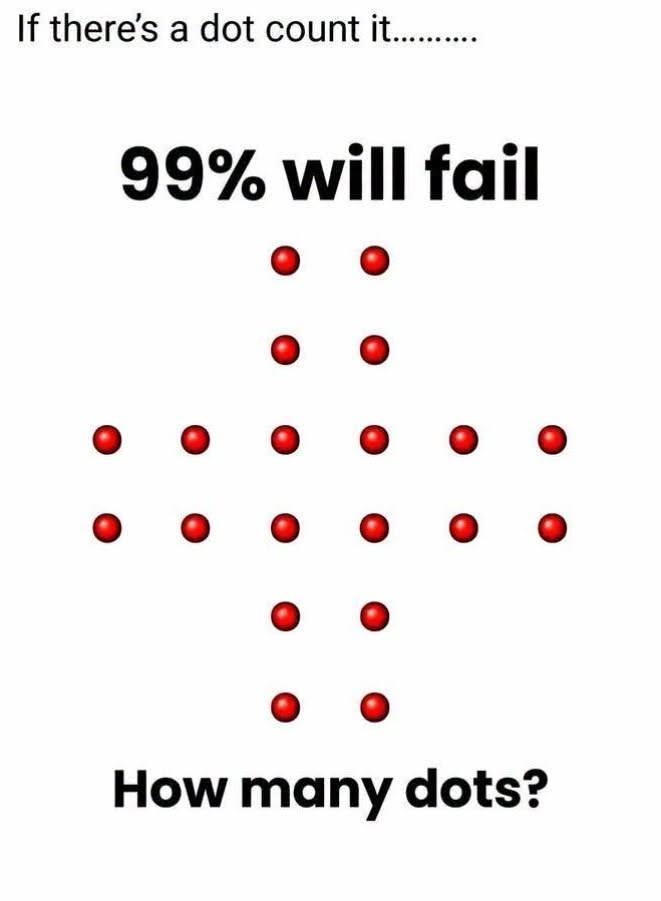
What If You Counted a Different Number?
If your first answer wasn’t 20, don’t worry.
The easiest thing to do is start again without looking at your previous total.
Begin at the top and count each row separately.
Avoid jumping between rows.
Once you finish one row, move to the next.
If you still get a different answer, check whether you accidentally included something that isn’t one of the red dots or counted a dot twice.
Visual puzzles can be affected by screen size, image quality, distractions, and even how quickly someone looks at the image.
Getting the answer wrong doesn’t mean anything about your intelligence.
It simply means your first counting method wasn’t completely accurate.
Is This Really an IQ Test?
No.
A how many dots puzzle can be entertaining and can involve observation, concentration, pattern recognition, and basic reasoning, but solving one image isn’t a scientifically valid way to measure intelligence.
Online puzzle posts sometimes describe simple challenges as IQ tests because that wording creates curiosity.
A person’s performance can depend on many ordinary factors.
Someone who is tired may overlook a dot.
Someone who is distracted may lose their place.
Someone who regularly solves visual puzzles may recognize the structure faster.
Someone else may simply prefer to count slowly.
For that reason, this puzzle is best treated as an entertaining visual challenge rather than a formal intelligence test.
What Skills Does This Puzzle Use?
Although the puzzle is simple, solving it carefully involves several useful abilities.
Observation
You need to notice each individual red dot rather than only the overall pattern.
Concentration
You need to stay focused long enough to complete the count.
Pattern Recognition
The symmetrical arrangement is immediately recognizable.
Organization
Dividing the image into rows creates a clear counting system.
Basic Arithmetic
Once the groups have been counted, you need to add them together.
These skills work together to produce the final answer.
Why Visual Puzzles Are So Popular
Visual puzzles are popular because almost anyone can participate.
You don’t need specialist knowledge or complicated equipment.
A person can see the image and immediately understand the challenge.
That makes these puzzles particularly suitable for social media and websites.
They also encourage interaction.
Someone may send the image to a friend and ask, “How many dots do you see?”
The friend gives an answer.
Then they compare results.
That simple interaction can turn an ordinary image into a small competition.
How to Make Your Own Dot Puzzle
Creating a similar challenge is relatively simple.
Start with a clean background and place several circular objects on it.
You can arrange them in rows, columns, groups, or a symmetrical design.
For an easy puzzle, keep the spacing consistent.
For a more difficult puzzle, change the spacing or create groups of different sizes.
You can also add distracting elements around the main objects, provided the instructions remain clear.
The most important thing is that the final answer should be easy to verify.
A good puzzle can be difficult without being confusing.
Ways to Make a Dot Puzzle More Difficult
If you want to create a harder how many dots puzzle, there are several possibilities.
You can increase the number of dots.
You can use different spacing between groups.
You can arrange the dots in irregular patterns.
You can introduce several colors and ask viewers to count only one color.
You can also place other circular objects in the image to make the viewer pay closer attention to the instructions.
Another option is to create overlapping patterns.
However, the more complicated the puzzle becomes, the more important it is to explain exactly what should be counted.
The Importance of Reading the Instructions
The wording of a puzzle matters.
The image says:
“If there’s a dot count it.”
Then it asks:
“How many dots?”
The intended challenge is to count the red circular dots forming the central pattern.
Reading the instruction before counting prevents unnecessary confusion.
This is a useful habit for many types of puzzles.
Don’t begin solving before understanding the question.
A correct method applied to the wrong question can still produce the wrong answer.
A Useful Strategy for Similar Visual Challenges
The same technique can be applied to many counting puzzles.
If the objects are arranged horizontally, count row by row.
If they are arranged vertically, count column by column.
If they form a grid, count one row at a time.
If they are arranged in a circle, choose one starting point and move around the circle until you return to it.
The goal is always the same: create a predictable path through the image.
This makes it much harder to skip an object or count one twice.