
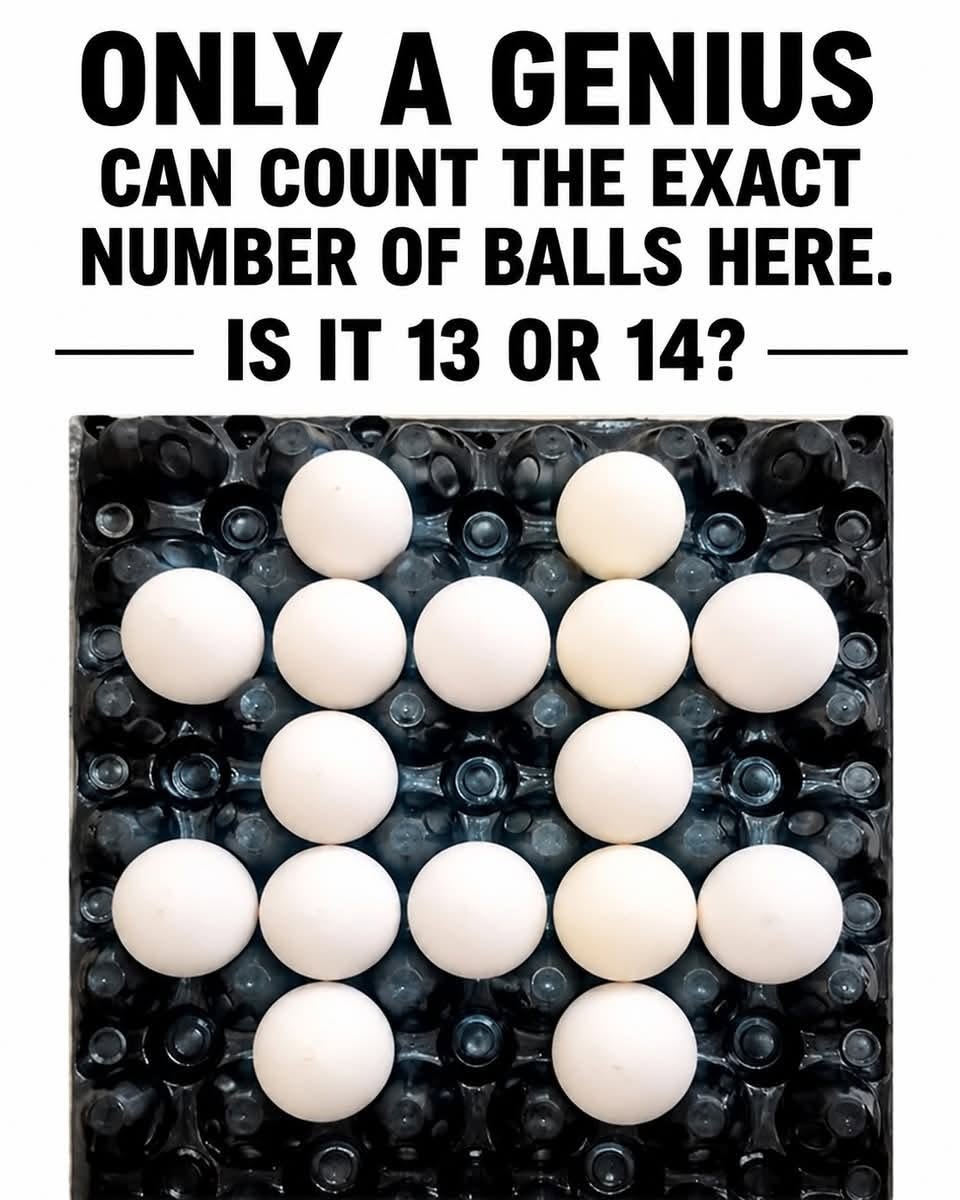
A Second Way to See the Pattern
The arrangement can be viewed as two long rows and three short rows.
The long rows contain ten balls altogether:
5 + 5 = 10
The short rows contain six:
2 + 2 + 2 = 6
Together, they contain:
10 + 6 = 16
This grouped approach is useful because it simplifies the image into two categories. Instead of tracking 16 individual objects, you only need to recognise two repeated row types.
Could Any Ball Be Hidden?
Only the clearly visible white balls should be counted. The black circular shapes are parts of the tray, not additional balls.
The puzzle asks for the number of balls visible in the picture, so there is no need to speculate about objects hidden beneath the tray or behind another ball.
Every visible white ball is separate and unobstructed. None of the white shapes appears to represent half a ball, a reflection, or part of another object.
The answer remains 16.
Why the Arrangement Tricks the Eye
The brain naturally looks for patterns and shortcuts. That ability is useful in everyday life because it allows us to understand a scene quickly without inspecting every detail.
However, shortcuts can produce mistakes when a task requires an exact total.
Pattern Recognition
The brain may recognise the white shapes as a general group without identifying each ball individually. This provides an approximate impression but not necessarily an exact count.
Visual Crowding
The tray contains repeated circular shapes. Although they are dark, they make the background visually complex. The eyes must separate the white target objects from the surrounding forms.
Interrupted Rows
The shorter rows are centred between longer rows. This can make them feel like part of a decorative pattern rather than independent rows that must be counted.
Divided Attention
The large headline, the numbers 13 and 14, and the tray all compete for attention. A viewer may spend more time considering the two suggested answers than inspecting the balls themselves.
Overconfidence
Because the puzzle looks easy, many people answer quickly. A difficult-looking problem encourages caution, but a simple-looking image often causes people to rely on their first impression.
Counting Versus Estimating
Counting and estimating are related but different skills.
Estimating asks, “Approximately how many objects are present?” It is useful when speed matters more than exactness.
Counting asks, “What is the precise number of objects?” It requires tracking each item or recognising reliable groups.
A review indexed by PubMed found that attentional demands can affect the speed and accuracy of visual enumeration. This helps explain why a distracting background or misleading instruction can increase mistakes even in a seemingly basic puzzle.
For this picture, estimation may produce an answer somewhere around 13–16. Exact counting is necessary to identify 16 as the correct total.
What Is Subitizing?
Subitizing is the ability to recognise a small number of objects almost instantly without counting them individually.
For example, most people can look at a group of two or three balls and know the quantity immediately. Larger groups usually require deliberate counting or grouping.
In this puzzle, each short row contains only two balls, so it can be recognised instantly. The rows of five require more attention, but five can still be recognised efficiently when arranged in a familiar pattern.
Combining the recognised groups makes the solution easier:
- Two balls
- Five balls
- Two balls
- Five balls
- Two balls
The total is then calculated rather than estimated.
Common Wrong Answers
Answer: 13
A person may arrive at 13 by skipping one short row and counting:
2 + 5 + 2 + 4 = 13
They may also lose track while moving between the two long rows.
Answer: 14
Fourteen is especially tempting because it is printed in the image. Someone may count the first four rows correctly but miss one of the balls in the last row.
Another possibility is counting:
2 + 4 + 2 + 4 + 2 = 14
In this case, the viewer mistakenly counts only four balls in each long row.
Answer: 15
Someone may correctly recognise most of the pattern but overlook one ball at the edge of a five-ball row.
Answer: 17
A viewer may count one central ball twice when moving vertically and horizontally through the pattern.
Correct Answer: 16
The row method removes ambiguity:
2 + 5 + 2 + 5 + 2 = 16