
Why Do So Many People Answer 13 or 14?
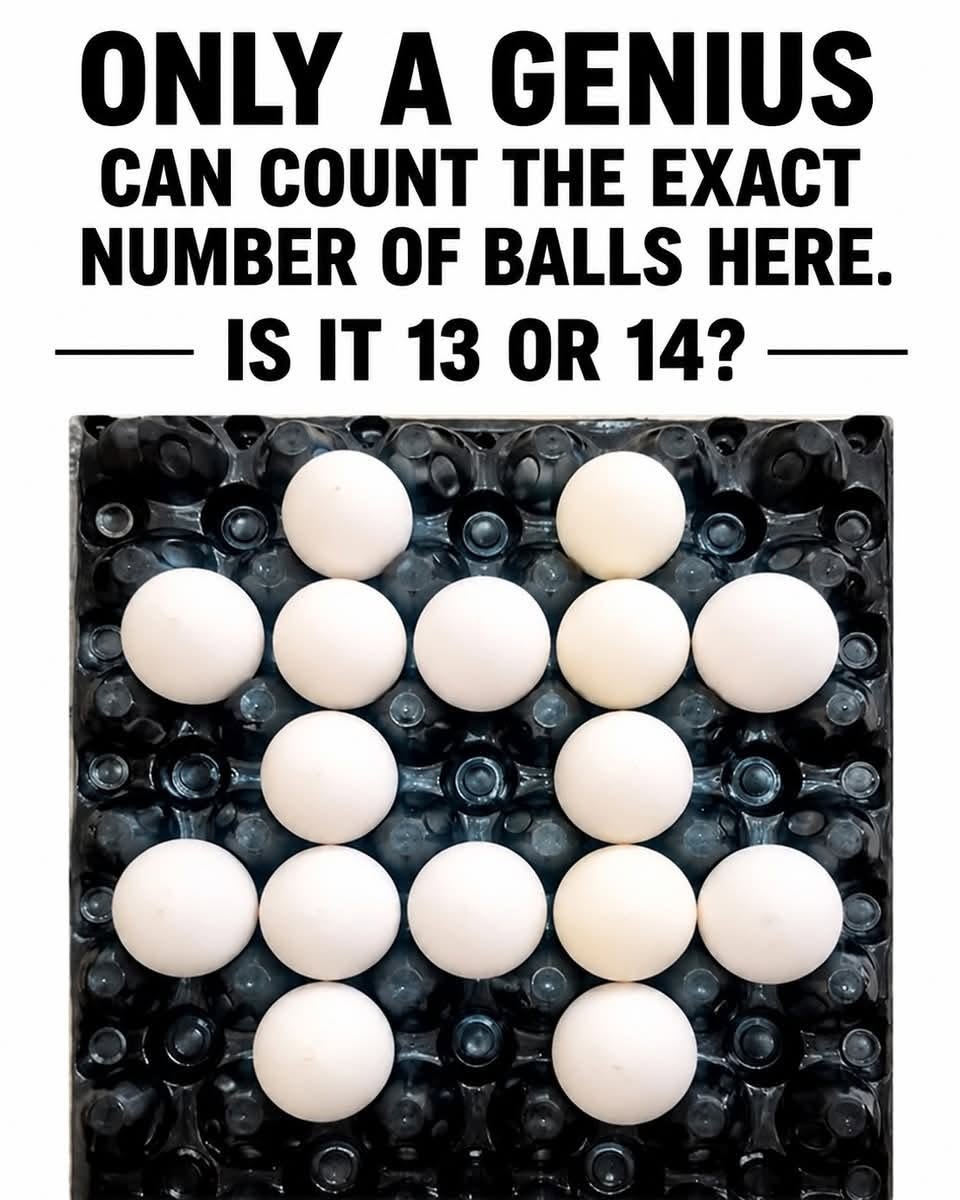
The puzzle influences the viewer before the counting process even begins. The large text asks whether the answer is 13 or 14, subtly encouraging people to assume that one of those numbers must be correct.
This is a common puzzle technique. Instead of asking an entirely open question, the image presents two incorrect choices. A viewer who trusts the choices may count carelessly, stop early, or adjust the result to match one of the suggested answers.
Several visual factors make the puzzle more difficult than it initially appears.
The Black Tray Creates Visual Distraction
The white balls are positioned inside a black tray containing many circular shapes. These dark circles compete with the balls for attention and can make it harder to track which objects have already been counted.
Although the white balls are clearly distinguishable, the busy background creates enough visual noise to encourage a quick estimate instead of an exact count.
The Pattern Is Not a Standard Grid
If the balls were arranged in four identical rows of four, most people would recognise the structure immediately. Instead, the puzzle alternates between rows of two and five.
The uneven structure makes the total less obvious and increases the likelihood that someone will accidentally skip or recount a ball.
The Suggested Answers Create an Anchor
The numbers 13 and 14 act as mental anchors. Once people see those options, they may expect the true total to be close to them.
Someone who counts 15 or 16 may doubt the result and repeat the count until it seems to match one of the choices. The best strategy is to treat every suggested answer as potentially misleading.
People Often Estimate Larger Groups
Small groups of two or three objects can usually be recognised immediately. Larger groups require more focused attention.
Research available through the National Library of Medicine explains that exact counting generally uses focused attention, while estimation relies more on distributed attention across the whole group. When a scene is crowded, estimation is faster but may not provide the exact number needed to solve the puzzle.
How to Solve the Ball-Counting Puzzle
A systematic method prevents skipped or duplicated objects.
Step 1: Ignore the Suggested Answers
Do not begin by choosing between 13 and 14. First determine the number independently.
The text is part of the puzzle and may be deliberately misleading.
Step 2: Choose a Starting Point
Begin at the top-left corner and move from left to right. Starting from a fixed location prevents your eyes from moving randomly around the picture.
Step 3: Count One Row at a Time
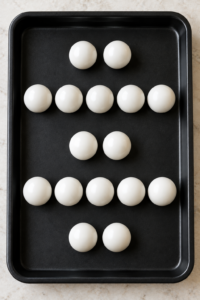
The first row contains two balls.
The second row contains five.
The third row contains two.
The fourth row contains five.
The final row contains two.
Step 4: Write Down Each Subtotal
Do not rely entirely on memory. Record the sequence:
2 — 5 — 2 — 5 — 2
Writing or mentally repeating the subtotals reduces the risk of forgetting a row.
Step 5: Add the Rows
Add the numbers:
2 + 5 + 2 + 5 + 2 = 16
Step 6: Verify with a Second Method
Group the rows according to size:
- Three rows containing two balls: 3 × 2 = 6
- Two rows containing five balls: 2 × 5 = 10
Then add the groups:
6 + 10 = 16
When two different counting methods produce the same result, confidence in the answer increases.