
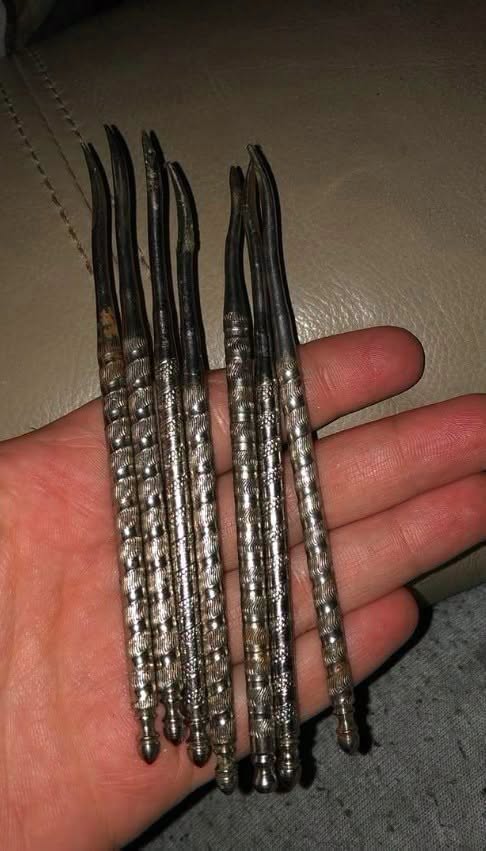
What Are These Vintage Kitchen Tools? A Look at Their History and Purpose
If you came across a handful of strange, silver-colored utensils like the ones in the photo, you might have wondered what they were actually made for. They look too narrow to be ordinary forks, too decorative to be modern cooking tools, and too unusual to immediately identify.
These little utensils are a great example of how different everyday kitchens once looked.
The tools pictured appear to be vintage nut picks or closely related small food picks. Nut picks were designed to help remove edible pieces from the shells of nuts after they had been cracked open. Vintage examples were often made with surprisingly elaborate handles, turning a simple kitchen implement into something that could also look beautiful on a dining table.
Today, most people simply buy shelled nuts, which means these utensils have largely disappeared from everyday kitchens. But their history tells us something interesting about how people used to prepare and serve food.
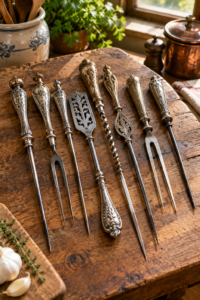
What Are These Vintage Kitchen Tools?
The utensils shown in the photograph strongly resemble vintage nut picks.
A nut pick is a small pointed utensil used to extract the nut meat from inside a hard shell. After a nut was cracked with a nutcracker, pieces could remain tucked inside narrow sections of the shell. A small pointed pick made it easier to reach those pieces without using a knife or one’s fingers.
Vintage examples can have long, narrow metal shafts and decorative handles. Some were made as part of matching nutcracker sets.
Similar vintage metal picks are still described by antique and vintage sellers as nut picks intended to remove nut meat after cracking the shell. Poshmark
That makes the unusual objects in this photograph much easier to understand.
They weren’t miniature forks.
They weren’t sewing tools.
And they weren’t simply decorative pieces.
They were practical little utensils designed around a very specific problem: getting the edible part out of a stubborn shell.
Why Did People Need a Nut Pick?
Today, many nuts are sold already shelled.
You can buy walnuts, pecans, almonds, pistachios, and other nuts in convenient packages that require little preparation. But that wasn’t always the case.
Whole nuts were commonly purchased and stored in their shells. Cracking them was only the first part of the process.
Imagine sitting at a dining table with a bowl of walnuts.
You crack one open.
A piece of the shell comes away.
But a portion of the walnut remains wedged inside a narrow corner.
Your fingers can’t reach it easily.
That’s where the nut pick came in.
The pointed end could be inserted carefully into the shell and used to loosen or lift the remaining nut meat.
For something so small, it solved a very practical problem.
How Vintage Nut Picks Were Used
Using one was relatively simple.
First, the hard shell was cracked with a nutcracker.
The two halves or broken pieces of shell were then separated.
If pieces of nut remained inside the shell, the pointed end of the pick was inserted carefully into the cavity.
The nut meat could then be loosened and lifted out.
The tool was especially useful for nuts with irregular interiors, where simply shaking the shell wasn’t enough.
Some picks were straight, while others had slightly curved or differently shaped ends depending on their design.
The basic idea remained the same: reach into places that were too narrow for a person’s fingers.
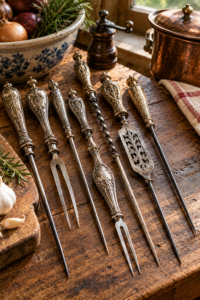
Why Are the Handles So Decorative?
This is one of the most interesting things about old kitchen utensils.
A modern nut pick might look like a simple piece of stainless steel.
Older examples could be considerably more decorative.
Handles were sometimes engraved, textured, twisted, or shaped with ornamental details.
That’s partly because these tools were associated with dining and entertaining rather than simply being hidden away in a kitchen drawer.
A host might place nuts, fruit, or other foods on the table for guests. Small serving utensils could therefore be designed to look attractive alongside the rest of the tableware.
Vintage examples with ornate metal handles are still collected today, and antique listings show that decorative nut picks were made in a variety of styles. Poshmark
In other words, the decoration wasn’t necessarily pointless.
It was part of the dining experience.
A Small Tool for a Different Kind of Kitchen
The existence of nut picks tells us something about older food habits.
Many foods that are now purchased prepared or shelled once required more work at home.
People cracked nuts.
They removed shells.
They separated edible portions.
They prepared ingredients manually.
Kitchen tools evolved around those tasks.
The result was a collection of specialized utensils that many modern households no longer recognize.
This is why vintage kitchen tools can be so fascinating.
A strange-looking object may have had a very ordinary purpose when it was first made.