
Why Did These Utensils Disappear?
There isn’t one single reason.
One major factor is convenience.
Modern grocery stores offer a huge variety of nuts already shelled and packaged.
Instead of buying a bag of whole walnuts and cracking them at the table, consumers can purchase walnut halves or pieces that are ready to eat.
That eliminates the need for several specialized tools.
Kitchen design has also changed.
Modern homes generally favor utensils that perform several functions rather than maintaining large collections of highly specialized implements.
As a result, small tools like nut picks became less common.
The Forgotten Dining Ritual Behind Them
There was also a social aspect to these utensils.
Serving whole nuts could be part of a meal, gathering, or holiday table.
A bowl of nuts could sit on the table alongside a nutcracker and small picks.
Guests could crack a nut, remove the edible portion, and eat it immediately.
That sounds unusual to many people today, but it was simply another form of table service.
The decorative handles found on many older examples make more sense when viewed in that context.
The utensil wasn’t necessarily intended to be hidden.
It could be part of the table setting.
Are Vintage Kitchen Tools Safe to Use Today?
That depends on the individual item.
An old utensil may have:
- Corrosion
- Unknown plating
- Surface damage
- Cracks
- Tarnish
- Residue
- A coating that isn’t intended for food contact
If you don’t know what metal or finish was used, it’s better not to assume that an antique item is automatically suitable for food use.
This is particularly important with very old pieces whose manufacturing materials are unknown.
For collectible pieces, keeping them as display items may be preferable.
For everyday food preparation, modern utensils designed and sold for food use are generally the safer choice.
How to Clean Old Metal Kitchen Tools
If you own a vintage piece and simply want to preserve its appearance, avoid immediately reaching for harsh chemicals or abrasive pads.
Start gently.
Remove loose dust with a soft cloth.
If the item is confirmed to be suitable for cleaning, follow an appropriate method for its specific metal.
Different materials—including stainless steel, silver, plated metals, brass, and aluminum—can require different care.
And if the piece has collectible value, preserving its original condition may be more important than making it look brand-new.
A little age and patina can actually be part of the object’s appeal.
Why People Still Collect Vintage Kitchen Tools
For some collectors, these objects are interesting because they combine function and craftsmanship.
A small utensil may tell you:
- What people ate
- How food was prepared
- How families entertained
- What materials manufacturers used
- How dining habits changed
- What kinds of tools were considered necessary
That’s why vintage kitchen tools can be more than old pieces of metal.
They’re tiny examples of everyday history.
A modern kitchen might contain an electric food processor, blender, microwave, and dozens of specialized appliances.
An older kitchen might have relied much more heavily on simple hand tools.
The contrast is fascinating.
The Design Can Tell You a Lot
When identifying an unknown utensil, don’t focus only on what the pointed end looks like.
The entire design matters.
A long, narrow shaft suggests that the tool was intended to reach somewhere difficult.
A decorative handle suggests that it may have been designed for table use.
A sharp or hooked tip suggests that the tool needed to grab, loosen, or pierce something.
When several nearly identical tools appear together, that is another important clue.
It may have been a set intended for multiple guests.
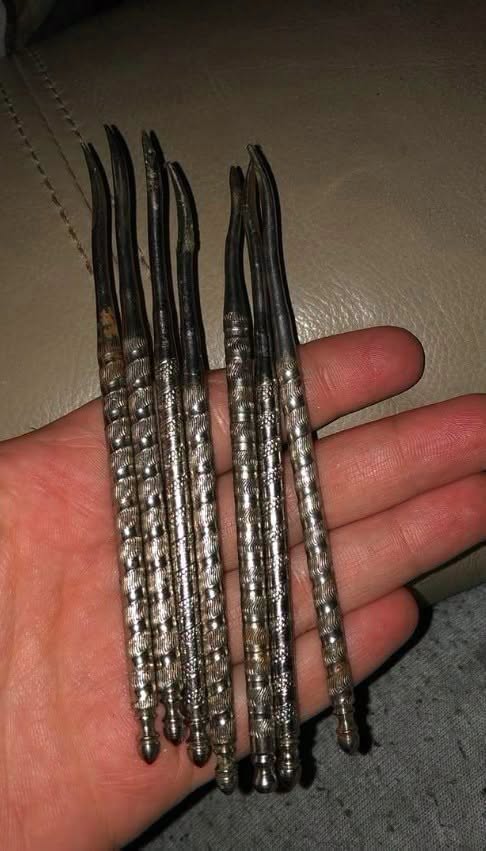
The photograph you’ve provided shows several similar ornate metal picks together, which fits the idea of a vintage tableware or food-pick set.
Why These Old Utensils Feel So Familiar
Even if you have never used one, there is something recognizable about their design.
They resemble modern tools that still use the same basic principle: make a small object long and narrow enough to reach into a difficult space.
The difference is that today’s versions tend to prioritize simplicity.
Older household goods often had much more decorative styling.
Handles could feature elaborate patterns, engraving, ridges, or ornamental shapes.
That craftsmanship is one reason people continue to photograph, collect, and display old kitchen utensils.
What Should You Do If You Find a Set Like This?
Before throwing it away, take a few minutes to investigate.
1. Photograph every piece
Take clear photos of both sides.
2. Check the handles
Look for maker’s marks or symbols.
3. Look for matching tools
A nutcracker or serving piece may help identify the set.
4. Don’t aggressively clean it
Preserve the original surface until you’ve established what it is.
5. Search the markings
The maker’s name can be more useful than a general description.
6. Compare similar examples
Antique and vintage marketplaces can reveal similar designs and descriptions. For example, vintage listings identify ornate metal picks as nut picks and seafood picks. eBay
7. Consider an expert appraisal
If the item appears to be sterling silver, unusually old, or associated with a recognizable maker, professional identification may be worthwhile.
Common Questions About These Vintage Kitchen Tools
What are the vintage kitchen tools in the photo?
They appear to be vintage nut picks or similar food picks. Their narrow pointed ends were designed to help remove food from difficult-to-reach areas, especially from cracked nut shells.
What is a nut pick used for?
A nut pick is used to remove pieces of nut meat from inside a cracked shell.
Did people use nut picks with nutcrackers?
Yes. A nutcracker could break the shell, while the pick could help extract the edible portion left inside.
Why do vintage nut picks have decorative handles?
Many were associated with table service, so manufacturers sometimes gave them decorative handles that matched other serving utensils.
Are nut picks still used today?
They still exist, but they are much less common in everyday kitchens because many nuts are sold already shelled.
Are all pointed vintage kitchen tools nut picks?
No. Some similar-looking tools were made for seafood, serving, or other specialized tasks. Identification depends on the exact design and any maker’s markings.
How can I tell what an old kitchen utensil was used for?
Look at its shape, tip, handle, markings, material, and whether it belongs to a larger matching set.
Are old kitchen utensils collectible?
Some are. Rarity, maker, material, condition, age, and completeness of a set can all influence collector interest.
Should I use antique kitchen tools for cooking?
Not automatically. Unknown materials, finishes, corrosion, or damage can make an old utensil unsuitable for food use.
Why don’t modern kitchens have as many specialized utensils?
Modern food packaging, convenience products, and multipurpose kitchen tools have reduced the need for many specialized implements.
Final Thoughts
The strange little objects in this photograph are a reminder that everyday kitchens once depended on many tools that have nearly disappeared from modern life.
The pieces appear to be vintage nut picks or similar food picks, designed to help retrieve food from places that were difficult to reach by hand. Their ornate handles also show how even a tiny practical utensil could be given an attractive, almost jewelry-like appearance.
Today, most people would probably never think to buy a dedicated tool for removing a walnut from its shell. But for earlier generations, it was simply another useful item at the dining table.
That’s what makes vintage kitchen tools so interesting: they don’t just show us what people used—they show us how everyday life has changed.
And sometimes, the strangest object sitting in an old kitchen drawer has a surprisingly practical story behind it.