
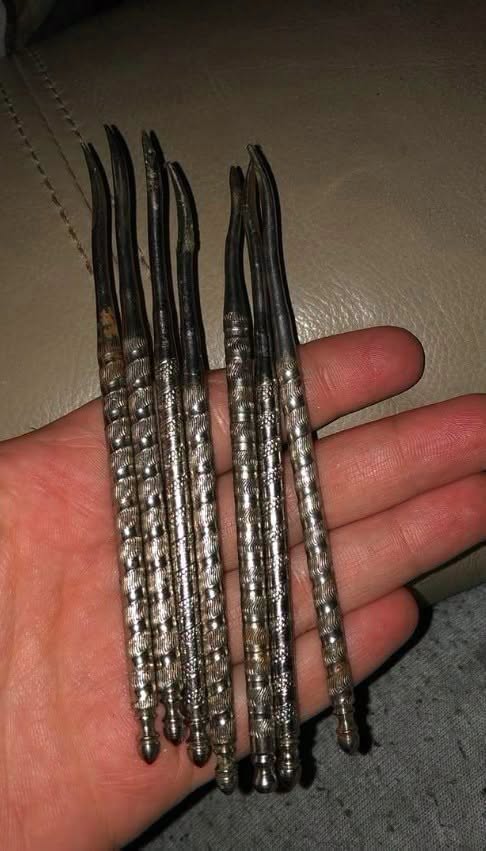
What Nuts Were Nut Picks Used For?
Nut picks could be useful for a variety of shelled nuts, particularly those whose edible portions could become trapped inside the shell.
Walnuts
Walnuts have an irregular interior with ridges and cavities.
After cracking one open, pieces of walnut can remain tucked inside.
A pointed pick makes those pieces easier to remove.
Pecans
Pecans can also be difficult to completely remove from their shells.
A small pick can help separate pieces from the shell without crushing them further.
Brazil nuts
The hard shell of a Brazil nut makes specialized tools useful when the nut is purchased whole.
Other shelled nuts
Depending on the household and the particular tool, nut picks could be used for other shelled foods as well.
The exact design varied, but the principle was straightforward: crack first, pick second.
Vintage Kitchen Tools Were Often Specialized
One reason modern people struggle to identify old utensils is that kitchens once contained many tools designed for very specific jobs.
There were tools for:
- Cracking nuts
- Removing nut meat
- Serving olives
- Picking seafood
- Opening bottles
- Cutting pastries
- Serving sugar
- Straining food
- Separating bones
- Serving individual portions
Today, many of these functions have been combined into fewer multipurpose utensils.
That’s one reason an old kitchen drawer can look like a collection of mysterious objects.
What looks useless today may have been an essential little helper decades ago.
Nut Picks vs. Seafood Picks
One potential source of confusion is that some small pointed utensils look extremely similar.
Seafood picks are also narrow tools designed to reach into difficult spaces. They can be used with foods such as crab and lobster to remove meat from shells.
Vintage seafood and nut-pick sets can therefore sometimes look alike.
Vintage listings show sets of metal picks marketed for nuts as well as crab, lobster, and other shellfish. eBay
So if you find a mysterious set like the one shown in the photograph, the exact original purpose may not always be possible to determine from appearance alone.
Look for:
- Manufacturer markings
- Engraving
- Matching nutcracker pieces
- Original packaging
- Shape of the pointed end
- Shape and size of the handle
- Other utensils from the same set
Those clues can help establish what the manufacturer intended.
Why Were These Tools Made of Metal?
Metal was a practical choice for small food picks.
The tool needed to be thin enough to enter narrow spaces but strong enough to loosen food from a shell.
A rigid metal shaft provided both characteristics.
Decorative metal handles also allowed manufacturers to create visually distinctive pieces.
Some vintage examples have silver-colored finishes, while others were made from different metals or plated materials.
The material alone, however, doesn’t necessarily tell you the age or value of a particular piece.
Are These Vintage Kitchen Tools Valuable?
Sometimes—but usually the value depends on more than appearance.
Collectors may consider:
- Age
- Maker
- Material
- Condition
- Rarity
- Matching pieces
- Original box
- Decorative quality
- Hallmarks
- Provenance
A common vintage nut pick may have modest resale value.
A rare sterling-silver set from a recognized manufacturer can be considerably more interesting to collectors.
That’s why it’s a good idea not to polish or alter an old piece immediately if you think it might be valuable.
Aggressive cleaning can remove original finishes or affect collectible surfaces.
If an item appears to be silver, sterling, or associated with a notable maker, identifying the markings first is a better approach.
How to Identify Vintage Kitchen Tools
If you discover something similar in an old drawer, don’t throw it away before investigating it.
Start with the handle.
Look for:
- Initials
- Brand names
- Numbers
- Hallmarks
- Symbols
- Country-of-origin marks
- Decorative patterns
Then examine the shape.
Is the end pointed?
Is it curved?
Does it have a spoon-like bowl?
Does it have a fork?
Does it appear to belong to a matching set?
Those details can narrow down the possibilities considerably.
A search for the maker’s mark together with terms such as “nut pick,” “seafood pick,” “antique kitchen utensil,” or “vintage serving tool” can also reveal similar examples.
Don’t Confuse a Nut Pick With a Nutcracker
These two tools perform different jobs.
A nutcracker breaks the hard outer shell.
A nut pick helps remove the edible nut after the shell has been opened.
Think of them as a two-step system.
Nutcracker → opens the shell
Nut pick → retrieves the nut
That simple distinction explains why older nut sets sometimes contain several different-looking tools.