
Important note: Age spots are usually harmless, but a photograph alone cannot confirm that a dark mark is an age spot. New, unusual, or changing spots should be examined by a qualified healthcare professional.
What Are Age Spots on Hands?
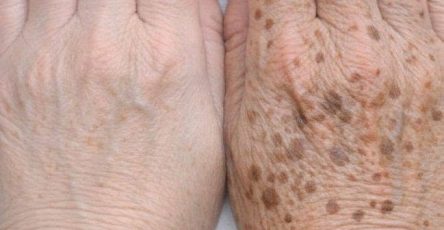
Age Spots on Hands are flat areas of increased pigmentation that commonly appear after years of exposure to sunlight. They may be tan, brown, or dark brown and often develop on the backs of the hands, face, shoulders, arms, and other areas regularly exposed to ultraviolet radiation.
They are also known as solar lentigines, sun spots, or liver spots. Despite the traditional name “liver spots,” they are not caused by liver disease and do not indicate that the liver needs to be cleansed.
Most age spots are harmless. However, not every brown mark is an age spot. Some moles, precancerous lesions, and skin cancers can resemble harmless pigmentation, particularly when viewed in a photograph. This is why identifying the nature of a spot should come before attempting to lighten it.
4 Ways to Erase Age Spots with Baking Soda for Younger, More Even Skin
The image shows two hands for comparison. One has relatively even pigmentation, while the other has multiple flat brown marks. This appearance can be consistent with accumulated sun-related pigmentation, but it is not possible to provide a diagnosis from the image alone.
Why Do Age Spots Develop?
Age spots develop when pigment-producing cells make extra melanin in certain areas. The process is strongly associated with cumulative ultraviolet exposure.
According to the American Academy of Dermatology, repeated unprotected sun exposure can gradually cause visible skin changes, including freckles, wrinkles, and age spots. Protecting the hands from ultraviolet radiation can help prevent existing spots from becoming darker and reduce the appearance of new ones.
Sunlight does not affect only the surface appearance of the skin. Repeated unprotected exposure can gradually damage skin cells. Over time, visible changes may include uneven pigmentation, freckles, wrinkles, loss of elasticity, and age spots.
The American Academy of Dermatology explains that accumulated sun damage can produce freckles, age spots, wrinkles, precancerous growths, and skin cancer.
Common Risk Factors
Age Spots on Hands are more likely to occur in people who:
- Have spent many years working or exercising outdoors
- Frequently drive without protecting their hands
- Have experienced repeated sunburns
- Use indoor tanning beds
- Rarely apply sunscreen to their hands
- Have lighter skin that burns easily
- Are middle-aged or older
- Have a personal or family history of significant sun damage
Although they become more common with age, the spots are primarily connected to accumulated ultraviolet exposure rather than ageing alone. A younger adult with extensive sun exposure may develop them, while an older person who has consistently protected the skin may have fewer spots.
Are Age Spots Dangerous?
Typical age spots are benign and do not turn into cancer. The difficulty is that a suspicious growth can sometimes be mistaken for an ordinary sun spot.
A dermatologist may examine the mark with a dermatoscope, a magnifying instrument that reveals structures not visible to the naked eye. If the lesion appears suspicious, the doctor may recommend a biopsy.
Do not automatically treat every brown mark as a cosmetic problem. The safest approach is to have uncertain spots identified before applying bleaching agents, acids, freezing products, or other treatments.