
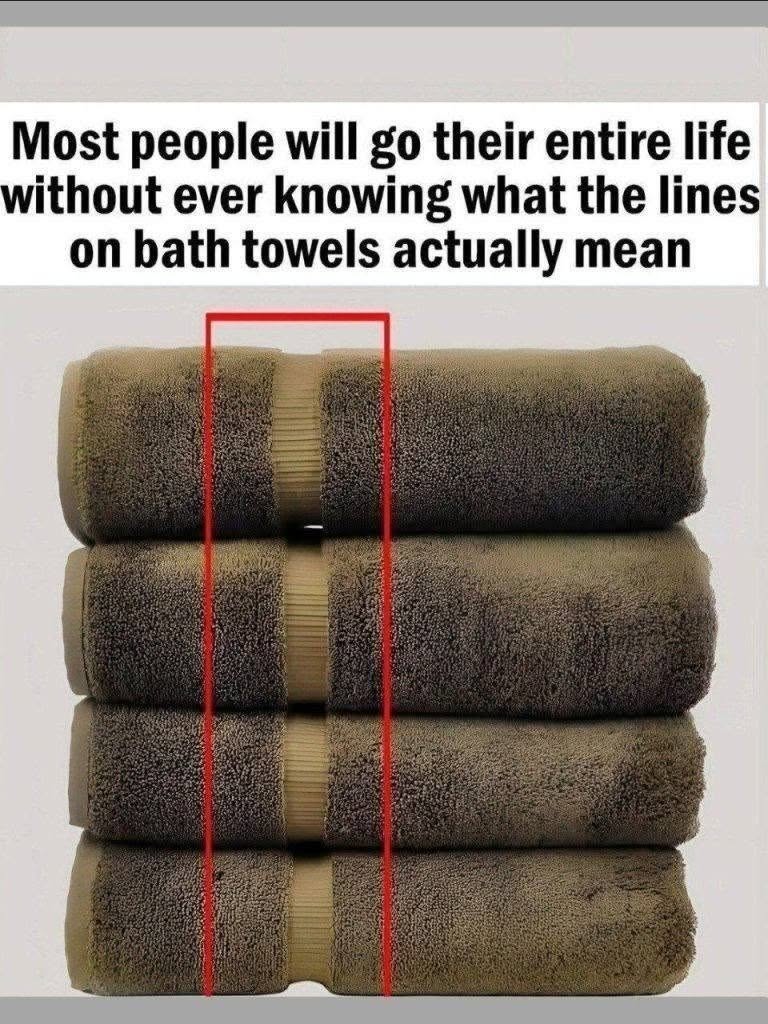
- What Do the Lines on Bath Towels Really Mean? The Surprisingly Clever Design Most People Never Notice
Take a close look at almost any bath towel in your home, and you’ll probably notice one or more horizontal bands woven into the fabric. Some towels have a single decorative stripe near each end, while others feature several raised or flat lines across the towel. Most people assume they’re simply there to make the towel look more stylish. While appearance is certainly part of the story, those woven lines actually serve several practical purposes that most people never realize.
For decades, towel manufacturers have used these bands as part of the towel’s engineering. They aren’t random decorations, and they aren’t leftover marks from the manufacturing process. Instead, they’re carefully designed sections that improve durability, maintain the towel’s shape, and even help it perform better over years of washing and drying.
Understanding what these lines do offers an interesting glimpse into how something as ordinary as a bath towel is carefully designed for everyday use. It also explains why high-quality towels often feature these bands while cheaper towels may not.
The Decorative Border Isn’t Just Decoration
The most recognizable lines are known in the textile industry as dobby borders. They’re created using a specialized weaving technique that produces a flatter, tighter section of fabric compared with the plush loops that make up the rest of the towel.
At first glance, the border simply adds a clean, elegant appearance. Hotels, luxury brands, and premium home collections often use decorative borders to create a more polished look.
But the design serves a much bigger purpose than aesthetics.
Helping the Towel Keep Its Shape
One of the biggest jobs of the woven border is structural support.
Every time you wash a towel, thousands of cotton fibers absorb water, expand, shrink, twist, and dry again. Over months or years, this constant cycle places stress on the fabric.
The denser woven bands help stabilize the towel, reducing distortion and helping it stay rectangular instead of stretching unevenly over time.
This reinforcement is especially useful for larger bath towels, which carry more weight when soaked with water.
Reducing Curling at the Ends
Without reinforced borders, towel edges would be much more likely to curl, wrinkle, or become misshapen after repeated washing.
The woven bands distribute tension across the fabric, helping the towel lie flatter after drying.
That’s one reason quality towels often continue looking neat even after years of regular use.
Protecting Against Fraying
The borders also strengthen areas that experience the greatest wear.
When towels are folded, hung, pulled from shelves, tossed into washing machines, and handled every day, the edges absorb much of the stress.
The tightly woven sections help reduce loose threads and slow down fraying, extending the towel’s lifespan.
The simple woven bands most people ignore are actually one of the reasons a good towel can last for years without losing its shape.
continued on the next page’
Improving Manufacturing Quality
The woven lines also serve an important role during production.
During weaving, finishing, cutting, and sewing, manufacturers use these reinforced sections to help maintain consistent sizing and alignment across thousands of towels.
This contributes to a more uniform final product and helps ensure each towel meets quality standards.
Balancing Softness and Strength
The fluffy loops across most of the towel are designed to maximize absorbency. These loops trap water efficiently while remaining soft against the skin.
If the entire towel consisted only of thick loops, however, it would be more likely to stretch and deform.
The flatter woven bands balance softness with structural integrity, allowing the towel to remain absorbent while holding its shape.