
Smaller Portions Can Be Convenient
Sometimes people are not looking for a complete three-course meal.
They might be:
- Eating before another event
- Having a late lunch
- Sharing food with someone
- Taking medication with food
- Eating after a large meal
- Simply not very hungry
In these situations, a smaller portion may be exactly what the customer wants.
Kids Menus and Adult Appetites
Appetite varies considerably from person to person.
Two adults of the same age can have completely different preferences.
One person may want a large steak dinner.
Another might prefer a small bowl of pasta.
Someone else might only want a sandwich.
Therefore, the idea that every adult should automatically eat an adult-sized entrée is not necessarily practical from a portion perspective.
However, restaurants are also businesses with their own pricing structures.
This creates the central tension surrounding the kids menu question.
Is It Fair for Restaurants to Restrict Kids Menus?
This question can be viewed from both sides.
The Customer Perspective
From a customer’s perspective, it can feel strange to be told that a particular meal is unavailable simply because of age.
If the customer wants a smaller portion and is willing to pay the listed price, they may wonder why the restaurant refuses.
The customer may also believe that ordering less food is better than buying a large meal and leaving most of it uneaten.
The Restaurant Perspective
Restaurants have the right to structure their menus according to their business model, subject to applicable laws and regulations.
A kids menu may be intentionally priced and designed for families with children.
The restaurant may have calculated its prices based on assumptions about:
- Portion size
- Customer demographics
- Ingredients
- Service
- Included extras
- Expected demand
From this perspective, the restriction is part of the restaurant’s menu policy.
Why Restaurants May Prefer Adults to Order From the Main Menu
Restaurants often have different menu categories for different customers.
The main menu may include higher-cost ingredients, larger portions, or more elaborate preparation.
If adults regularly ordered inexpensive children’s meals, restaurants could see changes in their expected average spending per customer.
That does not mean every restaurant experiences this problem.
It simply explains one possible reason a business may establish a kids-menu policy.
Could Restaurants Offer Smaller Adult Portions?
One possible solution is a dedicated smaller-portion menu for adults.
Instead of making customers choose between a large entrée and a children’s meal, a restaurant could offer:
Small Pasta
A reduced portion for customers with smaller appetites.
Mini Burger
A smaller burger without necessarily labeling it a children’s meal.
Half Portion
Half-size versions of selected regular dishes.
Side-Based Meals
A combination of two or three smaller sides.
This approach could give customers more flexibility while allowing restaurants to maintain separate pricing structures.
Why Smaller Portions Could Be Useful
A smaller adult portion could be useful for several groups.
Older Adults
Some older customers may prefer smaller meals.
People Eating Lightly
Someone may simply want a modest meal rather than a large entrée.
People Sharing
A customer may order a small dish because they plan to share other foods.
Diners With Different Appetites
Not everyone has the same hunger level.
A flexible menu can accommodate different needs.
Kids Menu Restrictions Can Be Confusing
One reason these situations create confusion is that restaurants do not always communicate their policies clearly.
A customer might see a kids menu on the table and reasonably assume that anyone can order from it.
If the menu does not clearly state an age restriction, the customer may be surprised when a server explains the policy.
Clear wording can prevent misunderstandings.
For example, a restaurant could write:
Kids meals available for children 12 and under.
Or:
Children’s menu available only for guests under 12.
That makes the policy clear before the customer orders.
What Should You Do If You’re Told You Cannot Order a Kids Meal?
If a restaurant does not allow adults to order from the kids menu, there are several practical options.
Ask About Smaller Portions
You can politely ask:
“Do you have any smaller portions for adults?”
The kitchen may be able to provide a reduced portion of a regular dish.
Ask About Side Dishes
You can also order a combination of sides.
For example:
- Soup
- Salad
- Vegetables
- Small fries
- Rice
- Bread
This can create a lighter meal without requiring the restaurant to break its kids-menu policy.
Ask About Sharing
If you are dining with someone else, you may be able to share an entrée.
Some restaurants may charge a sharing fee, while others may not.
It is worth asking beforehand.
Consider Ordering an Appetizer
An appetizer can sometimes be closer to the portion size an adult with a small appetite wants.
Depending on the restaurant, appetizers may include:
- Small salads
- Soup
- Bruschetta
- Chicken wings
- Vegetable dishes
- Small sandwiches
However, appetizer portions vary considerably.
Can Adults Order Kids Meals for Dietary Reasons?
People sometimes want smaller portions for personal dietary reasons.
However, a kids meal is not automatically healthier simply because it is smaller.
A smaller portion of fried food is still fried food.
Likewise, a smaller sugary dessert still contains added sugar.
If nutrition is your main concern, it may be better to look at the ingredients and preparation method rather than relying on the label “kids meal.”
Smaller Does Not Always Mean Healthier
This distinction is important.
A kids burger with fries may contain fewer calories than a large adult burger with fries, but that does not automatically make it a nutritionally balanced meal.
A meal’s overall nutritional value depends on factors such as:
- Protein
- Fiber
- Vegetables
- Whole grains
- Added sugars
- Sodium
- Fats
- Portion size
Therefore, customers interested in nutrition should look at the entire meal.
How Parents Can Choose Kids Meals
For children, parents may want to consider variety rather than choosing the same foods every time.
A kids meal can include:
- Protein
- Vegetables
- Fruit
- Whole grains
- Dairy or alternatives
Restaurants increasingly offer different side choices, allowing parents to build more balanced meals.
The goal does not need to be perfection.
Offering children variety and helping them become familiar with different foods can be useful.
Why Restaurants Design Special Children’s Menus
A kids menu can make family dining easier.
Children may become overwhelmed by a large menu.
A smaller menu gives them a limited number of choices.
This can help families order faster.
It can also make restaurant dining more comfortable for children who prefer familiar foods.
The Psychology of Menu Design
Menus are not simply lists of food.
Restaurants carefully consider:
- Pricing
- Descriptions
- Images
- Portion sizes
- Categories
- Popular dishes
Kids menus are often designed to be visually engaging and easy to understand.
They may use colorful graphics, simple wording, and familiar food names.
This is different from a traditional adult menu, which may contain more detailed descriptions and broader selections.
The Social Side of Ordering a Kids Meal
Some adults may feel embarrassed about asking for a kids meal.
Others may see nothing unusual about it.
There is no single social rule about how an adult should order food.
People eat differently for many reasons.
Someone may have a large appetite one day and a small appetite the next.
The practical issue is whether the restaurant permits the order.
Restaurant Policies and Customer Expectations
The easiest way to avoid an awkward situation is to check the policy.
Before ordering, look for wording such as:
- “Children under 12”
- “For children only”
- “Available to guests 10 and under”
- “Children’s menu”
- “Kids eat free”
If there is no clear wording, you can simply ask.
Why the Question in the Image Gets People Talking
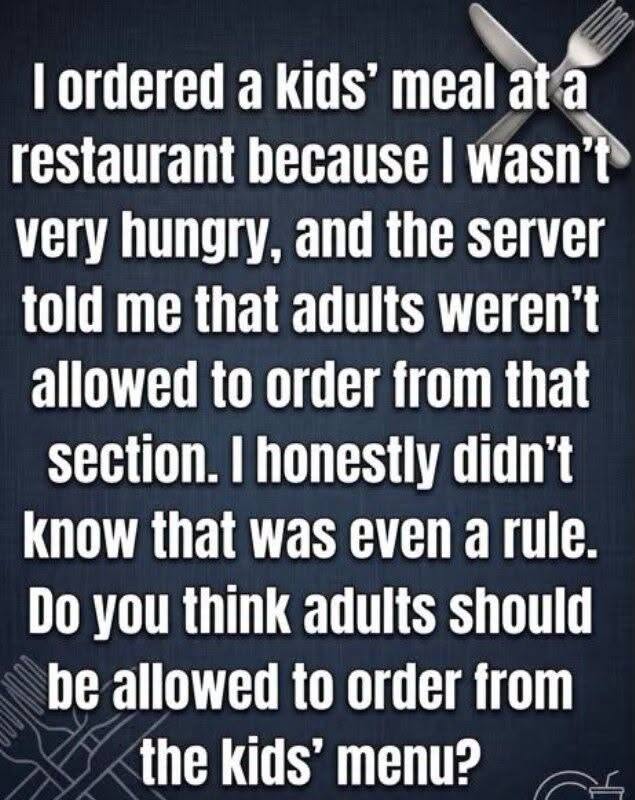
The image asks whether adults should be allowed to order from the kids menu.
That question is effective because it does not have an obvious universal answer.
People can approach it from different perspectives.
Some focus on:
- Appetite
- Portion size
- Food waste
- Personal choice
Others focus on:
- Restaurant pricing
- Business policies
- Fairness
- Menu design
This makes it a natural conversation starter.
The Difference Between a Rule and a Preference
There is an important distinction between a restaurant saying:
“We don’t allow adults to order from the kids menu.”
and a customer saying:
“I don’t think adults should order from the kids menu.”
The first is a restaurant policy.
The second is a personal opinion.
Keeping those two things separate makes the discussion clearer.
Could Restaurants Charge Adults More for Kids Meals?
Another possible approach would be to allow adults to order children’s portions but charge a slightly different price.
For example, a restaurant could offer:
Small Portion — $X
rather than labeling it as a children’s meal.
This would separate the portion size from the customer’s age.
Some restaurants already use similar concepts, although practices vary widely.
Small Portions and Food Waste
Food waste is an important consideration in restaurant dining.
When customers receive portions larger than they want, they may leave food behind.
Smaller portions can potentially reduce leftovers.
However, the relationship between portion size and waste depends on many factors, including what the customer orders, how much they eat, and whether leftovers are taken home.
Therefore, a smaller meal is not automatically the solution to food waste, but portion flexibility can give customers more options.
Why Some Adults Prefer Children’s Foods
There is also a simple reason: some people genuinely like foods commonly found on children’s menus.
Chicken nuggets, grilled cheese, fries, macaroni and cheese, and mini burgers are not exclusively children’s foods.
Adults can enjoy them too.
The distinction is mostly based on how the restaurant categorizes the meal.
Are Kids Menus Only About Age?
Not necessarily.
A kids menu usually reflects more than age.
It can reflect:
- Portion size
- Pricing
- Simplicity
- Food preferences
- Included items
- Family dining
Age is simply the most common eligibility condition.
What Makes a Good Kids Menu?
A well-designed kids menu can provide reasonable variety without overwhelming young diners.
It might include:
Protein Options
Chicken, fish, eggs, beans, or meat.
Vegetable Options
Steamed vegetables or salads.
Fruit Options
Fresh fruit or fruit cups.
Grain Options
Rice, pasta, bread, or whole-grain alternatives.
Drink Choices
Water, milk, or other beverages depending on the restaurant.
The exact menu depends on the establishment.
How Restaurants Could Make Menus More Flexible
Restaurants looking for greater flexibility could consider creating three portion sizes:
Small
Designed for lighter appetites.
Regular
The standard entrée.
Large
Designed for customers wanting a bigger portion.
This system would make portion choice independent of age.
However, it would also require restaurants to consider kitchen operations, pricing, and menu complexity.
What Customers Should Remember
If you are not very hungry, there is nothing wrong with looking for a smaller meal.
But if a restaurant’s policy limits kids meals to children, the simplest approach is to ask whether another smaller option is available.
You might be surprised by what the restaurant can offer.
A server may be able to recommend:
- An appetizer
- A half portion
- A side combination
- A smaller sandwich
- A soup or salad
Frequently Asked Questions
Can adults order from a kids menu?
It depends on the restaurant. Some restaurants allow it, while others restrict children’s meals to customers below a specified age.
Why don’t some restaurants let adults order kids meals?
Possible reasons include portion pricing, restaurant economics, included extras, and the fact that the menu was designed specifically for children.
Can I ask for a smaller adult portion?
Yes. You can politely ask whether the restaurant offers half portions or smaller servings. The restaurant can decide whether it is possible.
Are kids meals healthier than adult meals?
Not necessarily. A kids meal may simply be smaller. Nutritional quality depends on the ingredients, preparation, and overall meal.
Why are kids meals cheaper?
They are often smaller and may contain fewer ingredients. Some restaurants also price them specifically as part of their family-dining strategy.
What can I order if I am not very hungry?
Depending on the restaurant, you could choose an appetizer, soup, salad, side dishes, or ask about a smaller portion of a regular entrée.
Are adults allowed to order children’s meals everywhere?
No. Restaurant policies differ, so it is best to check the menu or ask the restaurant.
Can restaurants have age restrictions on kids menus?
Restaurants may establish their own menu policies, subject to applicable local laws and regulations.
Conclusion
The question of whether adults should be allowed to order from a kids menu has no universal answer.
For some customers, a children’s meal simply provides the right portion when they are not very hungry. For restaurants, however, kids menus may be designed around specific pricing, portion sizes, and family-dining policies.
The most practical solution is often greater menu flexibility.
If a restaurant does not allow adults to order from its kids menu, customers can ask about smaller portions, appetizers, side dishes, or half-size versions of regular meals.
Ultimately, the image raises an interesting question because both customers and restaurants have understandable considerations. A customer may want a smaller meal, while a restaurant may want to maintain the structure of its children’s menu.
And that is probably why this simple question can generate so many different opinions:
Would you order from a kids menu if you weren’t very hungry?