
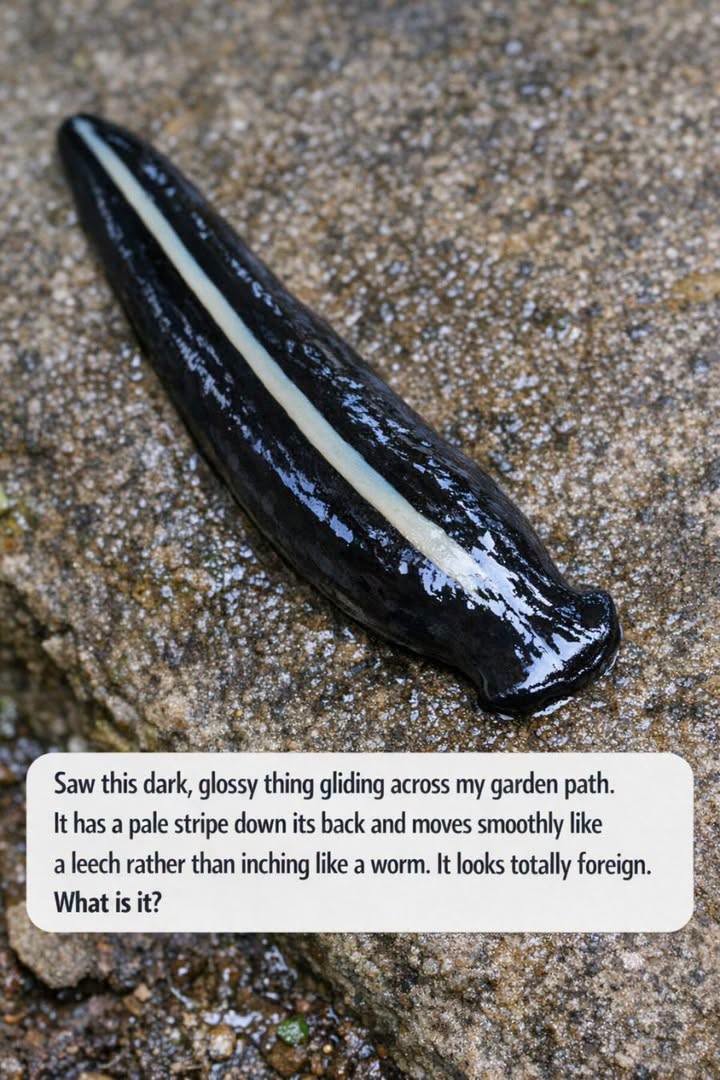
I Found This Strange Black Creature in My Garden — And It Wasn’t a Worm
Imagine walking through your garden after a rainy evening and suddenly noticing something unusual moving across the path.
At first glance, you might think it is an ordinary earthworm or perhaps even a leech. But when you look closer, something does not seem quite right.
The creature is dark, glossy, almost black, with a distinctive pale stripe running along its back. Instead of crawling or inching forward like a typical worm, it seems to glide smoothly across the wet surface.
That unusual appearance is enough to make almost anyone stop and wonder:
What exactly is this strange creature?
A Mysterious Visitor in the Garden
Gardens are home to countless small animals that we rarely notice. Many spend most of their lives underneath leaves, stones, logs, soil, and other damp hiding places.
After rain, however, conditions change.
Moisture can encourage worms, slugs, snails, and other soft-bodied creatures to leave their hiding places and move across exposed surfaces.
That is often when homeowners discover animals they have never seen before.
A dark, flattened creature with a light-colored stripe can be particularly surprising because it may look very different from the familiar earthworms normally found in gardens.
Its smooth movement can make it appear almost like a tiny leech sliding across the ground.
But appearances can be misleading.
It Could Be a Land Flatworm
Based on characteristics such as a flattened body, glossy appearance, pale stripe, and smooth gliding movement, one possibility is that the animal belongs to a group commonly known as land flatworms.
Land flatworms are terrestrial relatives of other flatworms and are generally found in moist environments.
Unlike ordinary earthworms, their bodies can appear noticeably flatter and smoother.
Some species also have distinctive stripes or patterns running along their bodies.
Their movement is another clue.
Rather than stretching and contracting in the obvious way an earthworm does, a land flatworm can appear to glide over a thin layer of mucus.
This can make its movement look surprisingly smooth.
However, identifying a species from a photograph alone can be difficult. Color, size, head shape, location, and other physical characteristics may all be important for an accurate identification.
Why Are They Showing Up in Gardens?
Moisture is one of the biggest factors.
Land flatworms generally prefer humid environments because their soft bodies can dry out relatively easily.
That means you are more likely to notice them:
- After rainfall
- Early in the morning
- Under flowerpots
- Beneath rocks and logs
- Around compost
- Under fallen leaves
- In shaded areas with moist soil
They may remain hidden during hot or dry periods and become much more noticeable when conditions are wet.
This is one reason someone can live in the same house for years without seeing one and then suddenly discover a strange-looking specimen crossing the garden.
Are They the Same as Earthworms?
No.
Although they may look somewhat similar from a distance, land flatworms and earthworms are very different animals.
Earthworms are segmented worms. If you look closely at a typical earthworm, you can usually see the small segments running across its body.
Many land flatworms, on the other hand, have a smoother and flatter appearance.
Their movement can also be noticeably different.
Earthworms generally move using muscular contractions, while flatworms can appear to glide.
There is another important difference.
Earthworms are extremely valuable to many garden ecosystems because their activity helps mix organic matter into soil and contributes to soil structure.
Some land flatworms are predators and may feed on other small soil animals, including earthworms.
Why Gardeners Pay Attention to Them
Finding one unusual creature does not automatically mean that your garden has a serious problem.
However, gardeners may want to pay attention if they repeatedly notice unfamiliar flatworms.
Certain non-native land flatworm species have attracted attention in different parts of the world because they can prey on earthworms and other soil organisms.
Earthworms play an important ecological role, so researchers are interested in understanding how introduced predators might affect local soil ecosystems.
The important point is not to panic.
A single photograph is rarely enough to determine exactly which species is present or whether it represents an ecological concern.
Proper identification matters.
What Should You Do If You Find One?
If you discover an unfamiliar worm-like animal in your garden, avoid immediately handling it with your bare hands.
Instead, take several clear photographs.
Try to photograph:
- The entire body
- The head
- The pattern or stripe
- The underside if this can be done safely
- Something nearby that shows its approximate size
You should also note where and when you found it.
Was it underneath a flowerpot?
Did it appear immediately after heavy rain?
Was it moving across concrete or living underneath leaves?
These details can make identification much easier.
If you suspect that you have discovered an unusual or potentially invasive species, consider contacting a local natural-history organization, agricultural extension service, university, or relevant environmental authority for identification advice.
Don’t Cut an Unknown Flatworm Into Pieces
There is another interesting reason to avoid cutting or crushing an unidentified flatworm.
Some flatworms are famous for their impressive regenerative abilities.
Depending on the species, portions of the animal may be capable of regenerating missing tissue.
That does not mean every land flatworm can simply become several completely new animals whenever it is cut, but it is still a good reason not to experiment with an unfamiliar specimen.
Observation and proper identification are much better approaches.
How Did It Get Into the Garden?
Sometimes these animals can spread unintentionally through human activity.
Soil, potted plants, landscaping materials, and garden products can transport small organisms from one location to another.
A flatworm hidden underneath a pot or inside moist soil could potentially travel a considerable distance without anyone noticing it.
This is also why gardeners sometimes discover unfamiliar creatures shortly after purchasing new plants.
Again, finding an unusual animal does not prove that it arrived through a recently purchased plant. It is simply one possible route by which small soil organisms can move between locations.
The Bottom Line
That strange dark creature gliding across a wet garden path may look like something from another world, but there is usually a natural explanation.
A flattened body, glossy surface, distinctive stripe, and smooth gliding movement can point toward a land flatworm rather than an ordinary earthworm.
Still, there are many species of worm-like animals, and appearances can vary considerably.
The safest approach is simple:
Take clear photographs, avoid unnecessary bare-hand contact, do not cut the animal apart, and seek local identification if you continue finding them.
Your garden contains an entire hidden ecosystem beneath your feet.
Sometimes all it takes is a rainy day for one of its strangest inhabitants to finally reveal itself.