
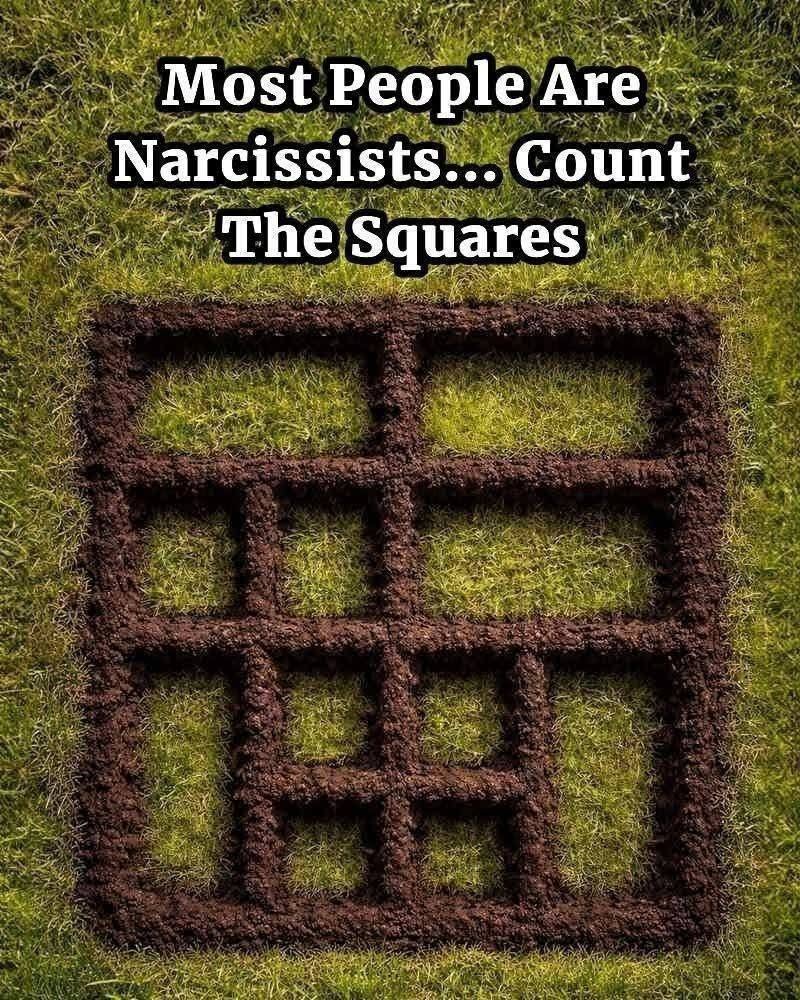
Look at the Horizontal Lines
After identifying the outer shape, examine the horizontal lines.
The image contains several horizontal divisions.
Some extend across large portions of the structure.
Others only appear inside smaller sections.
Each horizontal line should be examined together with the vertical lines that intersect it.
This is where you begin identifying smaller enclosed shapes.
Don’t immediately assume that every enclosed rectangle is a square.
A rectangle and a square are not the same thing.
A square has equal width and height.
A rectangle can have four right angles but different side lengths.
This distinction matters when solving a count the squares puzzle.
Follow the Vertical Lines
The next step is to follow the vertical boundaries.
Start from the top and move downward.
Ask yourself:
- Where does this vertical line begin?
- Where does it end?
- Which horizontal lines does it cross?
- Can it form the side of a larger square?
- Is there another vertical line at the correct distance?
This method is much more reliable than simply looking at the image and guessing.
When you find two vertical lines, look for two horizontal lines that connect them at the appropriate distance.
If all four sides exist and the dimensions match, you have identified a square.
Small Squares Are Not the Whole Answer
This is probably the most important lesson when solving a count the squares puzzle.
Don’t stop after counting the smallest shapes.
Small squares can combine to create larger squares.
For example, imagine four small squares arranged in a two-by-two pattern.
You have:
- Four small squares
- One large square
That means the arrangement contains five squares rather than four.
More complicated diagrams can contain several layers of this idea.
A three-by-three grid contains even more possible squares because larger combinations can be formed from the smaller cells.
Why Our Eyes Miss Larger Squares
Human vision is very good at recognizing simple patterns.
But when several lines overlap, we tend to focus on the smallest obvious shapes.
This is partly because our attention naturally breaks complicated images into smaller pieces.
A visual puzzle takes advantage of this tendency.
The designer wants you to notice the easy shapes first.
Then the challenge is to step back and see the entire structure.
This is why taking a short break can sometimes help.
Look away from the image for a few seconds.
Then look at it again.
You may suddenly notice a shape you missed before.
A Simple Method for Solving the Puzzle
Here is a reliable approach you can use for almost any square-counting challenge.
Step 1: Count the Smallest Squares
Start with the smallest clearly defined squares.
Don’t worry about larger combinations yet.
Write down the number.
Step 2: Look for Medium Squares
Next, look at combinations of two or more smaller sections.
Ask whether their outside boundaries form a larger square.
Step 3: Check the Outer Structure
Look at the larger divisions.
Some lines may create squares that include several internal sections.
Step 4: Count the Largest Square
Check whether the entire outside structure forms a square.
Step 5: Check for Overlapping Squares
Finally, examine whether any square uses only part of a longer boundary.
This final step is where many hidden shapes can be discovered.
Don’t Count Rectangles as Squares
One of the biggest mistakes people make in a count the squares puzzle is counting every enclosed area.
That doesn’t work.
A rectangle can be long and narrow.
A square must have equal sides.
So if you see a shape that looks like a box, don’t automatically count it.
Compare its width and height.
If the dimensions do not match, it should not be included as a square.
This is particularly important in the image because several areas look rectangular rather than perfectly square.