

Vintage Meat Grinder: What Is This Old Kitchen Tool For?
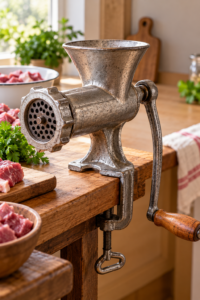
A metal device with a funnel on top, a crank on the side, and a clamp underneath can be difficult to identify if you have never seen one in use. The item in the photo is a vintage meat grinder, also known as a hand-cranked meat mincer or manual food grinder. It attaches to the edge of a sturdy table or counter. Turning the handle moves food through the body of the machine and out through a cutting plate at the front.
The raised lettering on this particular grinder appears to read ELMA, and the hopper has a 5 cast into it. Those markings may help identify its maker and size, but the photo alone does not establish its manufacturing date, exact model, or whether every original part is present.
Why You Should Never Ignore a Penny Stuck in Your Car Door Handle
These grinders were practical kitchen equipment long before electric food processors became common. A cook could use one to prepare mince for meatballs, sausages, burgers, or other dishes. Today, an old example might be a collectible, a decorative kitchen object, or a working tool—provided its materials, condition, and missing parts are carefully assessed.
Here is how to recognize the parts, understand the mechanism, and decide what to check before using a vintage meat grinder for food.
What Is a Vintage Meat Grinder?
A vintage meat grinder is a manually operated tool designed to mince meat by pushing it through a perforated metal plate. Unlike a knife, which chops pieces individually, a grinder moves food continuously through a tube. An internal spiral shaft advances it toward a cutting blade. As the blade turns against the plate, small pieces emerge through the plate’s holes.
The process requires no electricity. The user secures the machine to a work surface, loads appropriately sized pieces into the top opening, and turns the crank. The design is simple to recognize even when the grinder is missing an internal part: the hopper, horizontal body, front retaining ring, side handle, and table clamp give it its characteristic shape.
In the supplied photo, the broad opening at the top is the hopper. The wooden grip belongs to the crank, and the screw underneath tightens the clamp against a table edge. The round fitting at the left is the front of the machine, where the cutting components are normally held in place.
Because this is an older object, its visible shape tells us more about its purpose than its condition. A vintage meat grinder can look complete from the outside while lacking a blade, plate, or internal screw. Inspecting those pieces is the first step if you hope to use it.
Why Were Manual Meat Grinders Useful?
A manual grinder gave households a way to turn larger cuts or trimmings into mince at home. It also let the cook choose what went into a mixture and how coarse the result would be, provided compatible grinding plates were available.
That control still appeals to people who make their own burgers, meatballs, or sausages. Grinding a suitable cut just before cooking can give a different texture from repeatedly working ready-made mince. The result depends on the meat, the plate, the sharpness of the blade, and how smoothly the grinder operates.
A hand-cranked grinder also has straightforward limits. It requires physical effort, works more slowly than an electric machine, and must be taken apart for thorough cleaning. Its clamp needs a stable surface with an edge that fits. An attractive old grinder is therefore not automatically a convenient everyday tool.
The appeal of a vintage meat grinder can be historical as well as practical. Its solid metal body, cast lettering, and wooden handle show how ordinary kitchen tasks were accomplished with durable mechanical tools.