

How to Check Whether an Old Grinder Is Complete
Before thinking about recipes, inspect the equipment itself. Place the vintage meat grinder on a clean surface and look for the following components:
- The internal spiral shaft: This sits within the main body and turns with the crank.
- The cutting blade: It should be present, intact, and appropriate for the model.
- A perforated grinding plate: Check that it fits properly and is not bent or badly damaged.
- The front retaining ring: It should hold the cutting components securely without damaged threads.
- The crank and its fastener: The handle should attach firmly to the shaft.
- The clamp and screw: They should tighten securely to a suitable work surface.
If a part is missing, identify the precise grinder before seeking a replacement. The number stamped on a hopper may be helpful, but dimensions and part shapes still matter. An incorrect cutting assembly may fail to work properly or create a physical hazard.
Inspect metal surfaces closely. Look for deep corrosion, flaking material, damaged plating or coating, cracks, rough repairs, and crevices that cannot be cleaned. The fact that an object is old or made of heavy metal does not guarantee that its food-contact surfaces remain suitable for food use.
When the material or coating cannot be identified—or the interior cannot be cleaned thoroughly—displaying the grinder is the more sensible choice until a qualified specialist can assess it.
Cleaning and Food Safety Matter
A grinder has more food-contact areas than its simple exterior suggests. Meat can reach the hopper, shaft, blade, plate, front ring, and interior housing. If you intend to use any grinder for food, all of those parts need to be accessible for thorough cleaning.
Disassemble a working grinder promptly after use, following instructions appropriate to the model. Wash food-contact parts thoroughly, rinse them, and dry them completely before storage. Follow any material-specific care instructions; an old finish may respond differently from a modern stainless-steel appliance. Never leave bits of food lodged inside an assembled grinder.
Keep raw meat and the prepared mince cold, and prevent contact with ready-to-eat foods and clean utensils. Grinding moves meat across multiple surfaces, so starting with clean equipment and avoiding cross-contamination is essential. The USDA’s guidance on ground beef and food safety explains safe handling and recommends cooking ground beef to 160°F (71°C) as measured with a food thermometer. Follow the appropriate official guidance for whichever meat you use.
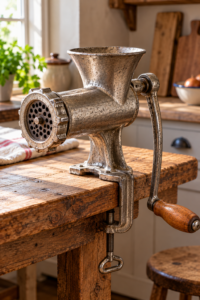
For the specific object in the photo, food safety begins with an inspection. The image does not let us verify its internal cleanliness, coating, blade, or plate. Treat it as an unidentified vintage food-contact item until those details have been checked.
Is This an Antique or a Vintage Item?
The image supports calling it an older-style hand-cranked grinder, but it does not provide enough evidence to date it accurately. “Vintage” is a useful general description here; “antique” would imply an age that needs more evidence.
The visible ELMA lettering and 5 marking are starting points for research. To narrow down the model or period, photograph:
- The lettering on both sides of the body.
- The hopper and any numbers cast into it.
- The underside of the clamp.
- The handle and its fastening point.
- The blade and plate, if the front can be safely disassembled.
- Any marks on the retaining ring or internal shaft.
Compare those details with reliable catalogues, original instructions, or specialist documentation for the same maker. Avoid assigning a manufacturing year based only on another grinder that looks similar. Designs and replacement parts can remain in circulation for a long time.
The same caution applies to value. An old grinder’s worth depends on identification, completeness, condition, local demand, and whether its surfaces and mechanism have been altered. A photograph alone cannot establish a reliable selling price.
Displaying a Vintage Meat Grinder
If you are not using it to prepare food, a vintage meat grinder makes an interesting piece of kitchen history. Display it where the crank, hopper, and clamp are visible; together, they help a viewer understand what the object does.
A shelf or sturdy sideboard is often easier than clamping an old tool to a valuable countertop. Protect surfaces from rough metal edges. If the clamp is fitted for display, tighten it only enough to keep the piece stable and use appropriate padding between metal and furniture.
Leave original markings visible if possible. They are part of the object’s identity. Aggressive polishing may remove details or alter a finish, so a cautious cleaning approach is preferable when preservation matters to you.
If you have a complete, food-safe grinder, freshly minced meat can be used for burgers, meatballs, or other meals. For more ideas after you’ve prepared the meat safely, browse our dinner recipes. The attachments and condition of your particular vintage meat grinder determine which foods it can process.
The text added over the supplied photo invites viewers to guess what the object is. For a website article, use a clean image of the grinder without the overlaid wording so readers can see the full clamp and handle. The existing image can still work as a social media guessing post.
Common Misidentifications
Is it a coffee grinder?
No. The pictured machine has the horizontal body, front output, crank, hopper, and clamp typical of a manual meat grinder or mincer. Coffee grinders usually use a different grinding mechanism and often collect the ground coffee in a drawer or container.
Is it a sausage maker?
It can be part of sausage preparation because sausage meat may first be ground. However, a stuffing function needs suitable attachments or separate equipment. No stuffing tube is visible in this photograph.
Is it a food processor?
It performs a food-processing task, but it is not a modern food processor. The crank powers a mechanical feed-and-cut system rather than spinning a blade in a bowl.
Is the number 5 a price or an age marking?
The image does not establish either interpretation. It is a cast number on the hopper that may relate to size or model identification. More documentation would be needed to say precisely what 5 means for this ELMA grinder.
When Should You Avoid Using It for Food?
Keep the grinder as a display piece unless you can confirm it is complete, cleanable, mechanically sound, and made with suitable food-contact surfaces. In particular, pause if you find:
- Cracks in the housing or clamp.
- A loose or damaged crank.
- Missing, incompatible, or badly worn cutting parts.
- Deep rust or corrosion on food-contact surfaces.
- Flaking coating or an unidentified repair inside the food path.
- Tight spaces that retain debris and cannot be cleaned.
Do not test a questionable vintage meat grinder by running food through it “just once.” Inspect and identify it first. A grinder that is attractive as a collectible does not have to be put back into kitchen service.
Frequently Asked Questions
What is the object in the photo?
It is a vintage hand-cranked meat grinder, also called a manual meat mincer. It clamps to a table and uses a crank-driven internal mechanism to move food toward a blade and perforated plate.
What does “ELMA” mean on the side?
It appears to be the name marked on the grinder’s body. The photograph does not provide enough information to confirm the item’s exact model, production date, or manufacturing history.
What does the number 5 mean?
It may be a size or model marking, but its precise meaning needs confirmation from documentation for this grinder. It should not be used on its own to date the object.
Can I use it to make ground beef?
Potentially, if the grinder has all the correct parts, operates properly, has suitable food-contact surfaces, and can be thoroughly cleaned. Those conditions cannot be verified from the image. Follow safe handling practices and cook ground beef to the appropriate internal temperature.
Can it make sausages?
A grinder can prepare minced meat for sausages. Filling casings requires a compatible stuffing attachment or separate stuffer; one is not shown in the photo.
Does it need electricity?
No. The wooden-handled crank provides the turning motion. The clamp holds the grinder steady while someone turns it.
Why is there a screw underneath?
That screw is part of the table clamp. Tightening it secures the grinder to the edge of a suitable table or counter.
How do I know if parts are missing?
Inspect the interior for the spiral shaft and the front for a cutting blade, perforated plate, and retaining ring. Compare their shapes and fit with documentation for the identified model. An exterior photo cannot confirm the complete cutting assembly.
Final Thoughts
The photo shows a recognizable piece of kitchen equipment: a vintage meat grinder with an ELMA marking, a number 5 on its hopper, a hand crank, and a table clamp. Its purpose is to mince food by moving it through an internal cutting assembly.
Whether this particular example belongs on display or can return to kitchen use depends on details the photograph cannot show. Check its parts, materials, condition, and cleanability before putting food through it. Even as a display piece, it offers a clear glimpse of how cooks once handled a common preparation task by hand.