
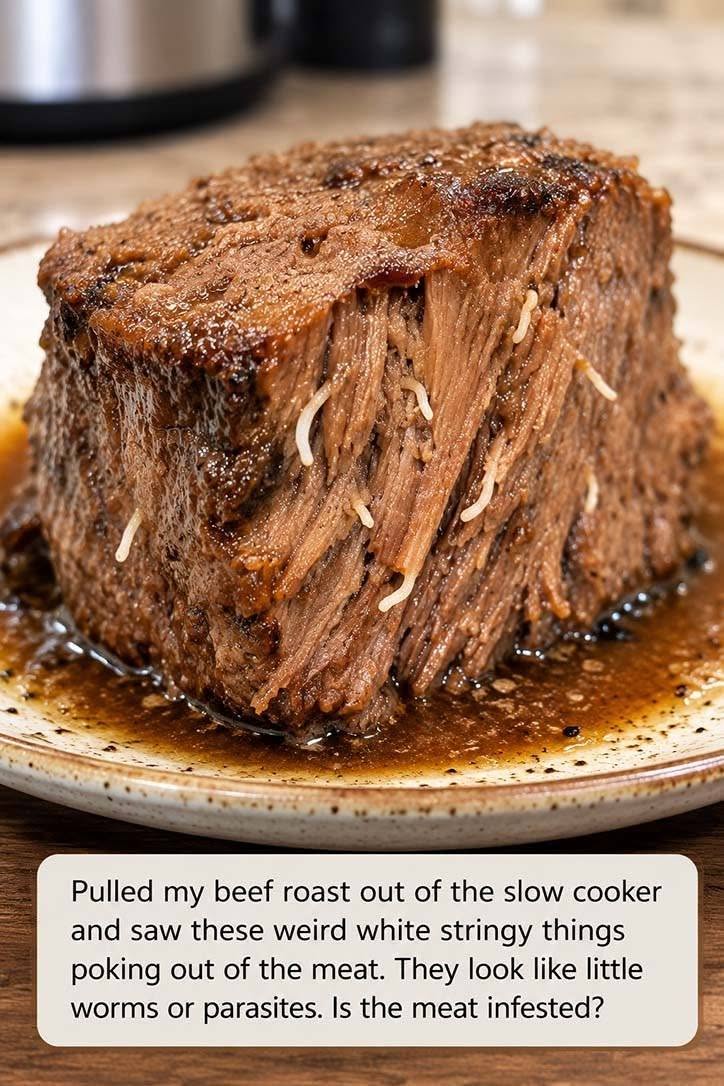
You lift the lid of your slow cooker after waiting hours for a beef roast to become tender.
The smell is wonderful. The meat looks juicy, and it practically falls apart when touched with a fork.
Then you notice something strange.
Tiny white or pale strands seem to be sticking out of the meat.
At first glance, they can look disturbingly similar to small worms.
For many home cooks, the immediate reaction is understandable:
“Is my beef infested with parasites?”
Before throwing the entire meal away, however, it is worth understanding what happens to beef during several hours of slow cooking.
In many cases, those pale strands are not worms at all. They are associated with the normal structure of meat—particularly connective tissue and collagen—which changes dramatically as a tough roast cooks slowly.
Still, appearance alone should never be used to declare questionable meat safe.
Here’s what you should know.
Why Beef Contains White Connective Tissue
A beef roast isn’t made entirely of red muscle.
Running between and around muscle fibers are different types of connective tissue. One of the major proteins associated with this tissue is collagen.
Collagen helps provide structure and strength.
Some beef cuts contain considerably more connective tissue than others because they come from muscles that were heavily used by the animal.
This is one reason cuts such as chuck and brisket are particularly well suited to long, slow cooking.
They may initially be tough, but time and heat can transform their texture.
What Happens to Collagen During Slow Cooking?
This is where the slow cooker becomes particularly useful.
During prolonged cooking in a moist environment, collagen gradually changes and can break down into gelatin.
That transformation contributes to the tender, rich texture associated with properly cooked pot roast, brisket, and other slow-cooked meats.
As the meat softens and its fibers separate, pale connective tissue can become much more visible.
Some portions may look:
- White
- Cream-colored
- Translucent
- Gelatinous
- Stringy
- Thread-like
Because the meat surrounding those strands has become darker during cooking, the pale tissue can stand out dramatically.
That’s often what creates the alarming “worm-like” appearance.
Why Can the Strands Suddenly Stick Out?
Continued on next page:
Raw meat is tightly structured.
During cooking, muscle proteins change, moisture is lost, connective tissue softens, and the overall structure of the roast changes.
Once you begin pulling the tender meat apart, connective tissue that was previously hidden can become exposed.
A thin strand surrounded by shredded beef can look remarkably biological when viewed out of context.
But something looking like a worm does not automatically make it a parasite.
Connective Tissue or Parasite?
This is the question most people want answered.
Unfortunately, photographs and descriptions aren’t always enough to identify every unusual structure in meat with certainty.
Normal connective tissue tends to be integrated into the structure of the meat rather than appearing as an independent organism.
After prolonged cooking, it may be soft, stretchy, slippery, gelatinous, or easy to pull apart.
You may also see multiple irregular strands running along natural separations between muscle fibers.
That appearance is compatible with connective tissue.
A genuinely unusual structure that is clearly distinct from the surrounding meat deserves more caution.
If you cannot confidently identify what you’re seeing, don’t rely on an internet photograph or social-media comment to decide that the meat is safe.
Are Parasites Possible in Beef?
Parasites associated with cattle do exist.
So it would be inaccurate to claim that parasites in beef are literally impossible.
Food inspection, commercial processing, proper storage, and proper cooking all play important roles in reducing food-safety risks.
This is also why buying meat from reputable, regulated sources matters.
The mistake is going to either extreme.
You shouldn’t assume every white strand is a parasite.
But you also shouldn’t declare every unusual object in meat to be harmless collagen without considering the rest of the evidence.
Look at the Meat Before Cooking
The condition of the roast before it enters the slow cooker can tell you a lot.
If raw beef has an obvious unpleasant or abnormal odor, unusual sliminess, or other convincing signs of spoilage, cooking it for several hours isn’t a sensible way to rescue it.
Cooking can destroy many microorganisms when appropriate temperatures are reached, but cooking isn’t a magical reset button for spoiled food.
When meat clearly appears spoiled before cooking, the safer choice is to discard it.
Storage History Matters
How the meat was handled before cooking is extremely important.
Raw beef should be kept refrigerated or frozen appropriately.
Leaving meat at unsafe temperatures for extended periods can allow microorganisms to multiply.
That risk cannot be evaluated simply by looking at a finished roast.
Think about where the beef came from, how it was transported, whether it remained cold, how long it was refrigerated, and whether it was thawed safely.
A normal appearance doesn’t compensate for clearly unsafe storage.
What About the Smell?
Continued on next page:
Odor can provide useful information about spoilage, although it isn’t a perfect safety test.
A properly cooked beef roast should have the expected savory aroma associated with the meat and ingredients used in the recipe.
If you encounter a distinctly abnormal, rotten, or otherwise strongly unpleasant odor, take that seriously.
Don’t taste suspicious meat simply to determine whether it’s safe.
When in doubt, throwing away one roast is far preferable to risking foodborne illness.
Don’t Judge Safety by Color Alone
Color can also be misleading.
Raw and cooked beef can display different shades depending on oxygen exposure, cooking method, ingredients, temperature, and other factors.
That’s why statements such as “red means fresh” or “brown means safe” are oversimplifications.
For cooked meat, a food thermometer provides much more useful information than color alone.
Use a Food Thermometer
A food thermometer is one of the most useful tools in a kitchen.
Instead of guessing whether meat reached an appropriate temperature based on its color or texture, you can actually measure it.
For whole cuts of beef, follow recognized food-safety guidance for minimum internal temperatures and resting time.
Remember, however, that slow-cooker recipes designed to make tough roasts fall-apart tender often cook the meat considerably beyond the minimum temperature needed for basic food safety.
That’s because tenderness and minimum safe temperature are two different questions.
A tough roast needs enough time for connective tissue to soften.
Why Tough Beef Cuts Work So Well in a Slow Cooker
The exact feature that can make a raw roast seem less appealing—its connective tissue—is one of the reasons it can become so delicious after slow cooking.
Cuts rich in collagen can start relatively tough.
Give them sufficient time in a moist cooking environment, and their texture changes.
The meat becomes easier to shred, while gelatin contributes richness to the cooking liquid.
So those strange-looking pale pieces may actually be connected to the process responsible for the texture you wanted.
Fat Can Also Look Strange
Connective tissue isn’t the only pale material you may encounter.
Beef naturally contains fat.
After cooking, some fat may remain white or cream-colored, while other portions render into the cooking liquid.
Depending on the cut and temperature, cooked fat can appear soft, gelatinous, stringy, or waxy.
Again, context matters.
Not every pale object in cooked beef is the same thing.
Why Social Media Makes This Look Scarier
Continued on next page:
Food photographs can be surprisingly deceptive.
Take a close-up picture of a thin strand of connective tissue, crop out the rest of the roast, and suddenly it can look much more alarming than it did on the dinner table.
Add a caption asking:
“IS MY MEAT INFESTED?”
and thousands of people may immediately assume the worst.
This is one reason food-safety questions shouldn’t be answered solely by viral comments.
The physical condition of the food, its storage history, cooking method, temperature, source, smell, and texture all provide useful context that a photograph cannot fully capture.
When You Probably Don’t Need to Panic
If you bought the beef from a reputable source, stored and thawed it correctly, cooked it appropriately, and the roast otherwise looks and smells normal, pale irregular strands that appear integrated into the meat may simply be connective tissue exposed during cooking.
This is especially plausible in connective-tissue-rich cuts cooked for several hours.
The appearance can certainly be unpleasant if you’ve never seen it before.
But unfamiliar doesn’t automatically mean dangerous.
When You Should Be More Cautious
Stop and investigate further if something genuinely seems abnormal.
Examples include meat with obvious spoilage signs, questionable storage history, severely damaged packaging before cooking, or a structure that looks clearly separate and unlike ordinary fat or connective tissue.
Also be cautious if you don’t know where the meat came from or how it was handled.
If you’re genuinely uncertain, don’t eat it merely because someone online says, “It’s definitely collagen.”
A butcher, food-safety authority, or other qualified professional may be able to provide better guidance depending on the situation.
Can You Simply Cut the White Strings Away?
If you’ve established that what you’re seeing is ordinary connective tissue or fat, removing it becomes a matter of preference rather than necessity.
Some people enjoy the rich gelatinous texture.
Others don’t.
You can pull away any pieces you find unpleasant and serve the remaining meat.
There’s nothing wrong with having a texture preference.
Why the Cooking Liquid May Turn Gelatinous
There’s another surprise that sometimes concerns people after making roast beef.
Place leftover cooking juices in the refrigerator and you may discover that the liquid has turned into something resembling jelly.
That can be perfectly consistent with gelatin produced during the breakdown of collagen.
When chilled, gelatin-rich cooking liquid can become noticeably firm.
Once reheated, it generally becomes liquid again.
This property is one reason slow-cooked stocks, broths, and braising liquids can develop such a rich mouthfeel.
What If You See the White Material Before Cooking?
Raw beef also contains visible connective tissue and fat.
Silvery membranes, pale seams, and white bands running through a roast can all be normal anatomical structures.
Some tougher exterior connective tissue—often referred to in cooking as “silverskin”—may be trimmed depending on the cut and recipe.
Visible fat can also be trimmed according to preference.
However, if you see something in raw meat that genuinely looks abnormal rather than like ordinary tissue, don’t simply assume slow cooking will make the problem disappear.
Ask the butcher or retailer, or avoid using the meat if its safety is genuinely questionable.
A Simple Checklist Before Eating Your Roast
Continued on next page:
If strange white strands have appeared, consider the entire situation.
Where did the meat come from?
Was it purchased from a reputable source?
Was it stored properly?
Did it remain refrigerated or frozen as appropriate?
Was it thawed safely?
Avoid unsafe extended room-temperature thawing.
Did it smell normal before cooking?
Obvious spoilage odors deserve attention.
Was it cooked properly?
Use appropriate time and temperature guidance.
What do the white strands look like?
Are they irregular and integrated with the meat’s natural fibers and connective tissue?
Is anything else unusual?
One unexpected visual feature is very different from multiple signs that something may be wrong.
The Biggest Mistake to Avoid
The biggest mistake isn’t necessarily eating a harmless strand of collagen.
It’s relying on one visual clue to make a complete food-safety decision.
Food safety is rarely that simple.
A roast can contain completely normal white connective tissue.
A piece of meat can also look normal and still have been stored improperly.
That’s why safe purchasing, refrigeration, thawing, preparation, cooking, and leftover storage all matter.
The Bottom Line
Finding strange white strings sticking out of a slow-cooked beef roast can be alarming, especially when they resemble tiny worms.
But in many ordinary slow-cooked roasts, pale stringy or gelatinous material can be part of the beef’s natural connective tissue and collagen becoming more visible as the meat cooks and softens.
Slow cooking changes the structure of collagen and contributes to the tender texture people love in cuts such as chuck and brisket.
That doesn’t mean every unusual object found in meat should automatically be declared harmless.
If the beef shows signs of spoilage, was stored improperly, comes from an uncertain source, or contains something you genuinely cannot identify, caution is appropriate.
But when a properly handled roast smells normal, has been cooked correctly, and simply develops irregular pale strands among the softened muscle fibers, the explanation may be much less frightening than it first appears.
Sometimes what looks alarming on your dinner plate is simply the hidden structure of the meat becoming visible after hours of slow cooking.
And understanding that difference can save a perfectly good dinner from being thrown away for the wrong reason.