
What Should You Do If You Find Something Similar?
Don’t immediately throw away the entire bedding set.
Start with a simple inspection.
Step 1: Take a Clear Photograph
Photograph the object from several angles.
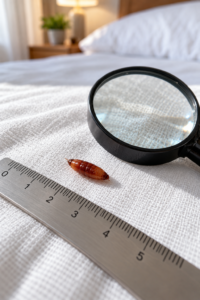
Place a familiar object next to it for scale, such as a coin or ruler.
This is much more useful than a close-up without any size reference.
Step 2: Check the Bed
Inspect:
- Mattress seams
- Mattress corners
- Under the mattress
- Bed frame
- Headboard
- Box spring
- Around the legs of the bed
- Nearby furniture
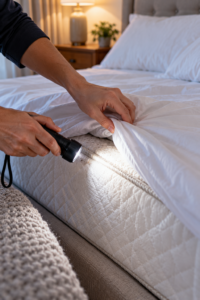
Use a flashlight.
Look for additional evidence rather than focusing only on the original object.
If you notice unusual marks or other signs around your sleeping area, you may also want to read our guide to common household pests and how to identify them.
Step 3: Check the Bedding
Remove the sheets and inspect them carefully.
Look for:
- Unusual stains
- Tiny dark spots
- Shed insect skins
- Small insects
- Eggs
- Additional unexplained objects
Pay particular attention to seams and folds.
Step 4: Check Nearby Furniture
If something is on the bed, inspect the surrounding area too.
Check:
- Nightstands
- Drawers
- Chairs
- Curtains
- Rugs
- Baseboards
- Closets
An object that appears mysterious in isolation may become much easier to understand when you discover where similar objects are coming from.
Step 5: Look for Patterns
One object is different from twenty identical objects.
If you find one unexplained piece, it may simply be debris.
If you find dozens of identical pieces repeatedly appearing in the same location, investigate further.
Patterns are often more useful than appearance.
What If You Find More of Them?
Finding additional objects does not automatically mean you have an infestation.
But it does increase the importance of identifying their source.
Ask yourself:
Are They All the Same Size?
Identical objects may indicate a manufactured item or biological source.
Are They All in One Area?
A concentrated location may indicate where they are coming from.
Are They Moving?
If they move, that changes the investigation significantly.
Are There Legs?
If you can clearly see legs, you’re dealing with an organism rather than an ordinary seed or piece of debris.
Are There Eggs Nearby?
If you find genuine insect eggs alongside the objects, professional identification becomes more useful.
What If the Objects Move?
This is an important distinction.
If the objects are genuinely moving on their own, take another photograph or short video if you can do so safely.
Do not touch an unknown moving organism with bare hands.
A moving object could potentially be:
- An insect
- Larva
- Mite
- Other small arthropod
Movement can provide much more information than color alone.
Don’t Rely on Color Alone
Many different things can be brown.
For example:
- Seeds can be brown.
- Food can be brown.
- Insect bodies can be brown.
- Droppings can be brown.
- Wood fragments can be brown.
- Plastic can be brown.
- Dried plant material can be brown.
Shape, size, texture, location, movement, and surrounding evidence all matter.
This is why identifying an object from a single photograph can be unreliable.
What Information Would Help Identify It?
If you want to investigate an unknown object, collect as much information as possible.
Size
Measure it in millimeters if possible.
Texture
Is it:
- Hard?
- Soft?
- Rubbery?
- Brittle?
- Sticky?
- Hollow?
Shape
Is it:
- Round?
- Oval?
- Elongated?
- Flat?
- Segmented?
- Ridged?
Color
Take photographs under natural light.
Artificial lighting can change the apparent color.
Location
Where exactly did you find it?
The mattress?
The pillow?
Under the bed?
On a blanket?
Near a window?
Location can provide important clues.
Why You Shouldn’t Immediately Spray Pesticides
If you don’t know what the object is, spraying random pesticides may not solve the problem.
It can also expose people and pets to unnecessary chemicals.
First determine whether there is actually a pest problem.
If you find convincing evidence of an infestation, identify the pest as accurately as possible before choosing a treatment.
For suspected bed bugs, for example, professional pest identification can be much more useful than randomly treating the bedroom.
When Should You Consider Professional Pest Control?
Consider professional help if you find:
- Multiple live insects
- Repeated evidence of pests
- Numerous eggs or egg cases
- Persistent unexplained bites together with other evidence
- Significant droppings
- Damage to furniture or structures
- A suspected infestation that keeps returning
A professional can inspect areas that are difficult to evaluate yourself.
What About Skin Bites?
If you wake up with unexplained marks, it can be tempting to assume that an object found on the bed is responsible.
But skin marks alone generally cannot identify the cause.
Many things can produce similar-looking skin reactions.
Instead of trying to diagnose the cause from the appearance of a mark, look for environmental evidence and consider speaking with a healthcare professional if the skin reaction is persistent, severe, or concerning.
Don’t Assume Every Mysterious Bed Object Is a Parasite
Online posts about mysterious objects can quickly become alarming.
Someone sees a tiny object and immediately suggests:
- Parasites
- Bed bugs
- Worms
- Fleas
- Mites
- Dangerous insects
Those claims are often made without enough evidence.
A responsible identification should be based on observable characteristics rather than fear.
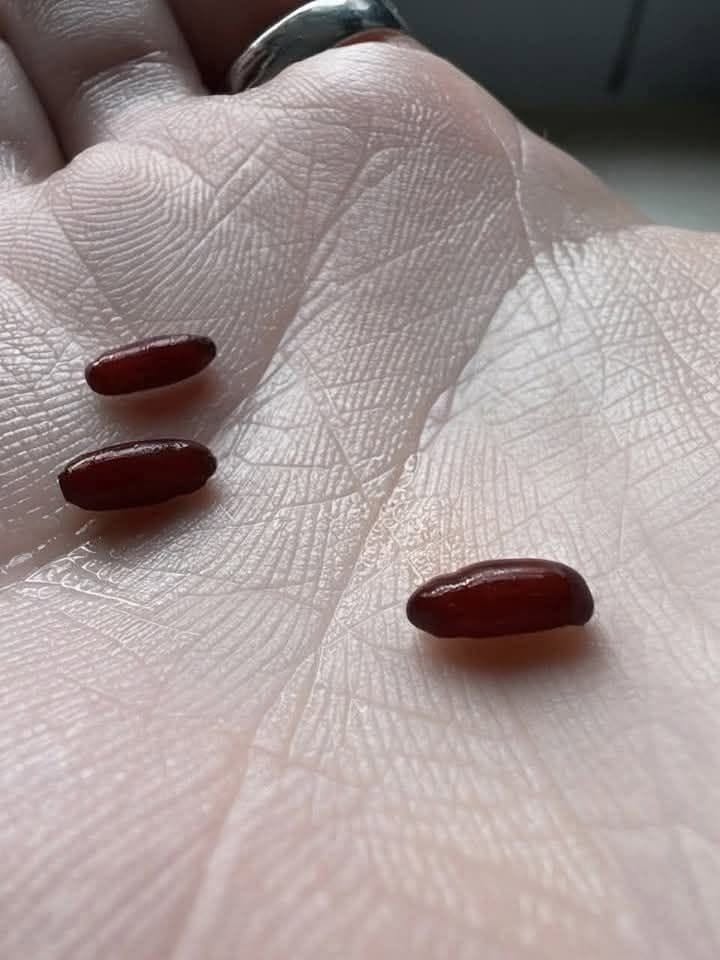
In this particular photograph, there are not enough distinctive details to confidently identify the objects as parasites or a specific pest.
That distinction is important.
What Makes the Objects in the Photo Unusual?
The objects appear relatively smooth and solid.
They don’t obviously show:
- Legs
- Antennae
- Wings
- Hair
- Obvious segmentation
Their dark reddish-brown appearance is also not enough to identify them.
They could potentially be biological material, food, seeds, or another small object.
Without knowing their exact size, texture, origin, and whether they move, a definitive identification would be speculation.
A Simple Home Inspection Checklist
If you find something strange on your bed, use this checklist:
On the Object
- Measure it
- Photograph it from multiple angles
- Check whether it moves
- Look for legs
- Look for segmentation
- Check whether it is hollow
- Check whether it breaks easily
Around the Bed
- Inspect mattress seams
- Inspect the bed frame
- Check under the mattress
- Check nearby furniture
- Look for additional objects
- Look for stains
- Look for insects or shed skins
Around the Room
- Check baseboards
- Check rugs
- Check curtains
- Check closets
- Check pet bedding
- Check food storage areas
This method gives you much more useful information than simply staring at the original object.
What If You Only Found One?
If you found only one or two objects and there are no other signs of insects or rodents, don’t automatically assume the worst.
Clean the bedding, vacuum around the bed, and continue observing.
If nothing else appears, the object may have been accidental debris.
If more identical objects appear, investigate the source.
What If You Keep Finding Them?
Repeated discoveries deserve more attention.
Try placing a clean sheet on the bed after cleaning the area.
Then check the bed again after sleeping.
Also inspect nearby surfaces.
If new objects repeatedly appear in the same location, you may be able to determine where they are coming from.
For example, you might discover that they are falling from:
- A damaged ceiling area
- A plant
- A piece of clothing
- Pet bedding
- A nearby food package
- Furniture
- A household item
Could the Bed Itself Be the Source?
Sometimes.
Old mattresses, damaged bed frames, loose fabric, and deteriorating foam can produce small fragments.
If the object resembles a piece of material rather than an organism, inspect the bed itself.
Check for:
- Torn seams
- Loose threads
- Crumbling foam
- Damaged wood
- Broken plastic
- Decorative pieces
A small object can travel surprisingly far from its original source.
How to Clean the Area Safely
For ordinary unidentified debris, normal cleaning is generally sufficient.
Wash bedding according to the care instructions.
Vacuum around the bed.
Clean nearby surfaces.
If you suspect biological contamination such as rodent droppings, use appropriate precautions rather than sweeping or vacuuming the material dry.
Follow established public-health cleaning guidance for the specific suspected source.
What If You Have Pets?
Pets change the investigation considerably.
Check where your pet sleeps.
Inspect blankets, toys, and fur.
Also consider whether your pet has recently been outdoors.
A small object found on your bed may have traveled there without the animal being directly responsible for any infestation.
If your pet has unexplained itching, visible parasites, or other symptoms, consult a veterinarian rather than trying to identify a possible parasite from a household photograph.
What If Children Sleep in the Room?
Children may bring small objects into bedrooms without realizing it.
Seeds, beads, pieces of food, toys, and craft materials can all end up in bedding.
If the object is small enough to pose a choking risk, keep it away from young children until you know what it is.
Don’t allow children to put unidentified objects in their mouths.
Could It Be a Seed From Outside?
Yes.
If you have outdoor plants, trees, gardens, or landscaping near windows, seeds can enter homes surprisingly easily.
They can also be transported indoors on:
- Shoes
- Pants
- Blankets
- Bags
- Pets
- Gardening clothing
If the object has a hard shell and does not move, a seed or plant fragment becomes a reasonable possibility.
Could It Be a Piece of Jewelry or Decoration?
Also possible.
Small beads and decorative pieces can look surprisingly organic.
If the objects are unusually uniform in size, extremely smooth, and have a glossy surface, consider manufactured materials.
Look around the room for:
- Jewelry
- Clothing decorations
- Toys
- Craft supplies
- Broken accessories
Sometimes the answer is much less mysterious than expected.
The Most Important Lesson
When you find something strange on your bed, don’t let the photograph make the diagnosis for you.
A close-up image can make tiny objects look dramatic.
Instead, ask:
- What is the exact size?
- Does it move?
- Does it have legs?
- Is it attached to anything?
- Are there more?
- What else is around it?
- Where could it have come from?
- Are there any other signs of pests?
Those questions can quickly narrow down the possibilities.
Frequently Asked Questions
What is this on my bed?
The objects in the photograph cannot be identified with certainty from the image alone. They appear to be small, smooth, reddish-brown objects without obvious insect legs or other distinctive structures.
Are these bed bug eggs?
They do not closely resemble typical bed bug eggs, which are generally very small and pale or whitish. A photograph alone cannot rule out bed bugs in a room, however.
Are these bed bug droppings?
The objects shown do not have the typical appearance of bed bug fecal spotting, which is generally seen as dark stains or spots rather than smooth capsule-like objects.
Could these be cockroach eggs?
Cockroach egg cases usually have a more recognizable capsule or ridged appearance. The objects in this image do not provide enough evidence to identify them as cockroach egg cases.
Could they be seeds?
Yes. Some seeds can be small, dark, smooth, and elongated. If the objects are hard and do not move, this is one possibility worth considering.
Could they be insect pupae?
Possibly, depending on their exact size and characteristics, but the photograph does not contain enough information to identify them as pupae.
Should I be worried?
Not necessarily. One unexplained object does not establish an infestation. Look for additional evidence around the bed and nearby furniture.
What should I do first?
Take clear photographs, measure the object, inspect the mattress and surrounding area, and look for additional examples.
Should I throw away my mattress?
No. Do not discard a mattress based on an unidentified object alone.
First determine whether there is actual evidence of an infestation or contamination.
Should I spray insecticide?
Not simply because you found an unidentified object. Identify the problem first whenever possible.
What if I find more objects?
Document where you find them and whether they appear identical. Repeated discoveries in one area may help identify their source.
What if the objects are moving?
Take a clear photograph or video without touching them directly. Movement can provide important identification information.
What if I find insects too?
If you find live insects along with the objects, photograph them clearly and consider professional identification if you cannot determine the species.
Can I wash my bedding?
Yes. Wash bedding according to its care instructions. Cleaning the surrounding area is also a sensible step while you investigate.
Can pets bring objects into the bed?
Yes. Pets can carry small debris, plant material, food particles, and other objects into bedrooms.
Could the object simply be food?
Yes. Small pieces of dried food, nuts, seeds, or other foods can sometimes look surprisingly unusual in close-up photographs.
Can a photograph identify an insect?
Sometimes a clear photograph can provide useful clues, but identification is not always possible from a single image. Size, location, movement, and multiple photographs can improve the chances of identification.
Should I ask an exterminator?
If you repeatedly find unexplained objects together with insects, droppings, eggs, damage, or other signs of an infestation, professional inspection can be worthwhile.
What to Do Tonight
If you just found something similar on your bed and you’re wondering what to do right now, keep it simple.
First, remove the object and place it in a small sealed container or on a clean piece of paper if you want to examine it later.
Take photographs.
Then remove the bedding and inspect the mattress seams and bed frame with a flashlight.
Vacuum the area around the bed.
Wash the bedding according to its care instructions.
Finally, check the room again after cleaning.
If you don’t find any insects, eggs, stains, droppings, or additional objects, there may be no reason to assume you have a pest problem.
If you continue finding the same objects or discover additional signs, that’s when a more detailed inspection becomes worthwhile.
Final Thoughts
Finding something strange on your bed can definitely make you stop and look twice.
The small reddish-brown objects in the photograph are unusual enough to attract attention, but they cannot be confidently identified from the image alone.
Importantly, they do not clearly match typical bed bug eggs, and their appearance alone is not enough to establish a pest infestation.
They could potentially be a harmless object such as a seed, food fragment, manufactured piece, or another small item. Depending on their exact characteristics, other biological explanations may also be possible.
The best approach is to investigate rather than panic.
Take a clear photograph, measure the object, check whether it moves, inspect the mattress and bed frame, and look for additional evidence.
If you find repeated signs of insects or rodents, professional identification can help determine exactly what you’re dealing with.
And if you discover that the mysterious objects are simply seeds, food particles, or household debris, you’ll have solved the mystery without turning your bedroom into a chemical treatment zone.
Sometimes the creepy-looking object on your bed really is something ordinary.
The important thing is to look for evidence before deciding what it is.