
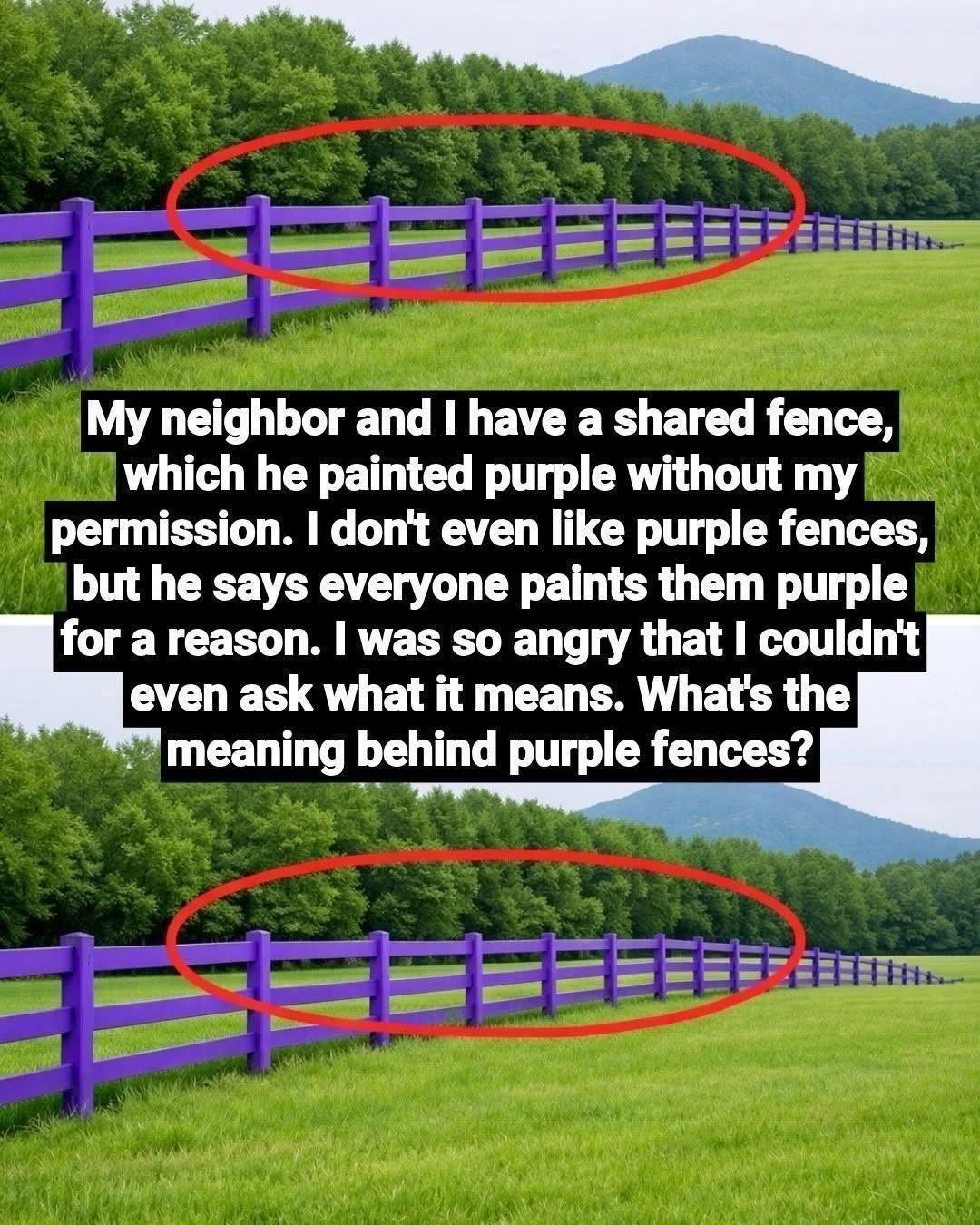
Purple Paint Doesn’t Always Mean a Purple Fence
This is an important detail that can easily be missed.
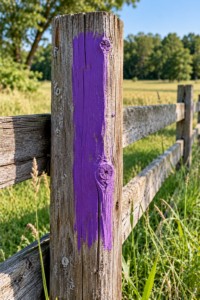
When people talk about the “purple paint law,” they’re often referring to purple marks on trees or posts, rather than an entire fence being painted purple.
For example, Texas law describes specific purple paint marks on trees or posts. The marks must be vertical lines at least 8 inches long and at least 1 inch wide, with the bottom of the mark positioned between 3 and 5 feet above the ground. They must also be readily visible and meet spacing requirements. sll.texas.gov
Missouri has its own requirements for purple marks, including dimensions, visibility, height, and spacing. revisor.mo.gov
So if you see an entire fence painted purple, don’t automatically assume the entire fence qualifies under a particular state’s purple-paint statute.
The purple fence meaning depends on the circumstances and the applicable state law.
How the Texas Purple Paint Rule Works
Texas provides one of the clearest examples.
Under Texas Penal Code Section 30.05, notice that entry is forbidden can be communicated in several ways, including signs, fencing, verbal or written communication, and qualifying purple paint marks. Parcs et Faune du Texas
The purple markings have specific requirements.
The markings must be vertical
A qualifying mark isn’t simply a random splash of purple paint.
Texas requires a vertical line.
The markings have minimum dimensions
The line must be at least 8 inches long and at least 1 inch wide. sll.texas.gov
They must be placed at the appropriate height
The bottom of the purple marking must be at least 3 feet but no more than 5 feet above the ground. sll.texas.gov
They must be visible
The markings need to be readily visible to someone approaching the property.
Spacing matters
Texas law provides different maximum spacing depending on the type of land: no more than 100 feet apart on forest land and no more than 1,000 feet apart on land other than forest land. Parcs et Faune du Texas
These details demonstrate why simply painting a random purple line on a fence doesn’t automatically establish the same legal notice.
What About Missouri?
Missouri has a similar but distinct system.
Under Missouri Revised Statutes Section 569.145, an owner or lessee may post property using identifying purple marks on trees or posts. revisor.mo.gov
The statute specifies that vertical marks must be at least 8 inches long, with their bottom edge between 3 and 5 feet above the ground.
The marks must also be readily visible and generally no more than 100 feet apart. Missouri law also provides an alternative involving marked posts with additional spacing and height requirements. revisor.mo.gov
This is a good example of why the exact purple fence meaning should always be considered in the context of the state where the property is located.
Why Purple Instead of Red or Orange?
You might wonder why purple was selected.
The answer is largely about creating a distinctive visual signal.
Property boundaries can be difficult to identify, particularly in wooded or rural areas. A distinctive paint color can stand out against trees, grass, and natural surroundings.
Texas A&M AgriLife Extension has explained that purple paint is used in Texas as an alternative form of trespass notice, while also emphasizing that the rules surrounding the markings matter. Texas A&M AgriLife
The color therefore functions as a recognizable warning where state law gives it that meaning.
Does a Purple Fence Mean You Can Never Enter?
Not necessarily.
The marking generally communicates that you do not have permission to enter.
There can obviously be circumstances where a property owner gives someone permission to enter.
For example, the owner might allow:
- A neighbor to cross the property
- A contractor to enter
- A utility worker to access equipment
- A guest to visit
- A hunter to use the land
- A delivery person to approach a building
Permission changes the situation.
The important point is that a purple marking should not be interpreted as an invitation.
What Should You Do If You See Purple Paint?
The safest response is straightforward.
Stop and identify the boundary
Don’t continue walking simply because you aren’t sure what the marking means.
Look for signs, gates, property boundaries, or other indicators.
Don’t cross without permission
If the property appears to be privately posted, don’t assume you can enter because there isn’t a traditional “No Trespassing” sign.
In states where qualifying purple markings are legally recognized, the paint itself may provide the required notice. sll.texas.gov
Check local rules
If you have a legitimate reason to access the property, find out what the applicable state and local rules are.
Ask the property owner
When possible, permission is the easiest solution.
A simple conversation can prevent an unnecessary misunderstanding.
Common Misunderstandings About Purple Fences
“Every purple fence in America means no trespassing.”
Not necessarily.
The legal meaning of purple paint varies by state, and a completely purple fence may not satisfy a state’s specific statutory requirements.
“Any purple paint is legally binding.”
Again, no.
Where statutes apply, they can specify the size, shape, location, visibility, and spacing of the markings.
“Purple paint is just decoration.”
Sometimes it may be.
But if you’re in a state that recognizes purple-paint posting, you should not assume it’s decorative.
“A purple marking means the property owner hates visitors.”
Not necessarily.
For many rural landowners, the marking is simply a practical way to communicate a property boundary and discourage unauthorized entry.
“If there’s no sign, I can enter.”
That’s a dangerous assumption.
Depending on state law, fencing, paint, verbal notice, or other circumstances may provide notice even without a traditional sign. Texas law is one example of this. Parcs et Faune du Texas
Purple Fence vs. Purple Paint Markings
These terms are sometimes used interchangeably online, but they’re not necessarily identical.
| Purple fence | Purple paint marking |
|---|---|
| May simply be a design choice | Can be a legal property notice in some states |
| Entire fence may be painted | Often consists of specific marks |
| Legal effect depends on local law | Statutory requirements may apply |
| Could be decorative | Usually intended to communicate a warning when used under the law |
This distinction is important when discussing the purple fence meaning.
Why This Matters for Hikers and Hunters
People who spend time outdoors may encounter purple markings more often than city residents.
A person walking through a rural area might see purple paint on:
- Trees
- Fence posts
- Wooden posts
- Property boundaries
Someone unfamiliar with the system might think the marks indicate a hiking trail or boundary decoration.
That’s exactly why understanding the signal can be useful.
If the marking is being used as a legally recognized property notice, crossing it without permission could potentially constitute trespassing.
Missouri’s statute, for example, specifically recognizes qualifying purple marks as a way of posting property against trespassers. revisor.mo.gov
Why Landowners May Prefer Paint
From the landowner’s perspective, purple paint can offer several practical advantages.
It is highly visible
The unusual color stands out.
It can be inexpensive
Compared with repeatedly replacing signs, paint can be a relatively simple property-marking method.
It doesn’t require a large sign
A small marking can communicate a boundary without putting up a large board.
It can work along large properties
On rural land covering many acres, traditional signs may need to be installed repeatedly.
Where state law permits it, properly spaced paint markings can make the boundary easier to identify.