
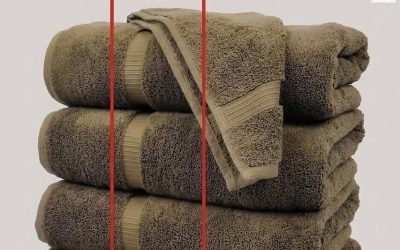
2. They Help the Towel Maintain Its Shape
In this way, the lines on bath towels may provide extra stability in an area exposed to frequent handling.
The flatter, tighter weave adds structure near the towel’s ends. These areas are handled frequently, pulled during use, folded, washed, and tumbled in dryers.
Without sufficient structure, repeated laundering can cause a towel’s ends to twist, stretch, or lose their clean rectangular shape more quickly.
Textile specialists quoted by Good Housekeeping’s Textiles, Paper & Apparel Lab explain that a dobby border can help a towel retain its shape and resist fraying. However, they also note that towels can function without one.
Therefore, it is best to view the border as a useful structural feature, not something every towel absolutely needs.
3. They Can Help Control Fraying
The edges and ends of textiles receive considerable stress. A tighter woven section near the end can help stabilize the construction before the finished hem.
This does not mean the dobby border makes a towel indestructible. Poor stitching, harsh laundering, chlorine bleach, overloaded machines, and pulling loose threads can still cause damage.
The quality of the cotton, yarn, hem, stitching, and overall construction also influences durability.
4. They Are Partly Decorative
Manufacturers also use the lines on bath towels to create a distinctive, polished appearance.
The dobby border gives a towel a cleaner and more polished appearance. Manufacturers can use different patterns, colours, and widths to distinguish a collection.
On hotel towels, the lines create a simple professional style without requiring printed graphics. On decorative towels, the woven strip may contain a complex geometric motif.
Some towels have borders that contrast strongly with their terry fabric. Others use the same colour, making the lines visible only through changes in texture and reflected light.
5. They Are Less Absorbent Than the Terry Area
The flat border has fewer raised loops, so it does not absorb and hold water as effectively as the main terry section.
That does not mean the border is defective. Its primary roles are structural and decorative.
When drying your hands or body, most of the work is performed by the larger looped area.
The absorbency of a towel depends on several factors:
- Fibre type
- Yarn quality
- Number and length of terry loops
- Fabric weight
- Weave density
- Chemical finishes
- Washing products
- Whether fabric softener residue has accumulated
The presence of a dobby border alone does not determine whether a towel is absorbent.
6. The Border May Shrink Differently
One frequent complaint about the lines on bath towels is that they become narrower, wavy, or puckered after laundering.
The border and terry area have different weave structures. They may respond differently to water, agitation, and dryer heat.
High heat can exaggerate uneven shrinkage. If the border contracts more than the surrounding terry fabric, the towel may develop ripples near its ends.
This does not necessarily mean the towel is unusable. However, severe distortion can make folding more difficult and may indicate that the washing or drying conditions are too harsh for that towel.
7. The Lines Are Not Hygiene Markers
A popular internet joke claims that the lines show which end should be used for the face and which end is intended for the rest of the body.
That is not their manufacturing purpose.
The lines also do not indicate:
- Which side of the towel is clean
- How far your body should touch the fabric
- Where to place the towel on a rail
- Which end should be folded first
- A hidden measurement system
- The towel’s absorbency level
- How many times it has been washed
If people in your household need separate towels or designated ends for hygiene reasons, use colour coding, labels, embroidered initials, or separate hooks.