
Ingredients
This method makes six hard-boiled eggs, but it can be adjusted for a larger batch.
- 6 large refrigerated eggs
- Water, enough to cover the eggs by about 1 inch
- 2 cups ice
- Cold water for the ice bath
Equipment
- Medium saucepan
- Slotted spoon
- Large bowl
- Kitchen timer
- Colander, optional
How to Make Easy-Peel Hard-Boiled Eggs
Step 1: Prepare the Ice Bath
Fill a large bowl halfway with ice. Add enough cold water to cover the ice and set the bowl beside your stove.
Preparing it in advance is important because the eggs need to be chilled as soon as they finish cooking.
Step 2: Bring the Water to a Boil
Fill a saucepan with enough water to cover the eggs by approximately 1 inch. Bring it to a full boil over medium-high heat.
The saucepan should be large enough to hold the eggs in a single layer.
Step 3: Lower the Eggs Into the Water
Reduce the heat slightly so the water is boiling steadily without splashing aggressively.
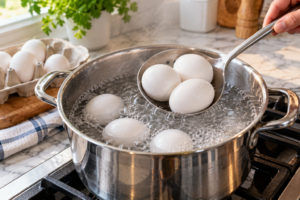
Using a slotted spoon, lower each refrigerated egg carefully into the water. Do not drop the eggs because they may crack against the bottom of the pan.
Once all the eggs have been added, make sure the water returns to a gentle boil.
Step 4: Cook for 11–12 Minutes
Set a timer as soon as the eggs enter the water.
Use these times as a general guide:
- 9 minutes: firm whites with a slightly soft center
- 10 minutes: mostly firm yolks with a creamy center
- 11 minutes: fully set but creamy golden yolks
- 12 minutes: classic firm hard-boiled eggs
For salads, deviled eggs, and meal preparation, 11 or 12 minutes works well.
Cooking times can vary slightly depending on egg size, starting temperature, elevation, and the intensity of the boil.
Step 5: Transfer the Eggs to the Ice Bath
When the timer ends, use the slotted spoon to transfer the eggs directly into the prepared ice bath.
Let them cool for at least 10 minutes. Do not rush this step. The sudden temperature change stops the cooking and may help loosen the membrane.
Step 6: Crack the Shell
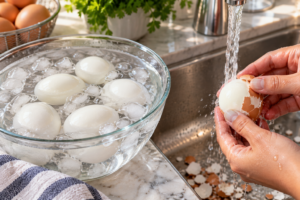
Remove one egg from the ice bath and dry it briefly.
Tap the wide end against a hard surface, then gently tap the remaining shell. Roll the egg lightly under your palm to create cracks around the entire surface.
Avoid pressing too firmly because this can split the cooked white.
Step 7: Peel Beneath Cool Running Water
Begin peeling at the wide end, where the air pocket is normally located. Try to lift the thin membrane together with the shell.
Peeling beneath cool running water can help wash away fragments and allow water to move between the membrane and egg white.
Seven Foolproof Tips for Smooth Eggs
1. Avoid Using Eggs Purchased the Same Day
When possible, use eggs that have been refrigerated for approximately 7–10 days. This is one of the simplest ways to improve peeling.
The secret to reliable Easy-Peel Hard-Boiled Eggs is combining a hot-water start with immediate cooling. Neither step should be skipped if you want clean, smooth results.
2. Start With Boiling Water
A hot start sets the outside of the egg white quickly. Lower the eggs into the water gently to reduce cracking.
3. Maintain a Gentle Boil
A violent boil can bounce the eggs against one another, causing cracks and uneven shapes. The water should bubble consistently without tossing the eggs around.
4. Use a Timer
Guessing the cooking time can produce undercooked whites or dry, rubbery yolks. Start timing when the eggs enter the boiling water.
5. Use Plenty of Ice
A bowl of mildly cool water is not as effective as a true ice bath. Use enough ice to keep the water very cold during the entire cooling period.
6. Crack the Entire Shell
A finely cracked shell is easier to remove in larger connected sections. Begin at the wide end and work gently around the egg.
7. Peel Under Running Water
Water can move beneath the membrane and help release stubborn sections. Alternatively, peel the egg in a bowl of clean, cold water.