
Protection
The cover also helps shield the threaded receiver from everyday exposure to road debris and dirt.
Pedestrian and Vehicle Design Considerations
Keeping protruding components behind the bumper helps manufacturers maintain the intended exterior design rather than leaving unnecessary hardware permanently exposed.
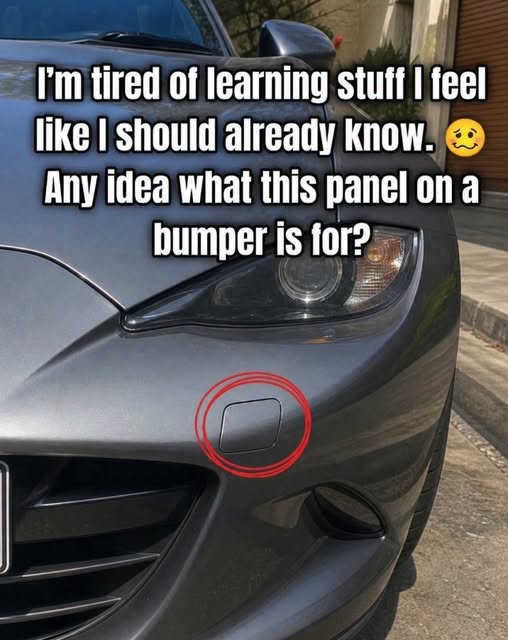
What Is Behind a Car Bumper Tow Hook Cover?
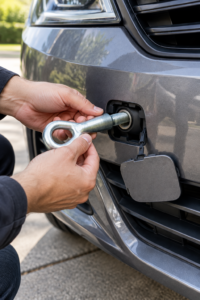
On an equipped vehicle, removing the panel typically reveals a threaded receiver.
The corresponding eyelet is a strong metal component with a threaded end on one side and a circular attachment point on the other.
The threaded portion screws into the receiver.
This distinction is important: the little plastic panel itself is not a towing point. It simply covers access to the hardware behind it.
Where Is the Removable Eyelet Stored?
The location depends entirely on the vehicle.
Common storage locations can include the trunk or cargo area with the emergency tools.
If you own a vehicle with a car bumper tow hook cover, it is worth checking the owner’s manual before an emergency occurs so you know whether an eyelet is supplied and where it is stored.
Do not assume every car uses the same system.
How Is a Tow Hook Cover Removed?
This is another area where the owner’s manual matters.
On some vehicles, the edge of the cap can be carefully released with a protected flat tool. Other designs use a different release method.
For example, Mazda’s current manuals instruct owners of applicable vehicles to protect the painted bumper with a soft cloth when opening the bumper cap and specifically warn against excessive force because it can damage the cap or scratch the paint.
So if the panel does not come out easily, do not start aggressively prying at it.
Check the manual first.
Is It Really a Tow Hook?
This is where online explanations often become misleading.
The answer is: sometimes, but not always.
The hardware can look almost identical while having different approved uses from one vehicle to another.
Some manufacturers describe the eyelet as a towing eyelet. On some Mazda models, for example, the manufacturer gives instructions for using a towing eyelet and warns that a strap or chain should pull straight rather than sideways.
However, other Mazda manuals explicitly state that certain front and rear tiedown eyelets are not for towing and are intended only to secure the vehicle during transportation.
That is an important distinction.
Never assume that because an eyelet physically accepts a rope or strap, it is approved for every towing or recovery situation.
Tow Eyelet vs. Recovery Point: They Are Not Always the Same
A proper off-road recovery point may need to withstand forces very different from those experienced during controlled vehicle movement.
For example, pulling a deeply stuck vehicle from mud, sand, snow, or a ditch can create large shock loads.
Some manufacturers specifically warn against using their towing eyelets for these situations. Mazda’s guidance for certain current models says not to use the eyelet to pull a vehicle out of mud, sand, a ditch, snowbank, or similar conditions where it cannot move under its own power.
So a bumper eyelet should never automatically be treated as a heavy-duty recovery point.