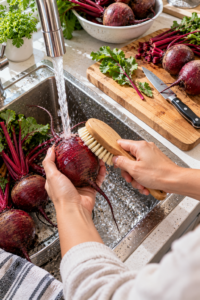
Cut off the beet greens, leaving approximately one inch of the stems attached. Do not trim deeply into the root end before cooking.
Scrub the beets carefully under clean running water to remove soil. Use a clean vegetable brush if needed.
Keeping the skin, root end, and a small amount of stem intact during cooking helps reduce colour loss.
Scrub the fresh beets thoroughly before simmering them until tender.
Step 2: Cook the beets
Place the cleaned beets in a medium saucepan and cover them with water.
Bring the water to a boil, then reduce the heat to maintain a gentle simmer. Cover the saucepan and cook until the beets can be pierced easily with a small knife.
Approximate cooking times are:
Small beets: 20 to 25 minutes
Medium beets: 30 to 40 minutes
Large beets: 45 minutes or longer
The exact time depends on size and freshness. Begin checking early rather than allowing the beets to become extremely soft.
Step 3: Cool and peel
Drain the cooked beets and let them cool until comfortable to handle.
Trim away the remaining stems and root ends. Rub the skins gently with your fingers or a clean paper towel. Properly cooked beet skins should slip away relatively easily.
Beet juice can stain clothing, wooden cutting boards, and light-coloured counters. Use a nonporous board and wear gloves if you want to avoid staining your hands.
Step 4: Slice or cut the beets
Cut the peeled beets into ¼-inch slices, wedges, or approximately 1-inch cubes.
Keep the pieces relatively uniform so they absorb the brine at a similar rate.
Slices become flavourful quickly and work well in sandwiches. Cubes are convenient for salads and grain bowls.
Step 5: Prepare the jar
Wash the jar, lid, and any utensils thoroughly in hot, soapy water. Rinse them well.
The jar does not need to be processed as a canning jar because the finished recipe will be refrigerated, but it should be completely clean.
Pack the sliced beets into the jar, adding the sliced onion between the layers if using it. Leave enough room for the brine to flow around the vegetables.
Step 6: Make the brine
Combine the vinegar, water, sugar, salt, mustard seeds, peppercorns, red pepper flakes, cinnamon, and cloves in a small saucepan.
Bring the mixture to a gentle boil over medium heat, stirring until the sugar and salt dissolve.
Reduce the heat and simmer for approximately two minutes. Remove the pan from the heat.
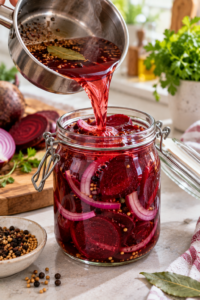
Cover the cooked beets completely with the warm, sweet-and-tangy vinegar brine.
Step 7: Add the brine
Carefully pour the hot brine over the beets, making sure the vegetables are fully covered.
Gently tap the jar against a folded kitchen towel or slide a clean utensil around the inside edge to release large trapped air bubbles.
Add more brine if necessary. Avoid packing the beets so tightly that the liquid cannot circulate.
Step 8: Cool and refrigerate
Let the jar cool briefly until it is no longer releasing strong heat, but do not leave it at room temperature for an extended period.
Cover the jar and place it in the refrigerator within two hours. General food-safety guidance recommends refrigerating perishable foods promptly because bacteria multiply more quickly at warmer temperatures.
Label the jar with the preparation date and the words “Keep Refrigerated.”
Step 9: Allow the flavour to develop
The beets can be sampled after several hours, but they are usually much better after resting for 12 to 24 hours.
For a stronger pickled flavour, wait approximately two days before serving.
Always use a clean fork or spoon to remove beets from the jar. Introducing food particles or used utensils can shorten their refrigerator life.
Tips for the Best Pickled Beets
Cook beets of similar size
If one beet is much larger than the others, it may remain firm while the smaller ones become overcooked.
You can remove smaller beets as they become tender and allow larger ones to continue cooking.
Avoid overcooking
The beets should be tender enough to pierce but not so soft that they break apart when sliced.
Use 5% acidity vinegar
Check the bottle label. Vinegars with unknown or lower acidity should not be used as substitutes in preservation recipes.
Keep the beets covered with brine
Exposed pieces may dry out, discolour, or spoil faster. Use a smaller jar if the brine cannot cover the vegetables.
Let them rest overnight
The flavour immediately after preparation will taste sharper and less balanced. Resting gives the vinegar, sugar, salt, and spices time to penetrate the beets.
Label the jar clearly
Write down the preparation date and mark the jar “Refrigerator Pickles.” This prevents someone from mistakenly storing it in the pantry.