
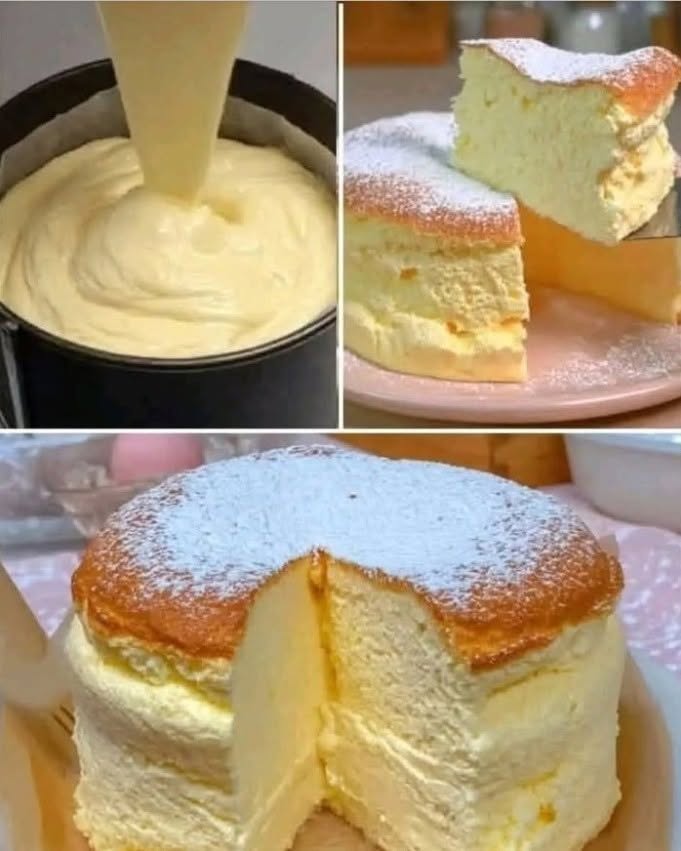
Place the softened cream cheese in a large mixing bowl.
Add the melted butter, milk, egg yolks, and vanilla extract.
Whisk everything together until the mixture is completely smooth.
This step is important.
You don’t want visible lumps of cream cheese remaining in the batter because they can make the finished cake uneven.
Once the mixture is smooth, sift in the cornstarch.
Whisk gently until the cornstarch is fully incorporated.
Don’t overmix unnecessarily. The goal is simply to create a smooth, uniform batter.
Set the bowl aside while you prepare the meringue.
Step 3: Whip the Egg Whites
Place the egg whites in a separate clean, dry bowl.
Add the lemon juice.
Begin whipping until the whites become foamy.
Gradually add the granulated sugar while continuing to whip.
Increase to medium-high speed and continue until the egg whites become glossy and reach soft to medium peaks.
This is one of the most important steps in the entire recipe.
You don’t want the meringue to be dry, grainy, or extremely stiff.
When you lift the whisk, the peak should hold its shape but still have a soft, flexible tip.
A smooth, glossy meringue is much easier to fold into the cream cheese batter.
Step 4: Fold the Meringue Into the Batter
Now comes the step that determines how airy your Cloud Cake will be.
Add approximately one-third of the whipped egg whites to the cream cheese mixture.
Use a silicone spatula to gently fold the mixture together.
Don’t stir aggressively.
Instead, use a slow folding motion, moving the spatula down through the batter, across the bottom of the bowl, and back upward.
Once the first portion has been incorporated, add another portion of the meringue.
Repeat the process.
Finally, add the remaining egg whites and fold gently until the batter is evenly combined.
It’s perfectly normal for a few small streaks to disappear as you finish folding, but avoid continuing to mix after the batter is uniform.
The goal is to preserve as much of the air from the whipped egg whites as possible.
Step 5: Pour the Batter Into the Pan
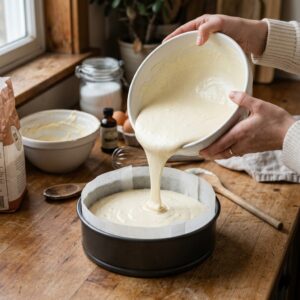
Pour the finished batter into your parchment-lined 6-inch cake pan.
The batter should look smooth, light, and airy.
Gently tap the pan against the counter once or twice to release any very large air bubbles.
Don’t repeatedly bang the pan.
You’ve worked hard to create all those tiny air bubbles in the meringue, and you don’t want to knock them out.
Place the cake pan inside the larger baking dish.
Carefully pour hot water into the larger dish until it reaches approximately 1 inch up the outside of the cake pan.
Now the cake is ready for its gentle bake.
Step 6: Bake in a Water Bath
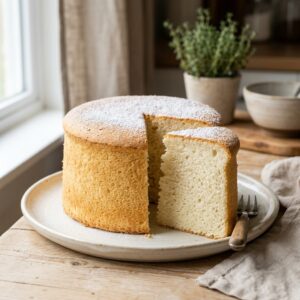
Place the cake in the preheated 300°F (150°C) oven.
Bake for approximately 50 to 55 minutes, or until the top is beautifully golden and the center is set.
The exact baking time can vary depending on your oven, the depth and material of the pan, and the temperature of the water bath.
Try not to open the oven repeatedly during baking.
The delicate structure needs a stable environment while it sets.
The cake should rise noticeably and develop the beautiful golden surface you’re looking for.
Step 7: Cool the Cake Slowly
Once the cake has finished baking, don’t immediately remove it from the oven and place it in a cold environment.
Turn the oven off and leave the door slightly open.
Let the cake rest inside for approximately 15 minutes.
This gradual cooling helps reduce the sudden temperature change that can cause a delicate cake to shrink quickly.
After that, carefully remove the cake from the oven and transfer it to a cooling rack.
Allow it to cool further before serving.
You can dust the top with powdered sugar for a simple and elegant finish.
The Secret Behind the Cloud-Like Texture
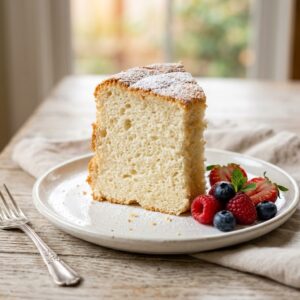
The most fascinating part of this recipe isn’t any single ingredient.
It’s the combination of whipped egg whites, careful folding, and gentle baking.
When you whip egg whites, you’re incorporating thousands of tiny air bubbles into the liquid egg-white proteins.
The proteins unfold and form a network around those bubbles.
Sugar helps stabilize the foam, which is why it is gradually incorporated while whipping.
When the meringue is folded into the cream cheese batter, those air bubbles become part of the cake mixture.
During baking, heat causes the trapped air and water vapor to expand, helping the cake rise.
As the proteins and starches set, they create a structure that holds the cake’s shape.
That’s why the technique matters so much.
If you aggressively stir the meringue into the batter, you can lose much of the air you worked to incorporate.
If you over-whip the egg whites, the foam can become dry and difficult to fold.
And if the cake experiences a dramatic temperature change immediately after baking, it may shrink more than you want.
Why the Water Bath Matters
Continue on the next page