
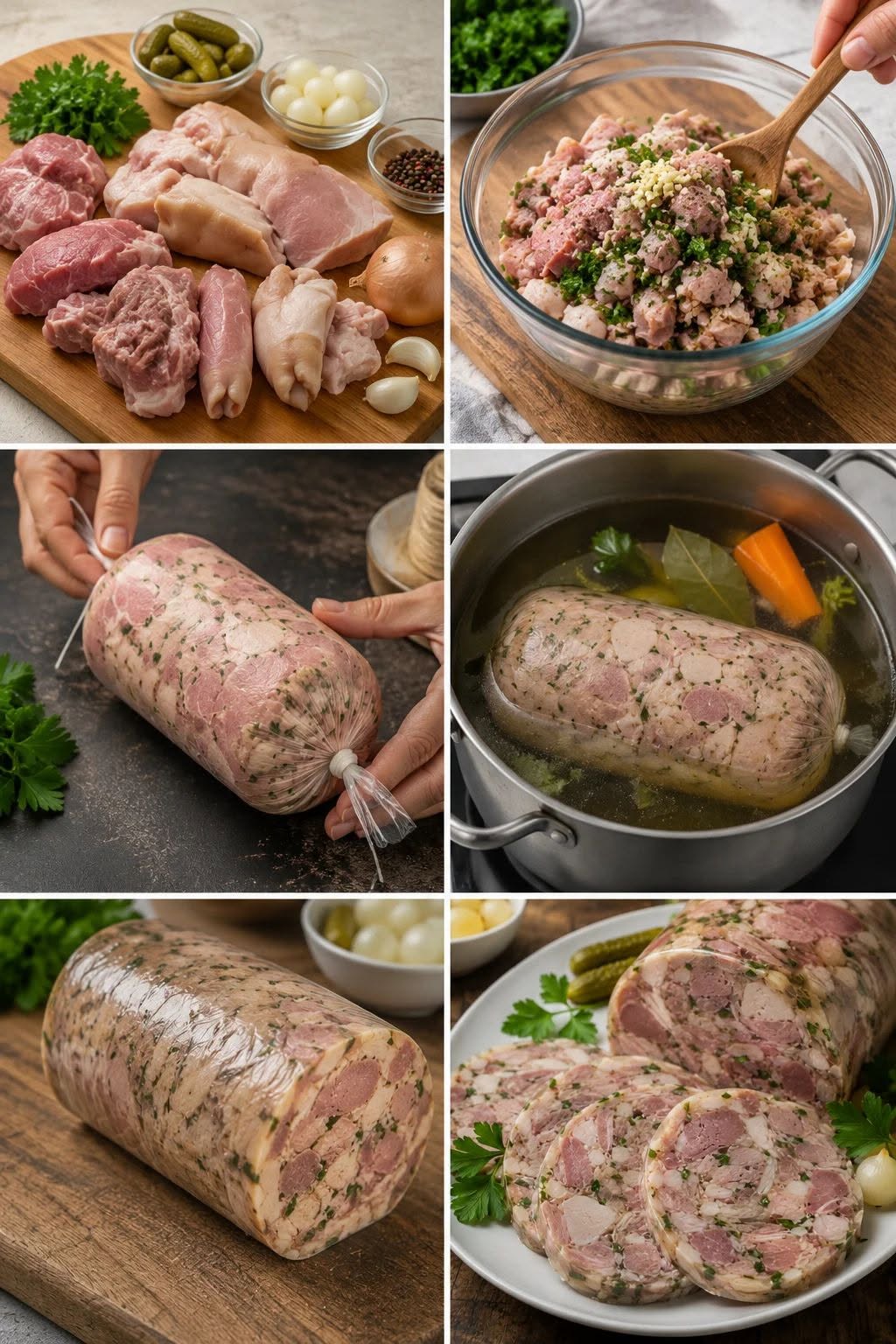
The cold parsley ham recipe is a great classic from communal tables: a long-cooked pork chop, chilled to gain tenderness, then dunked right on top of a light parsley glaze. The result ? Rosy tranches, bright, well drawn, with that fresh, herbaceous taste of parsley that evokes the palace.
Here, the promise is simple: you’re going to prepare a ready-to-serve cold parsley ham, intended for a clean cut thanks to full cooling and a frosting that holds just right.
An entree or cold dish that makes an “effect”, without complicated technique
The charm of cold parsley ham is that it doesn’t have to be an intimidating dish. Your success rests on two pillars:
a stir-fry broth cooker to obtain a melted meat ;
a light frosting issue of the cooking juices, to bring the hold without heaviness.
And above all: the cooling time. It’s the one that transforms a chunk of cooked meat into elegant, clean slices that hold up well to dressage.
Why this recipe works (and what to watch out for)
The magic comes from the pork’s natural gelatin. When the ham mixes gently with flavors, the broth thickens and “clings” to the manner of a jelly. Then, on cooling, the frosting takes and subtly binds the surface.
What really makes a difference:
a clear broth (regularly stirring) for a cleaner frosting ;
a light squeezing of the juice before mounting, to strengthen the holding power ;
a finely minced fresh parsley, incorporated at the proper time or simply reserved for dressing, to preserve its fragrance and colour.
Looking for a frosting that “slides” when cut and doesn’t form a thick block? It’s exactly the idea of a light parsley jelly.
Quels ingredients for cold ham parsley ?
Here are the expected ingredients for a piece of around 1.2 kg (you generally get more servings, depending on the thickness of the trench and the dressage). The amounts are done so that there is enough frosting without turning into too thick a layer.
The ham (about 1.2 kg)
That’s the key. Choose a pork ham with the skin or a gelatinous part: this ensures the natural hold of the frosting. At the time of purchase, check the color: it should be dewy to light flesh, without dark spots.
Garnish bouquet (thyme, bay leaf, stalked parsley)
Thyme : brings a round and “cooked” aroma, very pleasant in broth.
Laurel : gives a woody and elegant note.
Stemmed parsley: sweet fragrance and contributes to the “parsley” side without turning the broth into green soup.
The garnish bouquet is put in from the very beginning: it’s what gives depth to the broth.
met from the beginning: it’s what gives depth to the broth.
Vegetables for the broth: onions, carrots, leeks
Onions : brings a sweet base and the depth of flavour.
Carrots: for roundness, color and a slight sweetness.
Leek : for a finer vegetal touch, which alludes to the pork.
These vegetables mainly serve to flavor and balance: we are not looking for a thick sauce, but an aromatic broth.
Garlic (1 clove or 2 tsp)
Garlic adds character. A whole head can infuse sweetly without overpowering ; 2 drops is enough if you prefer a more discreet note. In both cases, the key is not to burn the onions: here, everything happens in a flash.
Seasoning: salt, pepper (and optional cloves of cloves or peppercorns)
Sel : to adjust in the broth to taste the meat through.
Pepper: for relief.
Option: one or two very aromatic flavors (cloves) can be used if you prefer a more “classic” style. In any case, use them sparingly so as not to mask the parsley.
Fresh parsley (for the “parsley” effect)
Chopped fresh parsley is what gives this cold parsley ham recipe its heart. For a fragrance and vibrant color, choose a well-green parsley, without soft stems. It will be finely hacked to spread nicely on the cutting.
Visual garnish option: rounds of pickles or small onions
These are gourmand “repairs” on the bed: they add a slight acidic contrast that evokes cold trenches. The pickles are placed in rounds, the small onions can be started or left whole depending on their size.
The role of each ingredient: from taste to texture.
The pork and its natural gelatin are at the heart of the recipe: it’s what allows for the light jelly. The garnish bouquet and vegetables build the fragrant broth. Salt and pepper provide balance. Finally, the fresh parsley brings the signature: herbaceous freshness and a “parsley” aspect on the tranche.
Don’t forget that the frosting isn’t there to mask: it enhances the meat and creates a brilliant finish.
Four-on ingredient substitutes ?
Yes, but with good sense.
Bouquet garnish: if you don’t have thyme or bay leaves, you can adapt with what you have (e.g. rosemary in small quantities, or an herb mix). Keep however the idea of “classic” flavors that support long cooking.
Fresh parsley: ideally stay on fresh. In an emergency, some frozen parsley can be used, but the flavor will be a bit less clean and the color less bright.
Garlic : adjust, but avoid omitting if you want a balanced recipe.
Garnish (raisins/small onions): replaceable with rinsed capers or a bit of similar pickles, to keep the acidity.
For any replacement, keep the goal: to preserve the fragrance of the parsley and the light texture of the frosting.
What material to anticipate before beginning ?
For truly “ready to serve” chilled parsley ham, consider:
a large fatut wide enough for the piece of meat to cook comfortably in the broth ;
une scumory to remove surface impurities and keep a clear broth ;
a fine (or Chinese) strainer for straining the broth ;
a mold (or container) for tasting the meat and getting a nice shape ;
a large plank and a well-sharpened knife for carving at the exit of the cold.
The bottom line: your mold should allow for easy demolition. A properly fitted and cleaned mold makes a huge difference on the final cut.
Preparations to do before the revision (to gain time later)
Before launching the cooker in Part 2, prepare now:
Wash and prepare the vegetables: peel the onion and carrots, clean the leek. Cut into big chunks: long cooking will make them fluffy.
Prepare the bouquet garnish: tie thyme, bay leaf and parsley into stalks. You want to prevent the weeds from spreading.
Detail fresh parsley: wash, dry carefully, then finely chop at the appropriate time (note: a thoroughly dried parsley gives a cleaner chop and a more present fragrance).
Provide freezer organization: reserve space in your freezer for the frosting to take without busting.
How to recognize a good ham for a clean cut
At checkout, choose a piece with the gelatinous part. If the meat is too lean, the natural jelly will be less effective and the cut less “clean”. The color should be healthy, and the skin (if present) should be intact.
Small choices that change everything for light frosting.
A successful freeze does not happen by chance:
Stir while cooking to limit particles: a clearer frosting is more elegant.
Keep the basics: the cooking juice is the main ingredient. The idea is not to thicken it too much, but to make it gelling enough.
Do not cut too early: the hold depends on complete cooling.
The complete preparation is waiting for you on the next page.
Preparation of the recipe step by step
1) Cooking the ham in broth (to get a tender meat)
Install your fan with a cover. Pour in enough water so that the ham is almost submerged (it should be bathing, not floating). Add aromatic base (onions, carrots, leeks), garlic, salt and pepper, then garnish.
Bring to a boil over medium heat until gently. Simmer, reduce to a gentle simmer: it should have small regular bubbles, not a big boil. It’s this gentle seasoning that will soften the meat without making it “effilochéed”.
Let it mix long enough: count around 2 hours 30 to 3 hours 15 depending on the thickness of the piece (and your firmness). While cooking, monitor the color of the broth: it should remain relatively clear. If foam appears, remove from oven and measure.
Pillow hanging monitor signs
Color: the broth should not become cloudy in excess.
Perfume: herbaceous smell, warm, related to scents (bouquet garnish).
Tenderness: at the end of cooking, a knife edge should come in with little resistance. If you still feel tightness in the center, extend for another 15 to 20 minutes.
When the meat is cooked, turn off the heat.
2) Resting, separating and straining (for a light and clean frosting)
Let the ham steep in the broth for a dozen minutes, without stirring it brutally. Next, gently remove the meat and place it on a plate or platter.
Strain the broth through a fine sieve (or strainer) to remove small residual flavors. You should get as clear a liquid as possible.
At this stage, you need to manage two textures:
the meat: it will gain by tender and continue to soften slightly by heating, then cooling;
the cooking juice: this is the “raw material” of the light ice cream.
3) Light juice reduction (the key to keeping “just what it takes”)
Pour the strained broth into a clean saucepan. Faites gently reduce to medium gentle heat.
Aim to get a more concentrated, slightly nappy base, without being too thick. Count generally 15 to 25 minutes depending on the starting amount.
To check :
trempese a spoon, pass the finger over the back of the spoon: the trace must remain clean and bright;
the liquid should “stick” lightly (not become a fixed frost immediately upon heating).
Let then cool this reduced juice. You can leave it at room temperature until warm, but avoid leaving it in the heat for too long.
4) Prepare the parsley (for a fresh parsley and sharing)
Finely chop the fresh parsley. The ideal: a regular ax, not a mash. You want a few sparkles for a visible persimmon effect on the cup.
Two possible choices (you can do both):
Incorporation: keep some of the parsley and add it to the reduced juice when it is tender, not burning. Parsley keeps its green color better.
Dressage: reserve the residue for surface parting for demolition and trenching.
5) Mold assembly and coating (the light frosting should take smoothly)
Choose your mold: a cake mold, terrine or salad dressing according to the desired effect. The important thing is that the piece can be demolished properly and trenched thickly.
Place the ham in the mold. If you store it whole (which is more aesthetically pleasing), position it upside down so it covers the bottom well.
Next pour a thin first layer of ice cream (the juice thinned with the parsley if you’ve incorporated it). Just let it take 5 to 10 minutes in the refrigerator: it should start to firm up, not get hard.
Cover with remaining warm frosting, until enveloping meat. The surface should be smooth and shiny.
Parsemez chopped parsley (and, if desired, a touch of pickles or baby onions for appearance). This trim remains “visible” at service, without becoming a thick layer.
6) Refrigerator cooling (mandatory for a clean cut)
This is the step that conditions everything: the frosting has to set completely.
Refrigerate several hours, ideally overnight. Count for at least 6 to 8 hours.
Don’t try to pierce too early: if the core isn’t cold, the frosting may crack and the cut will be less clean.
Signs of success at the exit of the cold.
The frosting is firm, shiny, and firm on the surface.
Gently touching the top (with a spoon), the frosting does not bubble.
The ham rolls into a clean block, without a thick crust.
7) Weeding, trenching and servicing (to keep the parsley crisp)
Remove the mold from the refrigerator 10 to 15 minutes before rolling. Just the right amount of time to ease the demolding without reheating the frosting.
Demolish on a serving platter. If it persists, very quickly dip the edges of the mold in the hot water (a few seconds), then try again.
Trench with a well-sharpened, generously thick knife: your goal is a rosy trench, clean on the edges, with a slight parsley effect.
Cutting tip: wipe the blade between two notches if you see traces of frosting hanging over.
At serving time, sprinkle with a sprinkle of fresh parsley and, depending on your choice of garnish, add a few rounds of cornichons and/or baby onions for garnish.
What to avoid (frostbite mistakes)
Too much broth: the meat becomes less tender and the broth may curdle.
Not to be forgotten: a less clear frosting, a “broiled” aspect.
Insufficient shrinkage: frosting too soft, slices that shrink.
Add the parsley too early (boiling): darker color and less fresh fragrance.
Cutting before complete cooling: irregular cutting, cracking frosting.
Top tips for a light and shiny frosting
A light ice cream isn’t “made” from the powder: it comes from concentrated cook’s juice and natural gelatin.
Preserve a warm frost on assembly: too cold, it takes before it has cooled; too hot, it dissolves the layers and can slow down the grip.
Monitor the shrinkage: if you over-shrink, the frosting becomes too firm and the tranche lacks suppleness.
Variants (without changing the spirit of the dish)
More parsley, more “parsley” effect: slightly increase the amount of chopped parsley in the frosting (always finely), or parse further into the dressing.
Visual garnish: privilege either pickle rounds or small onions. The goal is to have ridges to the cut, not an overly dense mixture.
Portions instead of the whole mold: you can assemble the meat in portions (very practical for a buffet service), by coating each piece with the frosting and letting it set.
Sides that go well (and that respect the cold)
A warm (or chilled) potato salad with a light vinaigrette: melting/cutting contrast.
A young chicken salad with a lemon vinaigrette: the parsley and herbs spring up.
A country bread and sweet mustard: perfect for unmasking.
Chair dressing (goal: clean trenches, shiny look)
Serve on a white plate to emphasize the rose and green of the parsley.
Serve 2 to 3 thick slices per person.
Add a touch of decorative garnish (a little pickle or small onion) and a final cloud of parsley.
If you want an even more “frosty” finish, very lightly dab the top with a micro-spoonful of uncapped frosting (but beware: this should remain discreet).
Prepare to advance (simple organization)
This recipe is made for planning:
You can peel and prepare the ice cream.
Assemble in the mold and keep in the fridge. On J day, all that remains is to demolish, mow and straighten.
Conservation (refrigeration and food safety)
Store in the refrigerator, covered, for 2 to 3 days.
To prevent desiccation, keep the slices cold in their freezer (or store the demolished block under the bell).
And refreeze pas.
Approximate Nutrition (Reps)
For a medium serving (assuming the piece of about 1.2 kg gives 10 servings): about 280 to 360 kcal per serving. The tenderness varies depending on the amount of fat, the thickness of the slices and the level of frosting consumed.
FAQ
How do I know if my parsley light jelly will take correctly?
The most reliable test is cold: after 6 to 8 hours in the refrigerator, the frosting should be firm, shiny and not “quivering” when you very lightly touch the surface. If it stays soft, the shrinkage was probably too short: next time, shrink a bit more.
Why is my broth too mushy when I made an écumade?
Too strong a broth disturbs the liquid. Work quickly then stir gently, stirring constantly until the foam rises. Filter then finely before reducing: it’s a gesture that gives a cleaner and cleaner frosting.
At what point should I add the parsley to the jelly?
Add the parsley when the reduced juice is lukewarm: neither hot (colour that fades, fragrance that evaporates), nor already too cold (risk of seizing before assembly). If you prefer, you can also reserve the majority to parse at the demolition in order to keep a very fresh note.
How long before carving the cold parsley ham?
Let soak in the refrigerator for at least 6 to 8 hours. For a really clean cut and stable frosting, head overnight pretty much. Trenching too early can crack the frosting and make the trenches less regular.
What knife to use to get clean slices?
Use a well-sharpened knife, ideally a long, thin blade. Before each tranche, you can wipe the blade to prevent frost formation. Trim in slow motions, without sawing too hard, to preserve the dew and shine.
Conclusion
Your cold parsley ham becomes truly spectacular thanks to broth cooking, straining, light reduction of the juice and above all complete cooling: this is what guarantees a clean cut and a brilliant frosting. Test it out for your next frozen meal, then share: it’s the kind of recipe that always makes a small impact.